
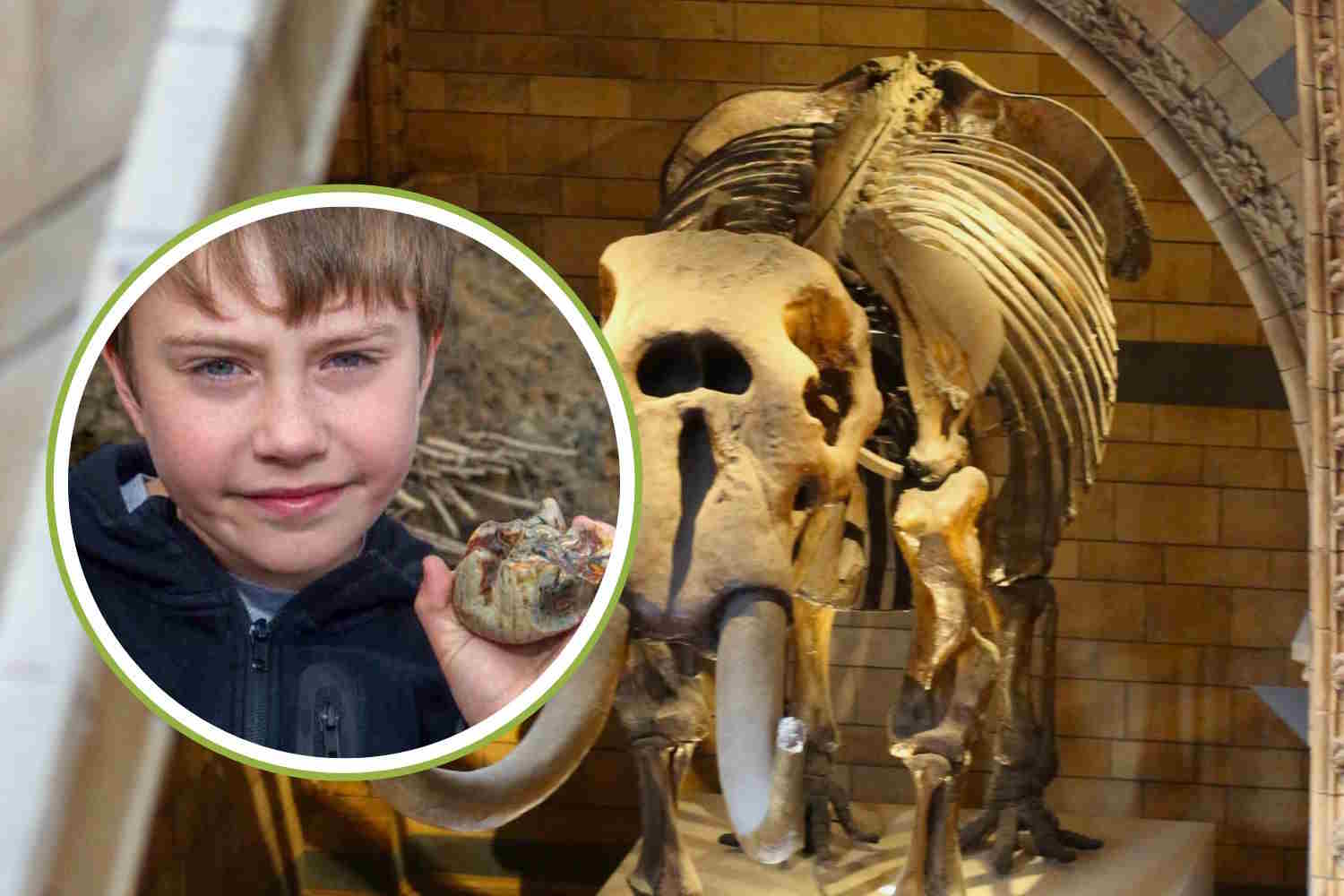
Sometimes prehistory arrives like this, without big scenes. It lies half hidden among the pebbles, takes the shape of a strange stone and waits for someone to bend down to pick it up. It happened to Charlie Orchard-Lisle11 years old, during a walk with her mother Eleanor on the beach of East Lane, in Bawdsey, a small coastal village in Suffolk, eastern England, about 120 kilometers from London.
It was May 24, 2026. Charlie was walking along the shore and, shortly before, he had told his mother how much he liked the elephants. Then he saw something in the shallow waves. A large, dark, compact object, with a shape too particular to be dismissed as any stone. They picked it up. It was heavy, it had a different consistency, it seemed to have come from a place much older than the beach on which it had ended up.
That piece found by chance was later identified as the upper left molar of an Anancus arvernensisan extinct relative of modern elephants. The tooth measures approx 10 centimetres wide and could have around 1.8-2 million years. A huge fossil to hold in your hand, small only when compared to the animal it belonged to.
A molar in the waves
Charlie’s mother said the object immediately attracted the attention of both of them. They took it precisely because it seemed different from everything else. And they were right. After the discovery, a photo of the tooth was sent to the professor Adrian Listerpaleontologist of Natural History Museum, Londonwhich confirmed the identification.
The most likely hypothesis is that the molar remained buried in the reddish Bawdsey cliff and that erosion gradually freed it. In that area of the English coast the sea continually consumes the rock and can bring to light remains that have been trapped for very long periods of time. This time, instead of a fossil shell or any fragment, he left the tooth of a gigantic animal on the shoreline.
THE’Anancus arvernensis lived between the upper Miocene and the lower Pleistocene, in a time span that goes roughly from 8.5 to 2 million years ago. It resembled elephants, even though it belonged to a now extinct line of proboscideans. It had a trunk and long, almost straight tusks, different from the curved ones we associate with mammoths.
A missing giant
The dimensions were impressive. This ancient relative of elephants could weigh up to six tons and reach approx 2.5 meters at the shouldermore or less like a large male African elephant. He walked in a Europe that was very different from the current one, made up of environments that changed together with the climate, the forests, the prairies and the animals that inhabited them.
A molar, in such an animal, tells a lot. It is not just a large and spectacular tooth: in proboscideans the dentition is linked to nutrition, the consumption of chewing surfaces, and the type of vegetation shredded every day. For paleontologists it can become a useful clue for reconstructing habits, environment and evolutionary history.
For Charlie, probably, something simpler will also remain: the day he found a piece of a prehistoric elephant while walking with his mother. One of those stories that seem to have been invented specifically for curious children, but actually happen.
The coast that brings back the past
Bawdsey is located on a stretch of coastline also known for its geological outcrops. The cliffs in the area are associated with the so-called Red Cragreddish sandy deposits rich in fossil remains. They are very ancient materials, exposed to the action of the sea and the wind. When the wall crumbles, something comes back out.
It is a natural mechanism, although not always harmless: coastal erosion consumes the landscape and modifies the shoreline. In this case, however, he turned a rock loss into a surprising discovery. The molar came off the cliff, onto the beach and stopped long enough for an 11-year-old to see it.
There are findings that arise from years of research and others that depend on a minimal detail. A look, an unusual shape, the decision to pick something up instead of walking over it. Charlie did exactly that. He saw a strange object in the waves and picked it up. Millions of years ended up there, on the wet sand. With the air of an ordinary stone.
