
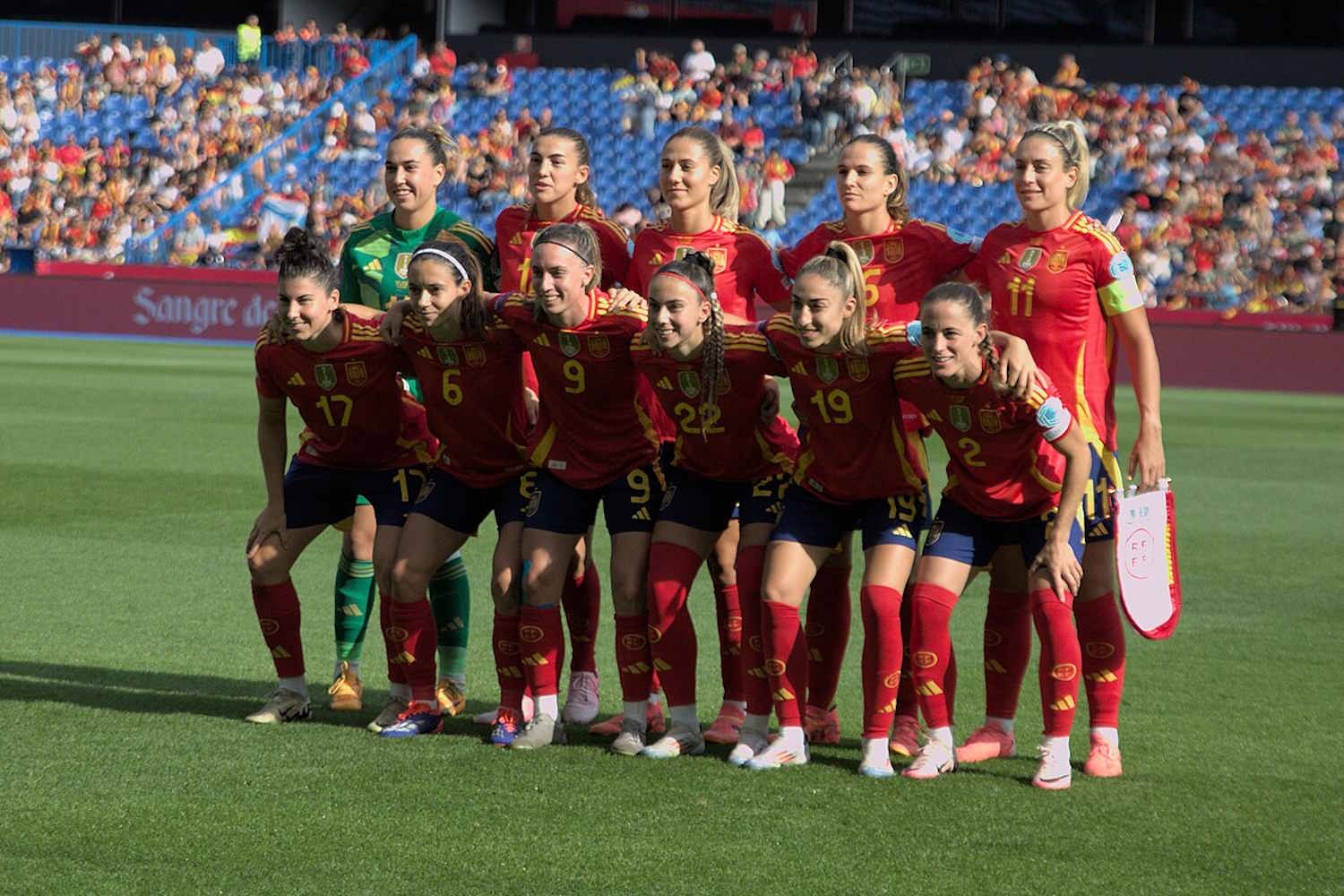
Sure, on paper it’s a step forward. The Spanish Football Federation (RFEF) is preparing an agreement with a fertility clinic (toh) to allow national team players to freeze their eggs.
One more possibility, one more protection, one more freedom. All true. Yet, it is difficult not to see the paradox behind this initiative: if you really want to become a mother, freeze your eggs now, so you can continue running, training, playing and producing results without interrupting your career.
Because, once again, instead of asking ourselves how to make professional sport truly compatible with motherhood, we risk asking women’s bodies to adapt to the times of sport and not the other way around.
Your body can wait, the championship can’t
In short, the RFEF is finalizing an agreement to offer the Selección’s female footballers the possibility of accessing fertility preservation programs through the freezing of oocytes. The initiative comes after some players had openly expressed the fear of having to choose between motherhood and career.
Among them there is Alexia Putellaswho in an interview with El País posed the problem in very clear terms: during the decisive years of her sporting life, a footballer uses her body to work just as her “biological time” continues to move forward. And at this point something jars, because the solution that is taking shape seems to be: don’t stop your career, rather try to stop biological time.
Naturally, no one will force a footballer to freeze her eggs and having this possibility can be invaluable for those who want it. But it would be naive to ignore the context in which this choice is proposed. A sporting world built on tight calendars, performances, contracts, call-ups and very little space for anything that risks interrupting the machine, including pregnancy.
Freezing your eggs is not putting your fertility on hold
Of course, because freezing your eggs doesn’t mean freezing your motherhood while waiting for better times. Cryopreservation may increase future reproductive possibilities, but does not guarantee pregnancy. Age at the time of collection, number and quality of oocytes, individual conditions and results of subsequent medically assisted procreation techniques affect the chances of success.
Therefore, presenting it as a sort of biological insurance would risk transforming a medical opportunity into a false promise. Therefore, the problem of female footballers is not only When become mothers, but what if they become mothers while they are still playing.
Marta Perarnau, president of FUTPRO, the union of Spanish professional footballers, underlined how many athletes put off motherhood for years and how returning to competition after a pregnancy remains extremely difficult. There is a lack of consolidated protocols for post-partum recovery, sufficient studies on the specific needs of athletes and standardized paths to accompany them in their return to the highest level.
In short: we know how to preserve eggs in liquid nitrogen, but we still struggle to build a sport capable of normally accompanying a woman who has had a child. In tennis, in June 2025, the Women’s Tennis Association (WTA) introduced a form of fertility protection that allows players to temporarily absent themselves from competitions to undergo, among other things, cryopreservation of eggs or embryos while maintaining a protected ranking upon return.
The debate, therefore, does not arise today and among other things it does not even concern only sport. Already in 2014, large technology companies such as Apple and Facebook made headlines by announcing the possibility of financing egg freezing for employees. Even then the measure was presented as an expansion of women’s freedom. But the provocation remains valid today: is it really emancipatory to be able to freeze your eggs to work longer, or would it be even more emancipatory to be able to have a child without fearing that your career will be compromised?
The two things are not mutually exclusive. Offering cryopreservation can be a safeguard. It becomes problematic when that possibility ends up replacing all the other protections that are still missing.
