
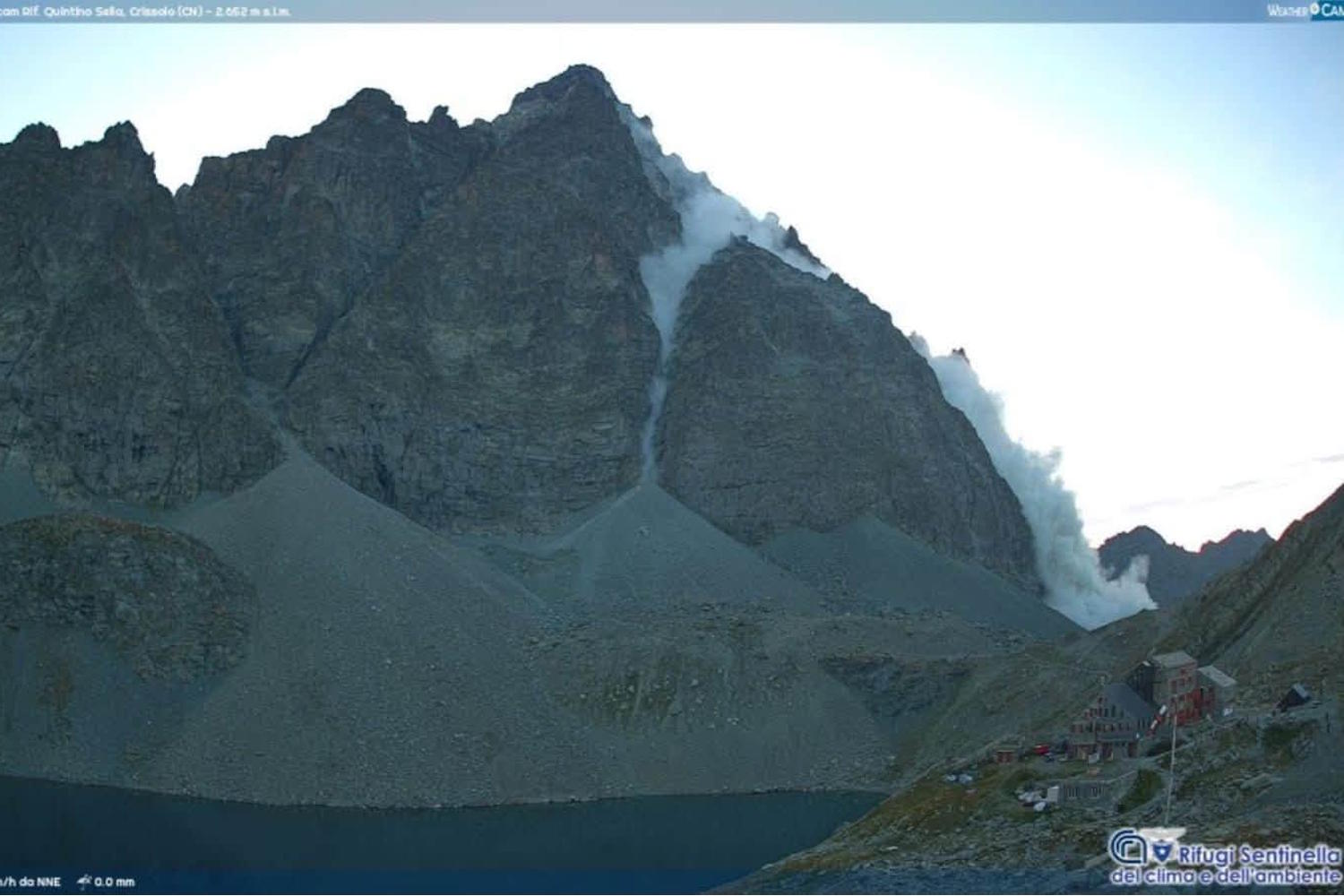
A very loud roar and then a lot of fear, among boulders, snow, debris falling into the valley: on the evening of September 1st a vast landslide came off the slopes of Monviso, the highest peak in the Cottian Alps, in Piedmont.
The checks carried out a few hours ago by the Piedmontese Alpine and Speleological Rescue have excluded the involvement of people in the landslide that broke off from the north-eastern side of the mountain, in the area of the Quintino Sella refuge.
The reconnaissance also debunked the initial information according to which the main mass of the landslide would have overwhelmed the path that connects the Quintino Sella area with Pian del Re. The path would have been hit above all by the cloud of dust and the finer debris raised by the detachment.
What happened on Monviso
The collapse occurred shortly after 8pm on September 1st and was accompanied by a loud bang, even perceived from a distance. An enormous cloud rose from the mountain, clearly visible from the shelters and the valley below. To establish the causes of the landslide, experts say, inspections, geological surveys and analyzes of the sector of the wall involved will be necessary.
The Monviso precedent, however, makes it impossible to ignore the context. In fact, it is not the first time that major collapses have occurred on the massif and, at least in the past, Arpa Piemonte itself has indicated the degradation of the permafrost among the factors that can favor them.
After the collapse that occurred on the north-east face of Monviso in 2019, the analyzes of the regional agency identified two main elements: the strong natural fracturing of the rock and, in fact, the degradation of the permafrost, the permanently frozen ground which at high altitudes can act as a sort of “cement” within the fractures. As ice warms and melts, that stabilizing action can diminish.
The Alps are changing before our eyes
There is no denying it: European mountains are among the environments where the effects of the climate crisis are most evident. Europe as a whole has been warming about twice as fast as the global average since the 1980s and, according to Copernicus data, exceptionally high temperatures have also repeatedly affected the Alpine arc in recent years.
What changes is not only what we see on the surface – snow and glaciers – but also what is inside the mountain. A study published in Nature Communicationsbased on data from 64 drillholes in European mountains, documented marked warming of the permafrost. At some sites, between 2013 and 2022, temperatures at ten meters of depth increased at rates exceeding 1°C per decade. And part of the warming already accumulated will continue to propagate towards deeper layers in the coming years. In other words, even when a rock wall seems immutable, its internal balance may not be at all.
@Nature
Because melting permafrost can make walls unstable
The term permafrost indicates soil – rock, sediment or debris – that remains at temperatures equal to or below zero degrees for at least two consecutive years. In the Alps it is present above all at higher altitudes and on the colder slopes. In heavily fractured walls, the ice contained in the cracks can contribute to the cohesion of the rock.
But if temperatures rise, that ice can degrade and water can penetrate deeper into the fractures. To the loss of the “cementing” action are therefore added cycles of freezing and thawing, precipitation, snow melting and local geological characteristics.
The result is – as scientific literature indicates – that warming and deterioration of permafrost can increase the susceptibility of high-altitude rock slopes to collapse.
Another research published on Nature Geosciencewhich reconstructed a century of rockfalls in the Swiss Alps, found a significant correlation between summer temperatures and rockfall activity, with high levels starting in the 1980s. Arpa Piemonte also underlines that in the Alps an increase in the frequency of large rock collapses is already documented in the areas affected by the degradation of the permafrost, with important phenomena also recorded on the Piedmontese massifs, from Monte Rosa to Monviso itself.
Permafrost deterioration is only part of the ongoing transformation. According to Copernicus and the World Meteorological Organization, in just two years, between 2022 and 2023, the glaciers of the Alps lost around 10% of their remaining volume. 2022 had already marked a record loss, followed in 2023 by another exceptionally bad season.
The scarcity of winter snow, which normally protects the underlying ice from the sun’s rays, and the very high summer temperatures weighed heavily.
Looking at a longer period, Copernicus calculates that between 1997 and 2022, European glaciers lost a total of around 880 cubic kilometers of ice, with the Alps among the most affected regions.
The disappearance of the cryosphere changes the availability of water, ecosystems, tourism, mountaineering routes and even the stability of the territory. Collapses, landslides and rockfalls have always existed in the Alps and will continue to be natural phenomena linked to the geology and evolution of the mountains, but the climate is changing the conditions in which these processes occur.
Walls that have remained frozen for decades can thaw; glaciers that supported slopes may retreat; Permanent snowfields may disappear and intense rains may reach altitudes where snowfall was more frequent in the past. For this reason, scientists insist on the need to monitor not only the glaciers, but also the temperatures inside the rock and the movements of the walls.
On Monviso, specific analyzes will now be needed before we can say what actually triggered the detachment on 1 September. But the great landslide that arrived at the end of the summer reminds us of something that now emerges from a growing number of studies: the Alps of the 21st century are no longer the same Alps we knew in the last century.
And learning to frequent them, protect them and make those who live there safe also means taking note of this change.
