
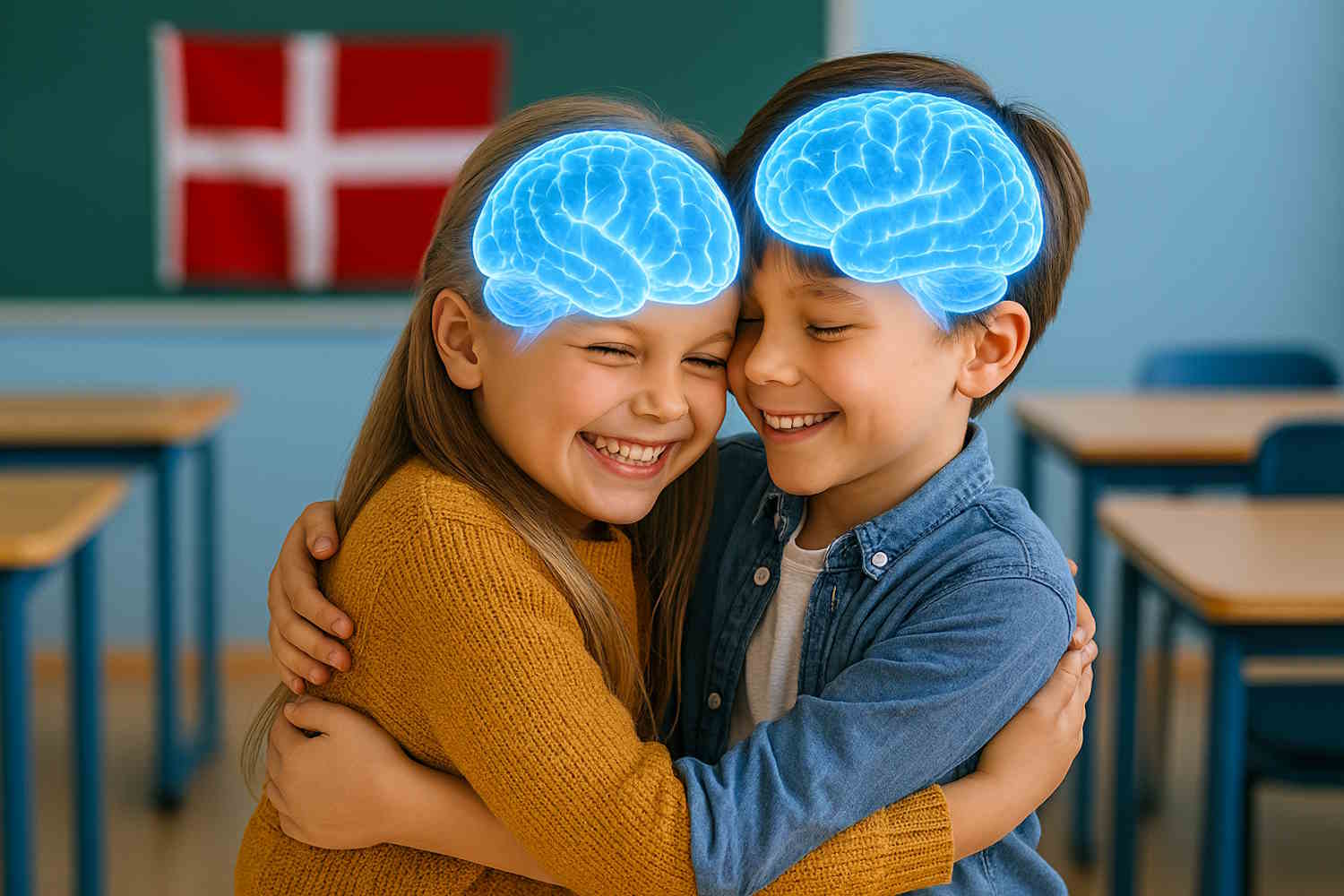
Since 1993, empathy has been an integral part of the Danish school program for all children and teenagers aged 6 to 16. This is not an optional activity or an extra project, but of a weekly lesson that has the same weight as mathematics or sciences. The basic idea is simple but revolutionary: kindness is not seen as a character trait, but as a real ability to learn and train.
Neuroscience confirm that practicing empathy changes the brain structure. By training it regularly, the medial prefrontal cortex, the area responsible for the ability to put on the shoes of others and regulate emotions is strengthened. In practice, children shape their brain to understand and respond better to the feelings of others.
In Denmark, almost 60% of school work takes place in a group. Over time, the collaboration stops being a assigned task and becomes a natural instinct. In a system where the competition is not the rule, the others are not seen as rivals, but as allies.
Bullying, solitude and a bond that cannot be ignored
An analysis conducted in 2022 by the Danish branch of the international study Health Behavior in School-Auged Children (HBSC), published on Researchgate with the title “Bullying at School, Cyberbullying, and Lonelyss: National Representative Study of Adolescents in Denmark”investigated the relationship between bullying and solitude.
The sample consisted of 5,382 students between 11 and 15 years old, selected in order to represent the entire school population of the country. The data, collected through the standardized HBSC questionnaire and analyzed with multilevel logistics regression models, revealed that:
The research shows a strong and progressive association between solitude and bullying, both physical and online. The bond is significant for both sexes, but more marked in boys. In addition, students victims of bullying both at school and on the internet have a risk 11.21 times greater than trying solitude than in the unwanted peers.
Long -term benefits and role of parents
The effects of education to empathy extend well beyond childhood. Longitudinal studies indicate that children who develop this competence from an early age have more likely to graduate, obtain stable employment and maintain solid relationships in adulthood.
Even in the family it is possible to encourage this process: ask “how do you think he felt?” Instead of saying “be kind” helps the little ones to reflect on the emotions of others. The example is also fundamental: children imitate more what they see what they hear.
In Denmark, the boys grow with a clear principle: they must not be the best in the room, but improve the room for everyone.
Don’t you want to lose our news?
You may also be interested in:
