
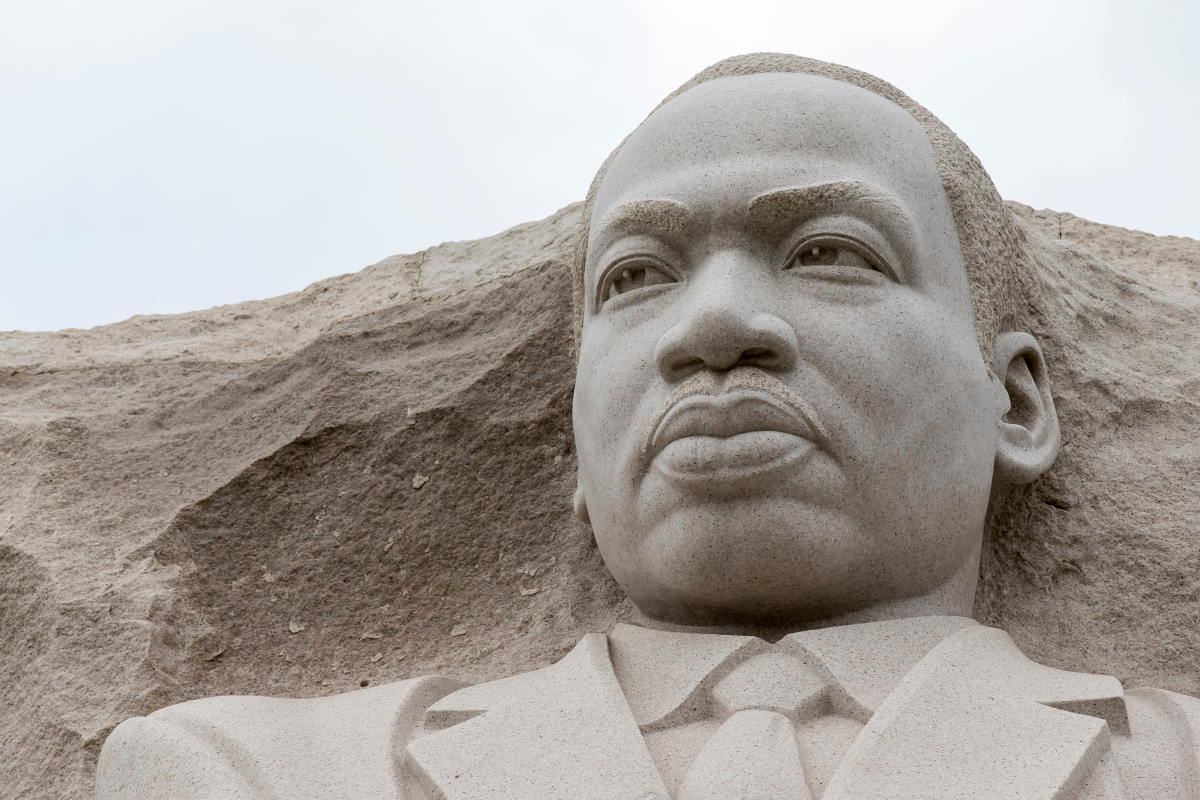
Martin Luther King. A black skin that was (still) uncomfortable in the United States of the early 1900s and such a huge passion for civil rights. If a child were to ask me today who Martin Luther King was, I would answer with just two words: vindication and justice. Vindication of the trampled rights of a slice of exploited and humiliated people. Justice against that racist mass which, unfortunately, still has its roots alive. But why did Martin Luther King make the history of America in the mid-1900s? And why shouldn’t we forget about it?
Martin Luther King Jr. was born to a family of pastors of the Baptist Church in January 1929 in Atlanta, Georgia, in that South where “race” and “social condition” had rhymed with segregation and discrimination for centuries. King, who himself became a Baptist pastor and civil rights activist, had a very strong impact on race relations in the United States throughout his life, starting in the mid-1950s.
Among his many efforts, he directed the Southern Christian Leadership Conference and, through his activism and famous inspirational speeches, played an integral role in ending the legal segregation of African-American citizens in the States, as well as in the creation of the Civil Rights Act of 1964 and the Voting Rights Act of 1965. He was awarded the Nobel Peace Prize in 1964 and was assassinated in April 1968.
Today he continues to be remembered as one of the most influential and inspiring African-American leaders in history. Let’s see why.
Martin Luther King, biography
The seats on the buses were reserved for whites and beware of contracting “mixed marriages”: the reality of advanced America at the beginning of the 20th century was the most retrograde it could be.
Martin Luther King was born in that year of the Great Depression, in 1929, to Martin Luther King Senior, of Nigerian/Irish origins and reverend of the Baptist church, and Alberta Williams, organist in the church choir. His name at birth was Michael King, but his father decided to change it to Martin Luther King in 1934, during a trip to the Holy Land and the Berlin of Nazi Germany, where the figure of the German reformer Martin Luther remained imprinted on him.
Martin’s maternal grandfather, the Reverend Adam Daniel Williams, was a pastor at the church where he was baptized, Ebenezer Baptist Church in Atlanta. Once he grew up, King took advantage of the opportunity to study in the best schools that black students could access, graduated in philosophy and in ’54 became a pastor himself, already carrying out strong action against racism and segregation in Montgomery, Alabama.
Deeply inspired by Gandhi’s teachings, Martin Luther King probably began his battle at a precise moment: when the black seamstress and activist Rosa Parks was arrested on a bus because she refused to give up her seat to a white man. Then he organizes a boycott by all blacks against local public transport for 382 days and from there his peaceful protests begin which go around the world and which will lead him to march for the cause of blacks.
(In Gandhi) “I discovered the method of social reform, which I had been searching for so many months. (…) I came to feel that this was the only method, morally and practically valid, available to oppressed people in their struggle for freedom
” (Pilgrimage to nonviolence).
In 1957 King formed the Southern Christian Leadership Conference, of which he was president, with the aim of uniting the black American masses under a single non-violent organization. In this way, he slowly manages to make black Americans aware of their condition, inculcating the idea that a reaction is possible. Without fears, but only with the desire to change things. Strikes and boycotts and a lawsuit: the one in the United States federal court to analyze the dubious constitutionality of the racial segregation laws still in force in some southern states.
It is certainly not a simple process, and intimidation and arrests are commonplace.
The 1963 Washington demonstration
In 1963, yet another year of violence and repression, King led one of the most spectacular demonstrations ever seen before: in Washington, 200,000 people gathered in front of the Lincoln Memorial to shout their indignation to the world and invoke the law on civil rights. That’s when King gives his most famous speech.
“I have a dream”, he begins, and even today those words make the heart skip a beat.
On that occasion, more than 80 thousand participants were white and they all marched together singing “black and white together” (“blacks and whites together”).
In 1964, King appeared on the cover of TIME as man of the year and won the Nobel Peace Prize, but in the following years his battle did not stop, with marches in the southern United States. This was an important year: in February the law on civil rights (the Civil Rights Act) was approved, with the prohibition of discrimination in registration in the electoral register and the obligation to admit all citizens, without distinction of race, to any school or public establishment. But the struggle was still very long, blacks are still beaten and killed by the white racists of the Ku-Klux Klan, a semi-clandestine organization, and equality between whites and blacks – the real one – was still very far away.


In 1968, King is in Memphis, Tennessee, to support a strike of local garbage collectors, but here the situation is no longer as peaceful as it once was: it is the time of the “Black Panthers” and “black power”, one in which many blacks prefer a more violent and intransigent struggle.
The FBI places him under surveillance and accuses him of having dealings with communists (a memorandum from the time described him as “the most dangerous and effective black leader in the nation“). Memphis was his last stop and on 3 April 1968 he gave his last speech: in the night he was killed, at the age of 39, at the hands of a sniper.
Martin Luther King – “I have a dream” speech
“I have a dream that my four children will one day live in a nation where they will not be judged by the color of their skin but by the content of their character
” — Martin Luther King, Jr. / “I Have A Dream” speech, August 28, 1963.
“I have a dream” is the title of the speech given by Martin Luther King on 28 August 1963 at the Lincoln Memorial in Washington, at the end of a civil rights protest march. It is certainly one of the most famous speeches of the 21st century and has become a symbol of the fight against racism in the United States.
The speech invokes the Declaration of Independence, the Emancipation Proclamation and the Constitution of the United States of America and at the beginning appeals to Abraham Lincoln:
“One hundred years ago a great American, in whose shadow we stand today, signed the Emancipation Proclamation.”
The phrase “I have a dream” is repeated eight times, precisely to enhance the image of a unified America in the name of integration. But phrases such as “now is the time”, with which King exhorts Americans, “some of you have come”, “come back”, “we can”, “free at last”, “let freedom echo”, “we can never be satisfied” are also repeated.
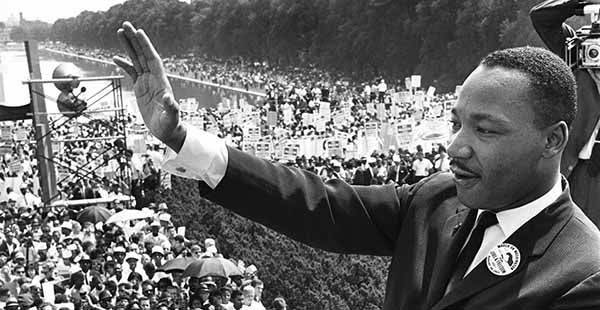
Martin Luther King, the speech
I have a dream. It is a dream deeply rooted in the American dream. I have a dream. That one day this nation will rise up and live the true meaning of its creed: “We hold this truth to be natural: All men are created equal.”
I have a dream, that one day on the red hills of Georgia the sons of the former slaves and the sons of the former slave masters will sit side by side, together, at the table of brotherhood.
I have a dream that one day even the state of Mississippi, today suffocated by the burning mantle of oppression, will be transformed into an oasis of peace and justice.
I have a dream. May my four children one day live in a nation where they will not be judged by the color of their skin
who I am at heart.I have a dream. That one day the state of Alabama, governed today by those who speak only of defeat and division, will become a place where black boys and girls will shake hands with white boys and girls, and walk together as
brothers and sisters…And if America wants to become a great nation this dream must come true. So let the echo of freedom resound from the beautiful hills of New Hampshire. The echo of freedom from the high Alleghenies of Pennsylvania! The echo of freedom from the snow-capped rocks of Colorado! The echo of freedom from the soft slopes of California! But not only that: the echo of freedom from Stone Mountain in Georgia! The echo of
freedom from every hill and every little mound of Mississippi earth. From every side, from every mountain, we make freedom echo.When the echo of freedom rings from every country, from every state and from every city, we can hasten the coming of that day when all of God’s children, black men and white men, Jews and Gentiles, Protestants and Catholics, can join hands and sing the words of that old Negro spiritual, “Free at last! Thank you Almighty God, we are free at last!”
Martin Luther King, famous quotes
“A revolt is ultimately the language of those who are not listened to”
“We have learned to fly like birds, to swim like fish, but we have not yet learned the simple art of living together as brothers.”
“My freedom ends where yours begins.”
“We must learn to live together as brothers or we will perish together as fools.”
“Seek earnestly to discover what you are called to do, and then set about doing it passionately. However, always be the best of whatever you are.”
“There can be no deep disappointment where there is no deep love.”

“If you can’t be a pine tree on the mountain, be a broom in the valley, but be the best, little broom on the bank of the stream. If you can’t be a tree, be a bush. If you can’t be a highway, be a path. If you can’t be the sun, be a star. Always be the best of who you are. Try to discover the plan you are called to be. Then set out with passion to realize it in life.”
“One day fear knocked on the door. Courage went to open it and found no one.”
“More than from repression, I suffer from the silence of the world.”
“Our lives begin to end the day we remain silent in the face of the things that matter.”
“To make enemies it is not necessary to declare war, just say what you think”.
“Nothing in the world is more dangerous than sincere ignorance and conscientious stupidity.”
“It’s always the right time to do what’s right.”
“Even if I knew the world would fall apart tomorrow, I would still plant my apple tree.”
“What scares me is not the violence of the bad guys; it’s the indifference of the good guys.”
“The only way to move forward is to move forward. To say: I can do this, even when you know you can’t.”
