
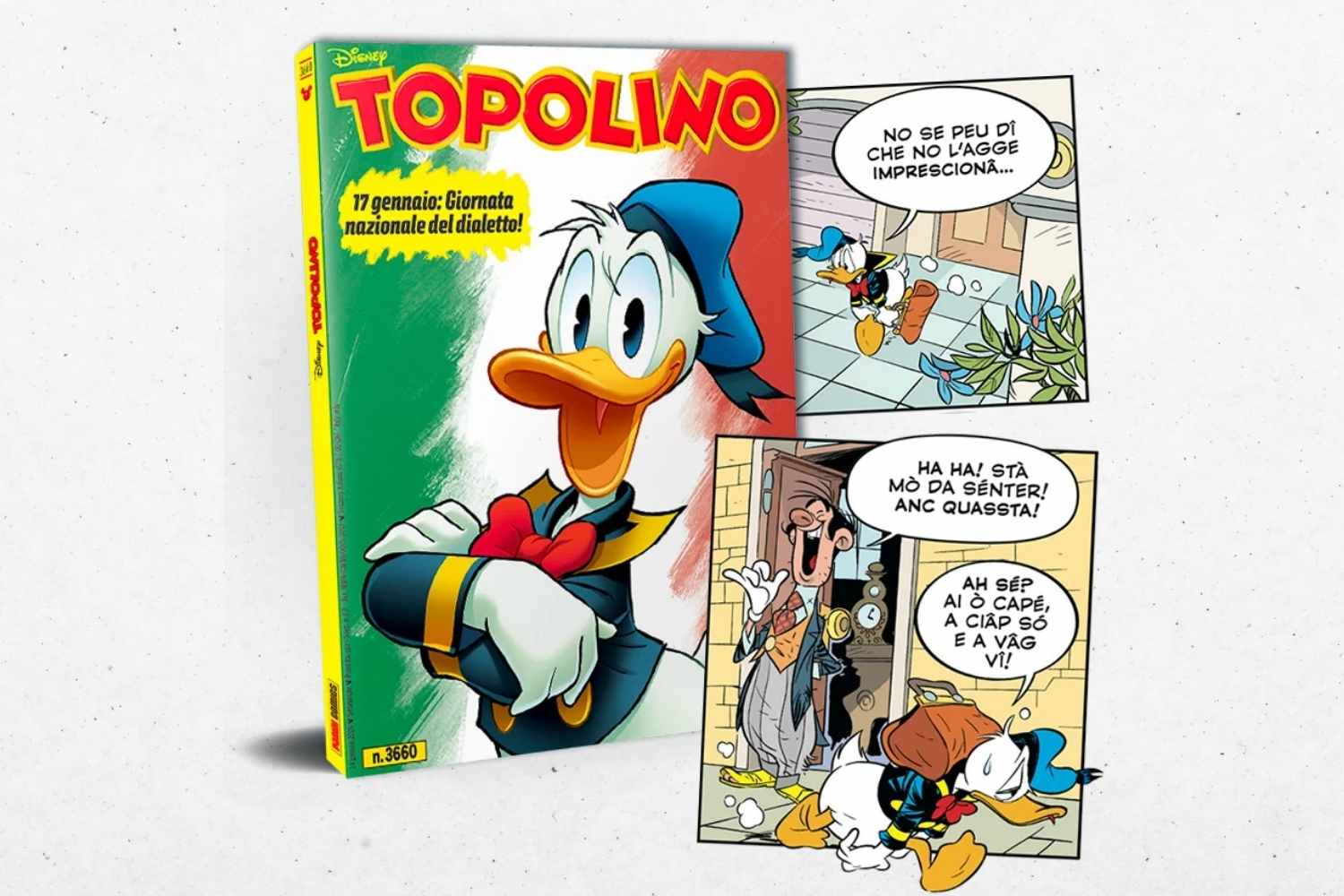
The weekly Topolino returns to valorise regional dialects with a special initiative linked to the National Day of Dialect and Local Languages. Issue 3660, on newsstands from 14 January, is available in four alternative versions dedicated to as many Italian dialects, confirming the magazine’s commitment to preserving and promoting the linguistic heritage of the Bel Paese.
Four dialects to describe Donald Duck
The operation involved the story “Donald the Home Polisher”, written by Vito Stabile and illustrated by Francesco D’Ippolito, which was “translated” into Bolognese, Genoese, Catanzaro and Franco-Provençal Aosta Valley. Each version represents a specific linguistic territory and the result is the result of a collective effort that combined scientific rigor and narrative readability.
The adaptations were coordinated by Riccardo Regis, full professor of Italian Linguistics at the University of Turin, who led a group of local specialists. Daniele Vitali and Roberto Serra edited the Bolognese version, Stefano Lusito the Genoese version, Michele Cosentino took care of the Catanzaro version and Fabio Armand the Franco-Provençal Aosta Valley version. The translation work required attention both to linguistic fidelity and to the ability to make the text understandable and pleasant for readers.
A project that continues the tradition
The project is part of an editorial line already started in previous years. Number 3608 had proposed the story “Uncle Scrooge and the PdP 6000” in Campania, Lombardy, Sicilian and Tuscan, while number 3619 had translated “Mickey Mouse and the bridge over the ocean” into Roman, Bari, Turin and Venetian. This time too, the union between comics and linguistics has transformed an entertainment product into a cultural laboratory, capable of interesting both Disney enthusiasts and those who consider local languages a heritage to be protected.
How and where to find dialect editions
The four special versions are not evenly distributed throughout the country. The copies with the story in dialect arrive exclusively at newsstands in the linguistic areas of reference: Emilia-Romagna for Bolognese, Liguria for Genoese, Calabria for Catanzaro and Valle d’Aosta for Franco-Provençal. In the rest of Italy only the standard edition in Italian is available.
For readers and collectors who live outside these regions, Panini Comics has provided alternative purchase channels. The four editions in dialect can be ordered through comic shops, on the official Panini.it website and through the Primaedicola.it service, which allows you to reserve the copy at your local newsstand while stocks last. In this way, regional versions become accessible to a wider audience and become sought-after objects even outside their original geographical borders.
The number 3660 is enriched by a special cover signed by Andrea Freccero, which gives visual unity to the entire operation. The initiative demonstrates how it is possible to include regional languages within a national distribution, making comics an instrument of attention towards the linguistic diversity of the country without changing its format or target audience.
