
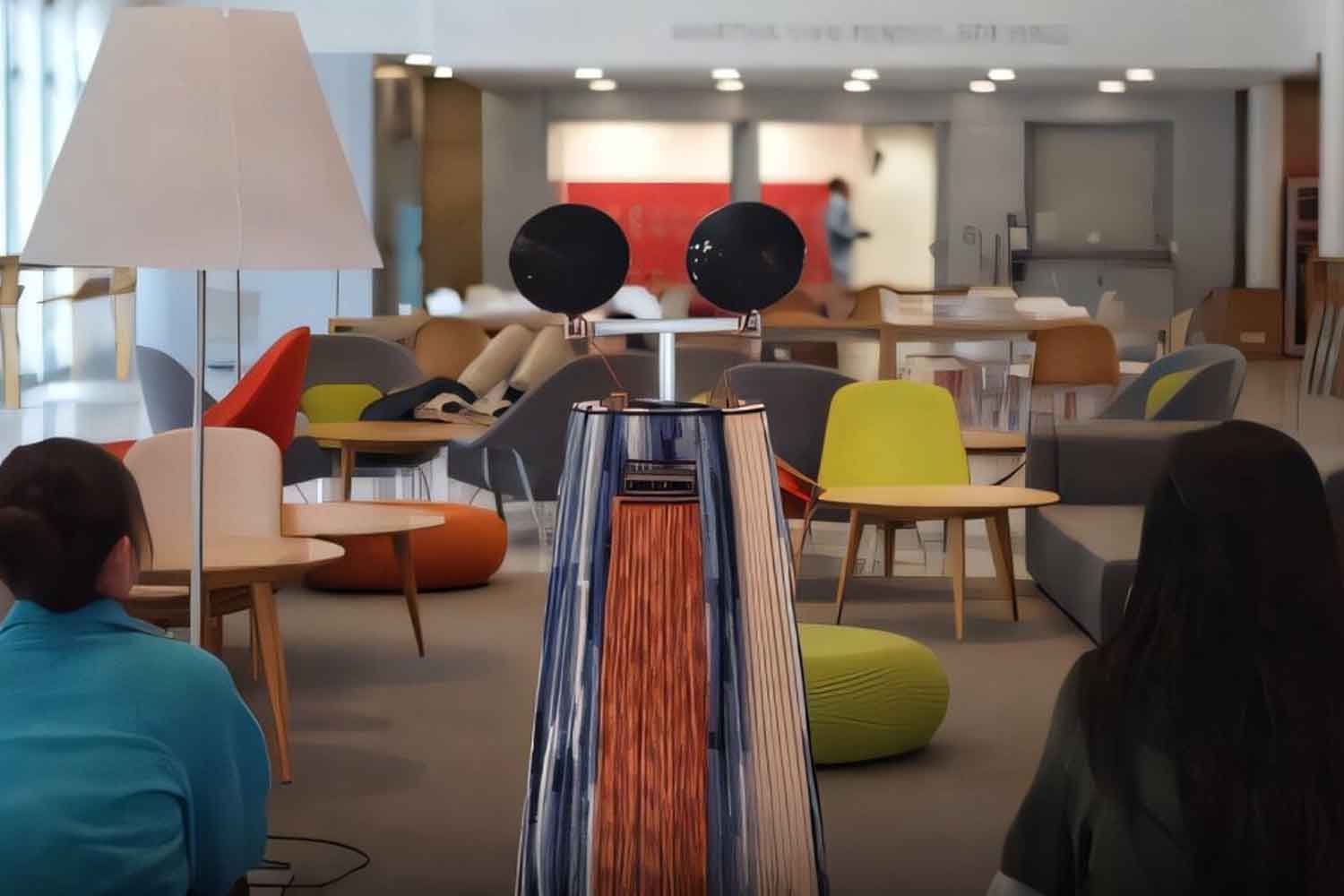
The waiting rooms have their own sad discipline: chairs lined up, eyes lowered, phones clutched in their hands like a barrier, bodies close together and heads far away. MirrorBot it starts exactly from there, from that silence mixed with embarrassment that today fills shared spaces such as clinics, parks and common areas. The project was born at Cornell University, within the Architectural Robotics Lab led by Keith Evan Green. The robot is approximately 1.20 meters tall, has two movable mirrors, a deliberately small appearance and a soft covering, chosen to be less intimidating. When he is placed in front of two strangers, he does a simple and quite surprising thing: he gives each person their own image in one mirror and the other person’s face in the other. Serena Guo, first author of the study, explained that the real target was the eye contactthat first tiny shot from which every human relationship often begins.
To see if that idea really worked, the team recruited 32 people between the ages of 18 and 50, divided into 16 pairs. Participants were told they would take part in a short-term memory test; the full explanation would only come later. They were seated in a waiting room measuring approximately 3.6 by 3.6 metres, with three chairs along one wall. After a few moments, the robot appeared from behind a booth. It was guided remotely by Guo herself, who controlled its movements and selected pre-set positions of the mirrors until both people could see both their own reflection and that of the other.
The interesting part comes next. In twelve out of sixteen couples, the first contact considered truly significant came through mirrors and not a direct face-to-face look. Some began to decipher the robot together, others played with the situation, still others used that filter to prudently probe the other’s availability. From there began conversations, light exchanges, a mutual curiosity that in a normal room would perhaps have remained buried under the usual ritual of silence. The study thus suggests a precise idea: a social robot it can act both as an interaction companion and as a mediator of space, that is, as an object that changes the way two people perceive each other.
When the robot stops being the protagonist and becomes a conduit
Behind MirrorBot there is also a fairly clear criticism of the present. Green and Guo start from an observation that can be seen everywhere: technology has narrowed geographical distances and allowed social ones to grow, especially in everyday spaces where people share meters and minutes without actually meeting. Waiting rooms, public parks, common areas: places full of physical presence and poor in mutual attention. MirrorBot tries to intervene precisely in that void, without making speeches, without entertaining, without stealing the scene. It just forces the geometry of the situation and leaves the rest to two human beings.
The work, however, retains a rough side that is worth more than a thousand slogans. A portion of the participants experienced the experiment with discomfort. The researchers observed people turning away, frowning, freezing the moment. One of the comments collected described the robot as a kind of “overenthusiastic friend”, one of those who force two reluctant people to talk. Inside this reaction there is the most serious detail of the entire project: a technology designed to bring people closer must also be able to retreat. The human encounter lasts as long as an invitation remains. When it becomes pressure, the scene stalls.
The group also asked itself another, very concrete question. Was it enough to put an unusual object in the middle to break the ice? In a related work, presented with a larger sample of 40 pairs, the researchers compared MirrorBot with a robot without mirrors, a mirror fixed to the wall and no devices at all. The result once again rewarded MirrorBot, precisely for its ability to facilitate the mutual eye contact. Strange or new objects, in fact, often manage to make people talk; the trouble is that the conversation ends up revolving around the object itself. Here the opposite happens: the center returns to the other human being.
