
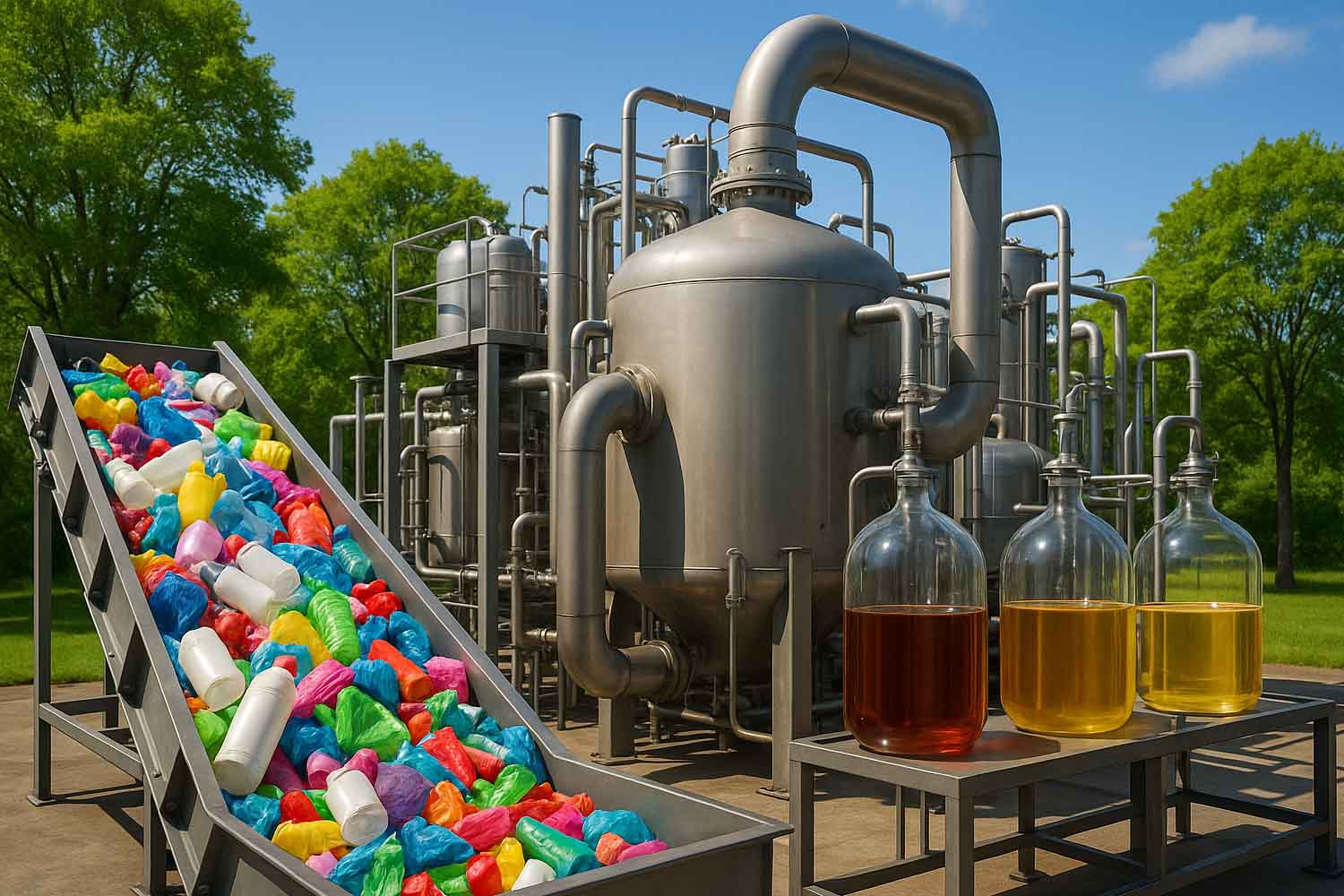
One of the largest challenges of plastic recycling has always been the same: in order to treat it, you must first separate it by type. A long, expensive and often ineffective process, especially when plastic is dirty, contaminated or unrequited. Now, however, a new research by Northwestern University promises to radically change things.
A team of US scientists has developed a nickel catalyst, economic and reusable, which manages to selectively degrade the olephalical plastics – such as polyethylene and polypropylene – without the need for preventive separation. These are the plastics we use every day: bottles, food films, bags, packaging. All waste that today often end up in landfills or in the environment, where they can remain for decades.
How it works
The idea is as simple as it is powerful: to use a nickel -based molecule that manages to “cut” the chemical bonds of the most common plastics selectively, transforming them into reusable products such as oils, waxes, lubricants or fuels.
The process is called hydrogenolisi: thanks to hydrogen and the new catalyst, the polymers break into smaller pieces. And they do it at lower temperatures than traditional industrial methods, with less pressure and much higher efficiency.
In addition, the catalyst developed by Northwestern is very stable, even when it comes into contact with other problematic materials, such as the PVC. In fact, Polivinile chloride is known to block or damage the catalysts, making the entire plastic lot to be recycled unusable. Here the opposite happens: the PVC even improves the chemical reaction.
Yosi Kratish, one of the authors of the research, explained:
Add PVC to the mix, it is usually prohibited. But in our case it accelerates everything. We didn’t even expect it.
Why is this discovery so important? Because it could eliminate one of the main obstacles to the recycling of plastic: the need to separate waste one by one. A long phase, which often fails, especially in the presence of plastic contaminated or not labeled correctly. Even small quantities of “wrong” material can compromise an entire load.
With this technology, however, you can deal directly with mixed plastic, without worrying too much about what is inside. And the advantages are many:
Furthermore, the catalyst can be easily regenerated with a low -cost substance, the alchilalluminium, and used for multiple cycles without losing effectiveness. And unlike noble metal catalysts (such as Platinus or Palladio), nickel is abundant and accessible, therefore perfect for large -scale production.
From waste to resources: recycled plastic without waste
The discovery comes at a time when plastic, especially the disposable one, continues to accumulate in our natural environments. According to some studies, more than 220 million tons of poliolefine are produced every year, but recycling rates are still dramatically low – between 1% and 10% globally.
Behind this figure there is a technical reality: the chemical ties of the olephantic polite plastics are very strong, difficult to break. For this reason, most end up in landfills, where he degrades only after decades, generating microplastics.
With the new catalyst, however, these plastics can have a second life, in a simple, efficient way and, above all, without the need to separate them.
The research was published on Nature Chemistry And coordinated by a group of experts led by Tobin Marks, professor at Northwestern University and considered one of the highest world experts in Catalisi. Researchers from Purdue University, the Ames National Laboratory and the Trienens Institute for Sustainability and Energy also worked on with him.
Don’t you want to lose our news?
You may also be interested in:
