
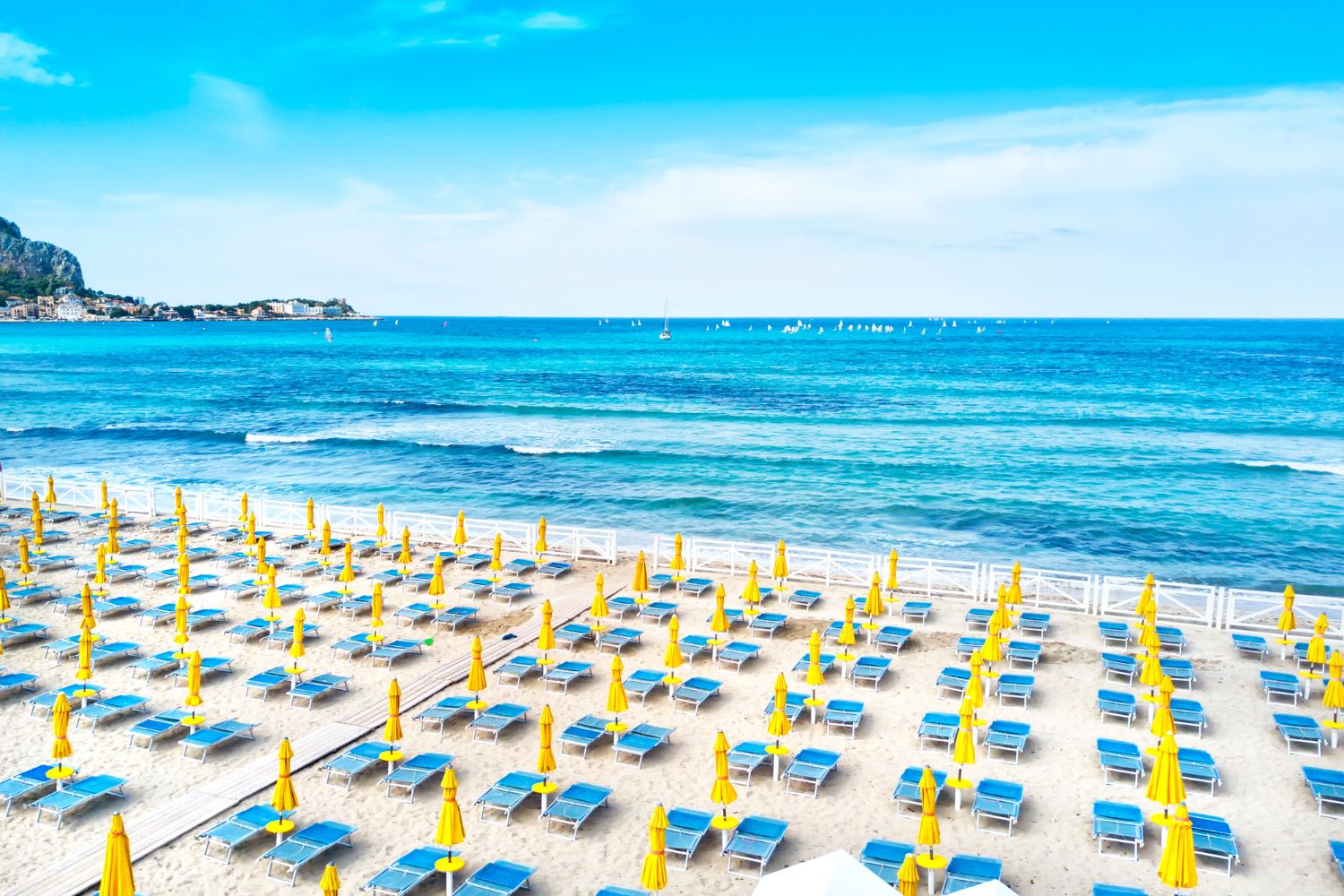
The management of Mondello beach returns to the Italo-Belgian company. This was decided by the Court of Administrative Justice for the Sicilian Region, which accepted the company’s appeal, suspending the provision with which the regional Territory Department had declared the concession of a large part of the coastline to be invalid.
At least until next September 30th, therefore, the historic concessionaire will still be managing one of the most iconic beaches in Sicily.
But Mondello’s case is much more than a simple administrative affair. A long battle has been going on for years around this stretch of coast, made up of appeals, controversies, accusations of privatization of the sea, requests for greater public accessibility and political clashes over the management of beach concessions.
The ruling of the CGA effectively overturns the previous decision of the TAR and confirms what was already ordered by president Ermanno de Francisco last April 25, when he accepted the precautionary request presented by Italo Belga against the revocation of the concession.
According to the administrative judges, both the Sicilian Region and the Municipality of Palermo did not prepare adequate tools to guarantee orderly management of the beach after the expiry of the concession. A situation which, according to the Court of Administrative Justice, would have risked compromising not only the interests of the excluded company, but also those of citizens and tourists who have the right to regular use of the coast.
The Court also highlighted critical issues in the so-called “Mondello Plan” prepared by the Municipality of Palermo, defining the measures envisaged to deal with the bathing season as insufficient.
Behind this story, however, there is a much broader issue that has divided citizens, institutions and entrepreneurs for years: who should really manage Italian beaches and how much space should be guaranteed for the free use of the sea?
Over time, Mondello has become the symbol of this clash. On the one hand there are requests for greater transparency in the management of concessions, also in light of the shadows highlighted by the Prefecture and the European references linked to the Bolkestein directive (which requires the putting up of tenders for beach concessions, prohibiting automatic renewals and promoting competition in the service sector). On the other hand, there are those who maintain that the historical presence of private concessionaires has guaranteed services, maintenance and protection of the beach.
Over the years there has been no shortage of protests and mobilizations to ask for more free beaches and less private occupation of the coast, especially in one of the busiest coastal stretches in Sicily. The regional councilor for Territory and Environment Giusi Savarino, while saying he did not agree with the CGA’s decision, reiterated that the Region’s objective remains that of “free Mondello from the irregularities and mafia shadows highlighted by the Prefecture”, announcing a new vision of the coast which will have to reconcile free beaches, private investments and future European rules on beach concessions.
The game, therefore, is far from over. The judgment on the merits is expected in September, while in the background the great issue of Italian beach concessions and the collective right of access to the sea remains open.
