
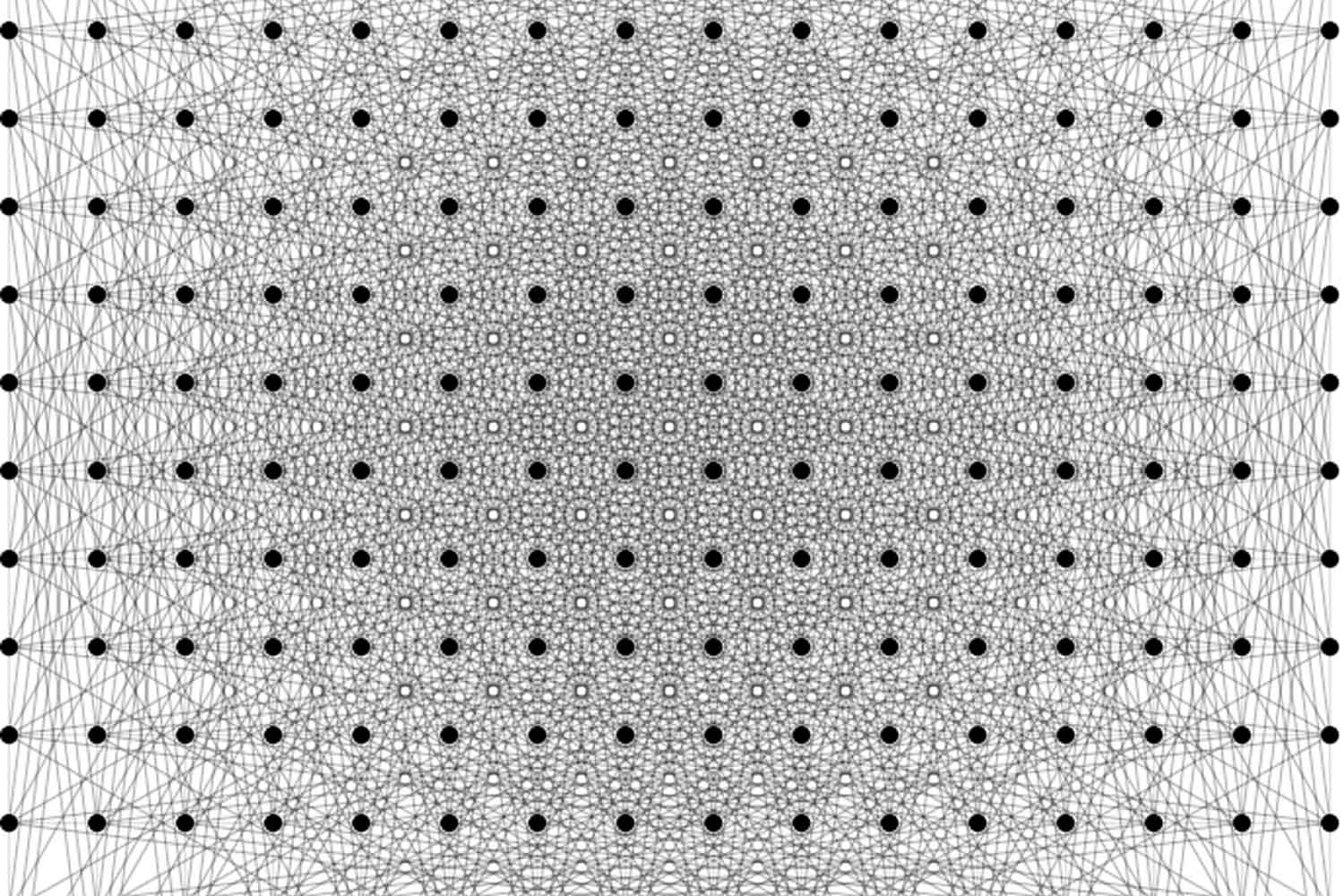
On a white sheet, just a few dots are enough to end up in one of the most stubborn problems of modern geometry. You take some points, arrange them on the plane and then count how many pairs are at exactly the same distance, for example at distance 1. Put like this, it seems like an exercise for a squared notebook. Instead, it is a question that has been forcing mathematicians to revisit grids, estimates, constructions and intuitions for almost eighty years.
Now she has entered that story OpenAI. The company announced that its internal reasoning model has disproved a conjecture related to the problem of unit distances in the planeformulated by Paul Erdős in 1946. The news must be taken with surgical precision: the entire problem remains open. What falls is a very important conjecture about how quickly the maximum number of pairs of points at the same distance can grow. OpenAI claims that the model has found a new infinite family of configurations capable of doing better than what for decades had seemed the natural limit of square grid-based constructions. The proof, as communicated by the company, was checked by external mathematicians.
Erdős’ dots
Paul Erdős was one of those mathematicians capable of leaving problems everywhere, like intelligent crumbs. Some are simple to talk about, very hard to close. The unit distance problem belongs to this category: given a set of n points on the planehow many pairs can be exactly at distance 1?
A row of dots gives almost trivial growth. A square grid works best. For a long time the dominant idea was this: grids, or very similar constructions, were essentially the best possible. Erdős had conjectured that the maximum number of pairs at unit distance grew only slightly faster than the number of points, with a formula indicated technically as n¹⁺ᵒ⁽¹⁾where that little extra term tends to disappear when n becomes very large.
OpenAI’s model has found a different path. For infinite values of n, the new construction yields at least n¹⁺δ pairs at distance 1, with δ greater than zero. Translated without breaking out in hives: the number of possible connections between points grows more robustly than the conjecture suggested. The old idea of ”little more than linear” is over.
Here comes the most interesting part, even for those who only have a traumatic memory of high school from advanced mathematics. The solution comes from instruments very far from the image of the sheet with the dots. OpenAI talks about algebraic number theorynumber fields, class towers and Golod-Shafarevich theory. Technical stuff, sure. But the meaning is quite clear: to answer a very concrete geometric question, the model delved into a deep area of algebra, where extensions of integers and numerical structures much richer than the numbers we use every day are studied.
The test of humans
The decisive part, to avoid the usual “AI has solved the mathematics” circus, lies in the verification. Work by leading mathematicians has appeared on arXiv, including Noga Alon, Thomas F. Bloom, WT Gowers, Daniel Litt, Will Sawin, Arul Shankar, Jacob Tsimerman, Victor Wang, and Melanie Matchett Wood. The paper presents a short, digested version and verified by humans of the counterexample generated by OpenAI. The authors also explain that the argument uses ideas already present, at least in retrospect, in the works of Ellenberg-Venkatesh, Golod-Shafarevich and Hajir-Maire-Ramakrishna.
This step matters a lot. AI has indicated a path, built a proof, connected tools that many mathematicians might have considered lateral to the problem. Then human beings arrived: they read, checked, cleaned up, simplified, relocated the discovery within the landscape of research. This is how math works. A proof lives when it holds up to scrutiny, when other minds can walk through it without a piece falling off.
In the reflections published together with the work, an almost psychological element also emerges. The model would have insisted a lot on the attempt to construct a counterexample, while a large part of the community tended to believe the conjecture to be true. In other words, he looked for a crack where many would continue to reinforce the wall. This does not make AI a magical mind. It makes interesting its way of exploring enormous spaces of possibilities, even those that a human researcher can quickly discard due to experience, habit or common sense.
The problem remains alive
Another mathematician, Will Sawin, has already produced a refinement of the result. In his work he shows that there exist sets of n points in the plane, with n arbitrarily large, which contain more than n¹·⁰¹⁴ pairs of points separated exactly by a distance of 1. This makes explicit the positive exponent which in the original OpenAI test was present without a precise numerical value.
The race, however, continues. The best known upper limit remains much higher: in technical terms, on the order of n⁴ᐟ³according to the classic result of Spencer, Szemerédi and Trotter. Between the new lower limit and the upper limit there remains a huge space, full of mathematics still to be done.
The discovery of OpenAI, therefore, is valid for what it opens. It shows that a belief that has stood for decades can be undermined by an unexpected construction. It shows that an AI model can contribute something more substantial to theoretical research than a summary or writing help. And it also shows the opposite of the laziest narrative: without mathematicians capable of verifying, interpreting and improving the result, that proof would remain a machine turned on in a closed room.
For now, the simplest image remains: dots on a sheet of paper, invisible lines between pairs at the same distance, a grid that seemed to be enough and then stops being enough. Mathematics sometimes does this. It seems stuck on a page for eighty years, then someone moves a point. This time a machine did it. Humans controlled the design.
