
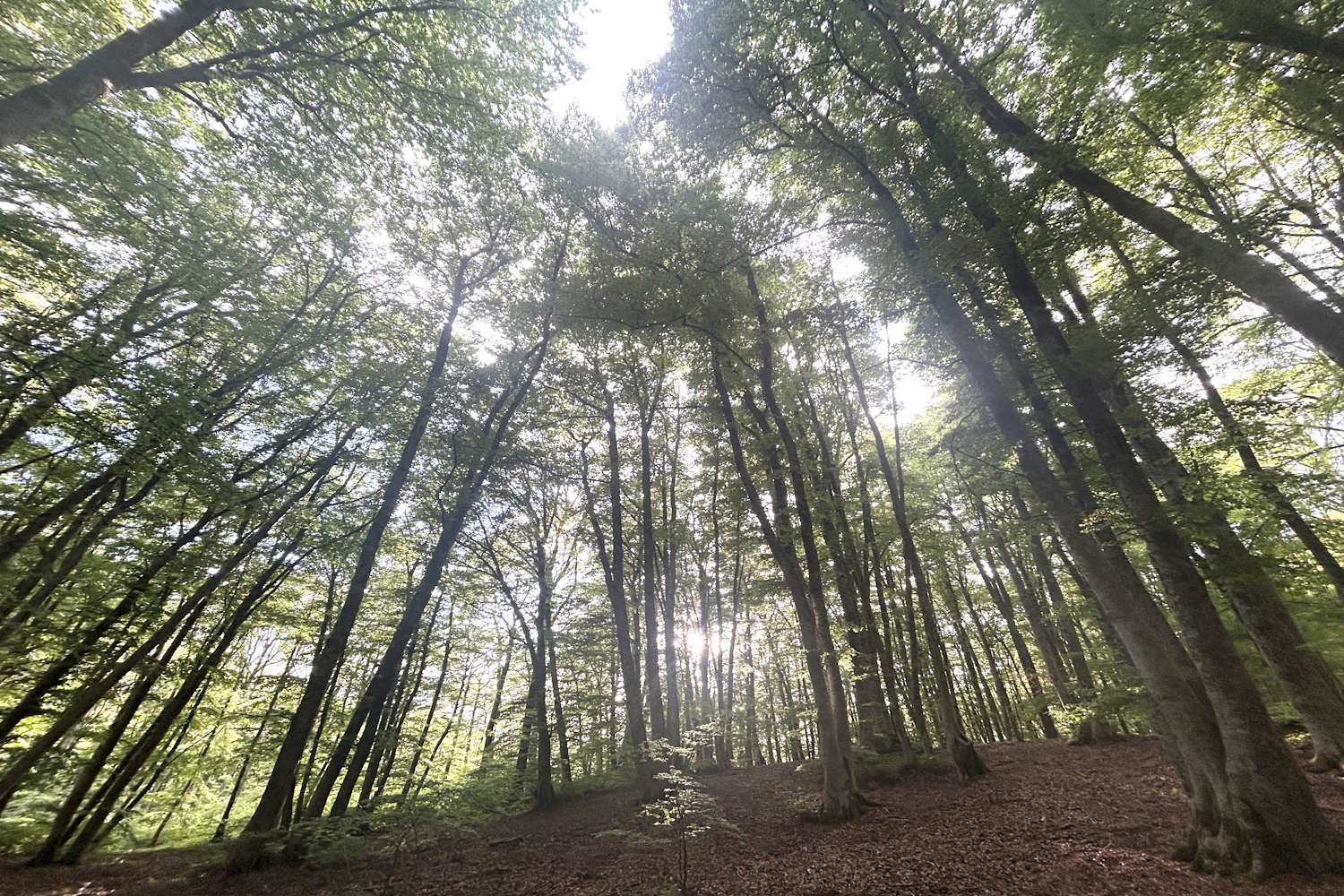
Basilicata is those few things put together, essential, incomparable, vital, which are enough to be happy and at peace with oneself. Without superstructures or constructed frills, without pretenses or turns of phrase from the cover: the land of Lucania is authenticity and intense green, lush and wild nature, guardian of traditions and beliefs, of human relationships and flavors at the table that you had lost.
Terra di Lucania knows what it means to really have nothing, to have so much potential and no one to listen to it. He knows what it means to experience the absence of trust and money, infrastructure and hope. A lack that is a bit of his luck (you will hardly find such uncontaminated nature in other parts of Italy), and his constant dilemma: what do those who have decided to stay here, not to emigrate, to roll up their sleeves do?
Rocco, Emanuele and Giuseppe know this well and, after having traveled far and wide around the world, they have settled here, in their land, in Basilicata, and dedicate themselves body and soul to Basilicata. To dedicate oneself precisely to that nature, to make it known and to leave it intact at the same time. This is how they gave life to Ivy Tour, a tour operator specializing in eco-tourism: here everything revolves around their Lucania, obviously, and the genius they had in creating routes and paths that silently reconnect man with that enchanting environment.
Among these is the Song of Free Men – Cammino del Melandro, a 120 kilometer itinerary that crosses the Melandro Valley following ancient paths, woods, small villages and landscapes that seem to have remained out of time. Not just a path to travel with a backpack, but a different way of inhabiting places, slowing down and rediscovering a more authentic connection with nature, with local communities. And with people.
Here each stage tells stories of resistance, returns, identity and freedom, in a Basilicata far from fast tourism and still profoundly true.
Melandro could mean the “song of men” – Rocco explains. To this we added the word “liberi” in honor of Giovanni Passannante, a character from Savoy of Lucania.
An attempt also, that of the Camino, to bring to light all the stories of the women and men of these lands who have distinguished themselves for having defended their own freedom and that of their fellow citizens and transform the Melandro Valley into a human destination, through the municipalities of Satriano di Lucania, Pignola, Tito, Satriano, Savoia di Lucania, Sant’Angelo Le Fratte, Atena Lucana (Province of Salerno), Brienza, Sasso di Castalda.
The Song of Free Men
The path connects abandoned paths, old sheep tracks and other already marked routes, creating a new path along the Melandro Valley and the Lucanian Apennine National Park. It is a 120km circular route. Ideally it is done in 6 days and 5 nights. We got to know this journey “as a preview” and some wonderful people. Here, some stages of our journey through the various villages:
The Tibetan bridges in Sasso di Castalda
Sasso di Castalda is one of those villages in the Song of Free Men where you arrive thinking you’re going for a “walk in nature” and instead end up suspended in the void wondering why you ever agreed to cross a Tibetan bridge at a height of 120 metres. But then you would do it again immediately.
Sasso, which gave birth to a man of freedom like Mimmo Beneventanoin fact, houses one of the most incredible routes in the region. It all starts from the historic centre, where narrow alleys and beautiful views lead towards the first suspension bridge over the Fosso Arenazzo: 95 meters long and approximately 70 meters high. A taste, practically. Because the real blow to the heart comes shortly after, when the path surrounded by nature leads to the famous “Ponte alla Luna”.
And there everything changes: 300 meters suspended in the void, with the stream below and around only air, rocks and Lucanian mountains.
View this post on Instagram
On the other side waiting for you are the ruins of the castle, a glass sky-walk that further tests your courage and a panorama that manages to make you forget even the fatigue and the shaking legs.
We talked about it here: Ponte alla Luna: the suspension bridge in Basilicata for those who want to walk among the clouds
Forest bathing in the Costara beech forest
In the collective imagination, talk about forest bathing means “to go and hug the trees”. But no. During our walk in the marvelous Faggeta della Costara (in the municipality of Sasso di Castalda), before arriving at the majestic Beech of San Michele – a monumental tree that has remained there for over 300 years, immobile and patient – we did not even hug a trunk. Although, to be honest, temptation certainly comes in front of certain silent giants.
Forest bathing does not ask you for spiritual performances or poses of a forest guru. The connection with nature happens in a much simpler and deeper way: through small invitations that everyone can freely choose to follow or not.
Listening to a sound, listening to your breathing, listening to the birds, focusing on a light between the branches. Close your eyes.
View this post on Instagram
And this is perhaps the most surprising detail: understanding how unaccustomed we are to being in the woods without having to do something.
The Tuorno waterfalls
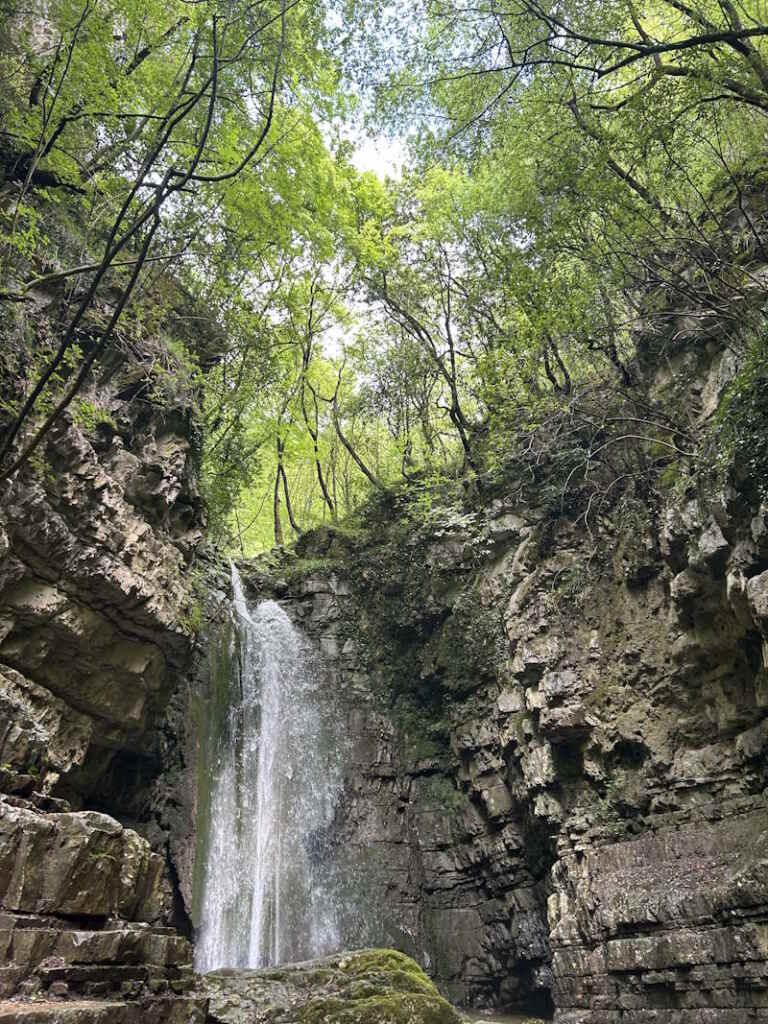
The Tuorno waterfalls are one of those places that Basilicata preserves almost in silence, far from noisy tourism and overly crowded maps. A few kilometers from Savoia di Lucania, this small natural paradise can be reached with a walk of about twenty minutes, among ancient oaks, ferns and the continuous sound of the stream that accompanies every step.
And then, suddenly, there they are: crystal clear water falling over 15 meters into an emerald pool, in the middle of vegetation so thick and fresh that it seems almost unreal. In spring, with the water falling more forcefully from the nearby Monte Volturino, the roar of the waterfall fills the entire forest and for a few minutes even manages to cover that constant noise that we carry within us every day.
Brienza
Another stop on the Camino is Brienza, a beautiful and fragile village, one of those that Basilicata knows well. Perched in the mountains of the Melandro Valley, it preserves stone alleys, ancient arches and a castle that dominates everything from above.
Walking among ancient churches, noble palaces and small squares, you can still perceive the soul of a town that has experienced so much but without losing its identity. And then there is nature all around: woods, paths, fresh air and that very rare sensation of real space that we have almost forgotten in the city.
Satriano of Lucania
What a fairytale place is Satriano di Lucania! One of those countries has decided to tell its story on the walls. Walking through its streets you continually happen to look up and find a mural: faces, hands, peasant scenes, symbolic figures and stories of emigration that transform the village into an open-air museum. Here urban art serves to preserve memory, identity and belonging in a territory that has been fighting against depopulation for years.
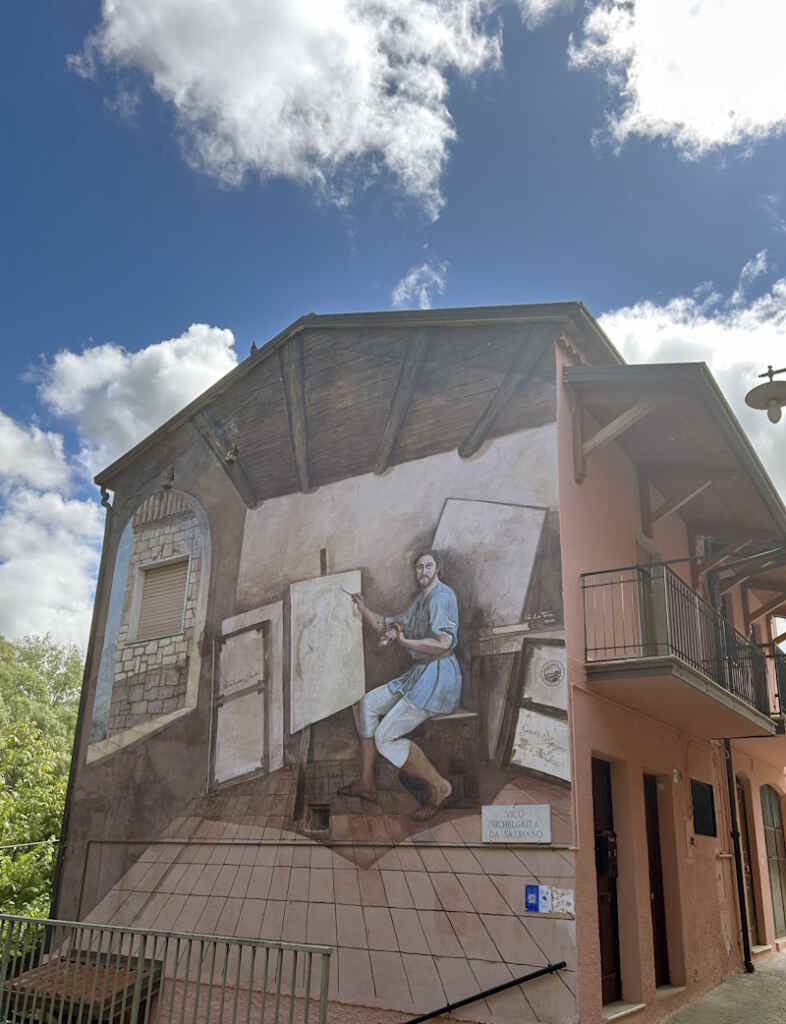
Satriano is also the town of Rumita, probably one of the most poetic and powerful figures of Italian folklore. During Carnival, the village is filled with tree-men completely covered in ivy, symbol of the ancestral bond between man and nature.
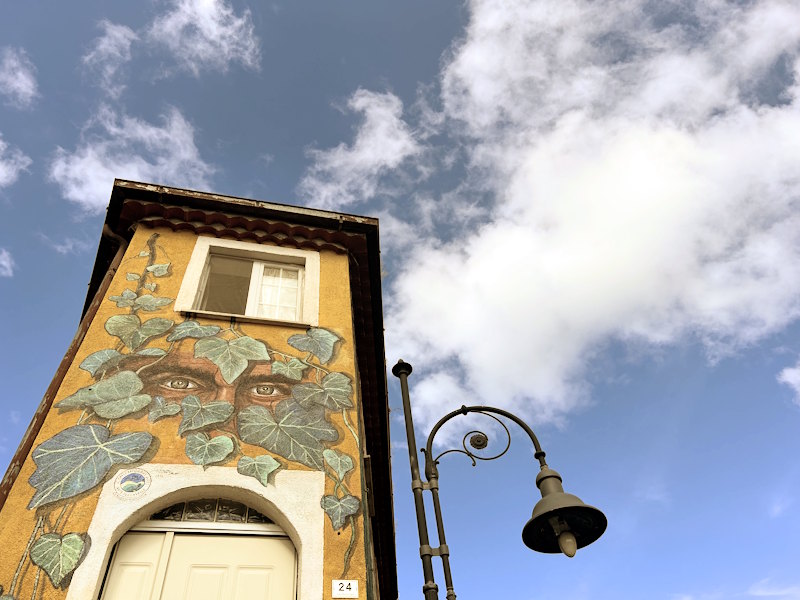
The Rumita doesn’t just parade: he walks slowly, knocks on doors, brings good wishes and reminds everyone that we come from the earth and we still depend on the earth. A very ancient tradition which today has also become a very strong ecological message.
Human destinations
In the Path of Free Men the landscape matters a lot, of course, but in the end it is always the people who stay with you more than the views.
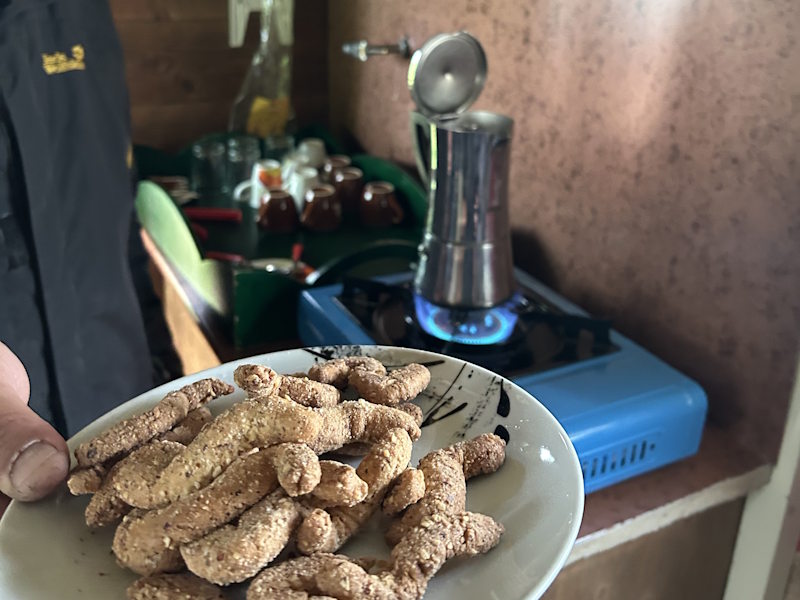
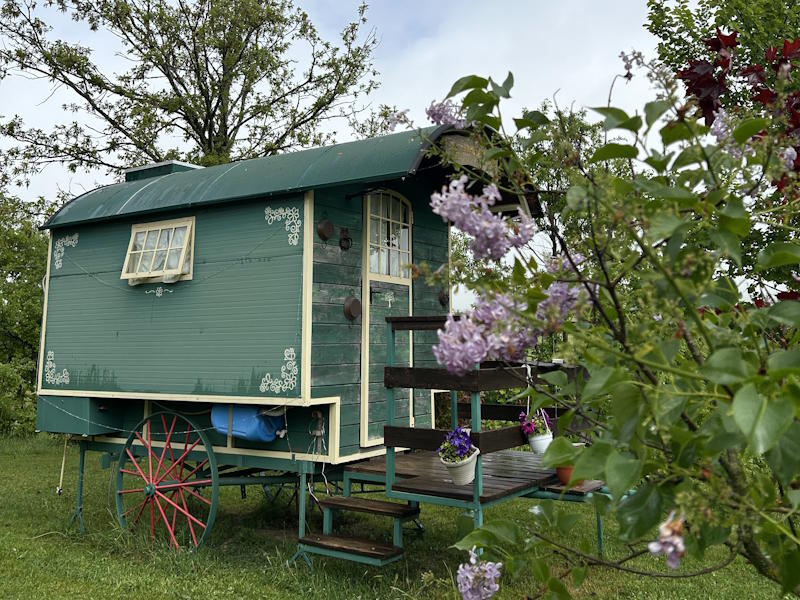
It is they, Ivan and Valentina, who at Athena Lucana in Domus Otium they welcome travelers and guests with a cuisine that tastes of home, of the territory and of true slowness, that made of hands, seasons and tables shared without haste. Or Donatello, in Savoia di Lucania, who with his B&B has transformed an ancient caravan wagon into a room to sleep in, as if to remember that certain journeys never really end. Which make you keep your pace and keep your eyes open to beauty, always (as well as offering you delicious coffee and biscuits…).
And perhaps this is precisely the heart of the Melandro Valley: not only the woods, the villages and the paths immersed in nature, but those who choose to stay every day, work this land and cherish its memory.
Those who cultivate, cook, accompany, tell, accompany. People who keep ancient traditions alive without turning them into postcards for tourists.
The Path of Free Men goes through all of this: a collective story made of effort, hospitality and silent resistance. And as you walk you understand that, more than visiting places, you are entering for a moment into the life of those who stubbornly continue to inhabit those places.
To date, the path of the Song of Free Men is taking shape and will only shortly be marked out and accompanied by credentials. Until that moment, to travel the path safely, you need to turn to the expert hands of Ivy Tour
