
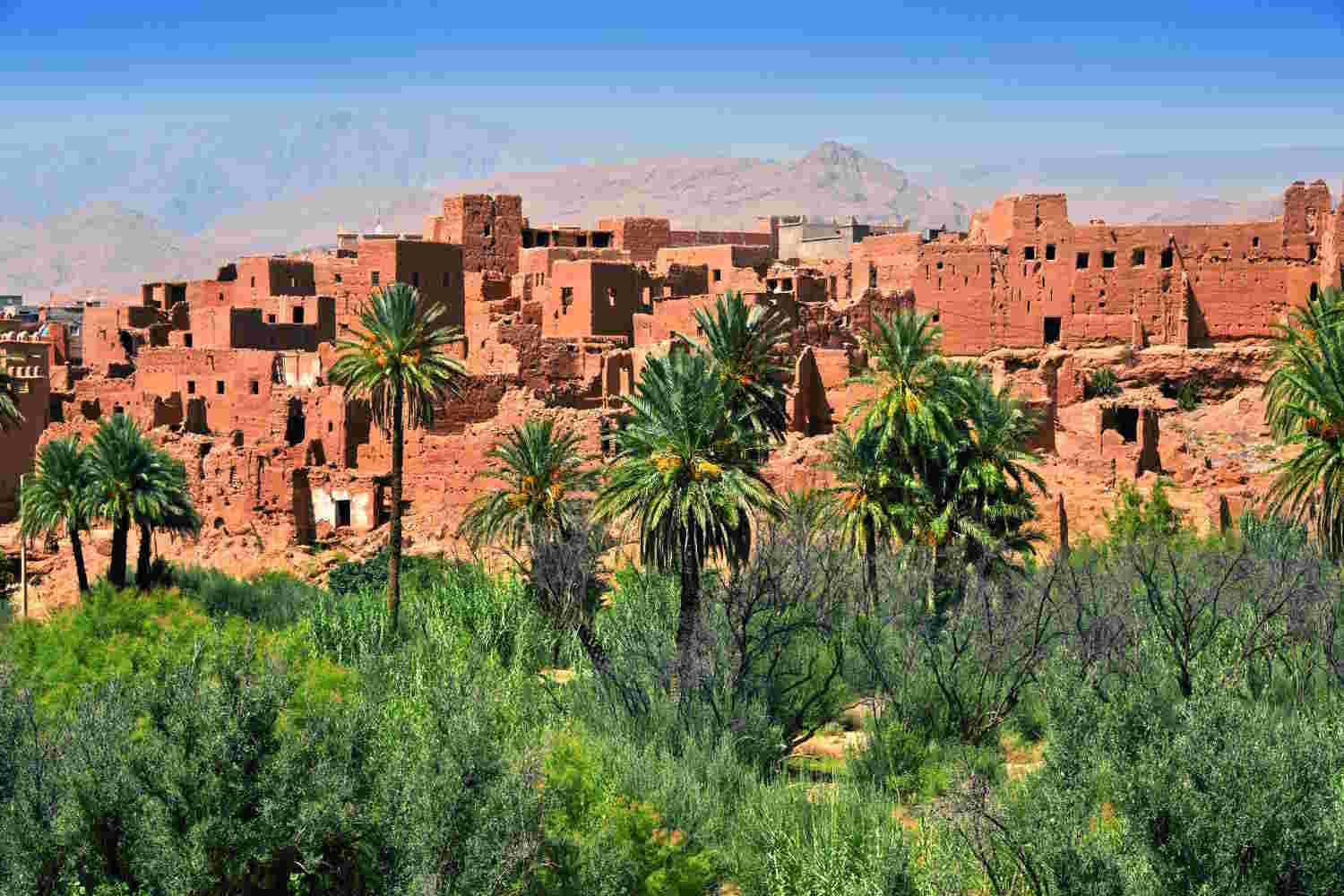
Morocco is a destination that works well for almost all types of travellers. Whether you are interested in history, nature, photography, food or simply an escape from the routine, traveling to Morocco offers something concrete for every need. Located between the Mediterranean, the Atlantic and the Sahara Desert, Morocco is also relatively easy to reach from Italy and does not require excessive preparations.
What makes this country interesting from a tourist point of view is the variety. In a few days we go from chaotic and crowded urban environments to quiet and isolated natural spaces. There is no single “face” of Morocco, but a succession of very different contexts.
The imperial cities: Marrakech, Fes, Chefchaouen and Rabat
Marrakech: the red city and its souks
Marrakech is known as the “Red City” for the rammed earth walls that characterize it. It is the point of reference for most tourists who visit Morocco, mainly because it offers a concentration of attractions in a relatively small space.
The center of the city is Jemaa el-Fna Square, a public space where during the day you can find everything: orange juice sellers, snake charmers, musicians, street vendors. At sunset the square transforms into a huge open-air restaurant with dozens of food stalls. It is not the most “authentic” Morocco from a tourist point of view, but it is certainly representative of how the city is a space where public life is central.
The souks (markets) of Marrakech are large and well organized for tourists, although they are still crowded and chaotic. Those seeking tranquility should visit the Majorelle Gardens or the Bahia Palace, both of which are less crowded than the square.
Fes: the largest medina in the world
Fes el-Bali is the medieval medina of Fes and is considered the largest and most complex pedestrian area in the world, with around 9,000 alleys. Unlike Marrakech, here the feeling is that of a real labyrinth, where it is easy to get lost and where tourism is less “packaged”.
The main attraction is visiting the Chouara tanneries, where leather is still processed using traditional methods today. The colored tanks where the processing takes place are photogenic, but the stench is particularly strong. It’s an authentic experience, but not for those who have problems with strong odors.
Fes takes longer to understand than Marrakech: two or three days is the recommended minimum.
Chefchaouen: the blue city in the mountains
Chefchaouen, located in the Rif Mountains, is a destination that has gained popularity in recent years largely thanks to social media. The city is painted entirely in blue and light blue, making it visually coherent and easily photographable.
The atmosphere is much more relaxed than in other medinas. There aren’t the big souks of Marrakech or Fes, and tourism is still present but manageable. It’s the kind of place worth stopping for two or three days, not just for a quick wander.
Rabat: the often overlooked capital
Rabat is the capital of Morocco, but receives less tourist attention than other imperial cities. However, it is worth a visit if you pass that way, especially for the Kasbah of the Oudaïa, an ancient area overlooking the ocean with white and blue alleys. It is less crowded than other medinas and more tidy.
Natural wonders: desert, mountains and coast
The Sahara Desert: Merzouga and M’hamid
The Sahara Desert is one of the most common experiences on Morocco tours. There are mainly two areas: Merzouga (Erg Chebbi) and M’hamid (Erg Chigaga). Merzouga is more touristy and easier to reach; M’hamid is wilder and less equipped from a tourist point of view.
Both areas offer camel rides and nights in desert camps. The experience is actually interesting: the landscape is impressive, the night sky is spectacular due to the lack of light pollution. It is important to choose reliable tour operators to avoid poor experiences.
The Atlas Mountains and Berber villages
The High Atlas is Morocco’s main mountain range, with peaks exceeding 4,000 metres. Here you will find traditional Berber villages, built of stone and mud on the slopes of the mountains. You can go trekking in this area, or simply visit the villages to learn about the local lifestyle.
Berber villages receive many tour operators, so authenticity is relative, but it still remains an interesting experience from an anthropological point of view. The hospitality is authentic: it is not uncommon to be invited into a local home to share a meal or tea.
The Atlantic coast: Essaouira and the surf spots
Essaouira is the main center on the Atlantic coast. It has a bohemian feel with a seaside fortress and an active fishing port. It’s a pleasant place to stop for a few days, even if it’s less “exotic” than inside the country.
Further south are Agadir and Taghazout, the latter of which has become famous among surfers for its constant waves. If surfing interests you, this is the right area. If you are looking for simple relaxation by the sea, Essaouira is more interesting from a cultural point of view.
Moroccan cuisine: what to eat
The tagine
The tajine is the most iconic dish of Moroccan cuisine, both in name and shape (the conical terracotta dish in which it is cooked). The main variations are the chicken tajine with confit lemon and olives, and the lamb tajine with plums and almonds. The meat is slow cooked and very tender.
It is the dish to try at least once, preferably in a local restaurant rather than in a tourist facility.
The couscous
Couscous is the festive Friday dish. It is based on steamed semolina, with vegetables, legumes and meat. It’s less “special” than the tajine flavor-wise, but it’s still an interesting culinary experience.
Mint tea
Mint tea (informally called “Berber whisky”) is the drink that accompanies almost all social interactions in Morocco. It is served very sweet, poured from a height to create a characteristic foam in the glass. Refusing it can be considered an offense; accepting it means participating in the social ritual.
How much time to dedicate to Morocco
A week long trip is the minimum to have a decent experience. With one week you can visit two imperial cities and the desert, or one imperial city, the desert and the coast.
A 10-14 day trip allows you to visit Marrakech or Fes, the desert, the Atlas Mountains and perhaps the coast, without rushing too much.
Avoid doing Morocco “in a hurry”: it is a country where the slow pace is part of the experience, and rushing involves the risk of missing out on the interesting aspects.
