
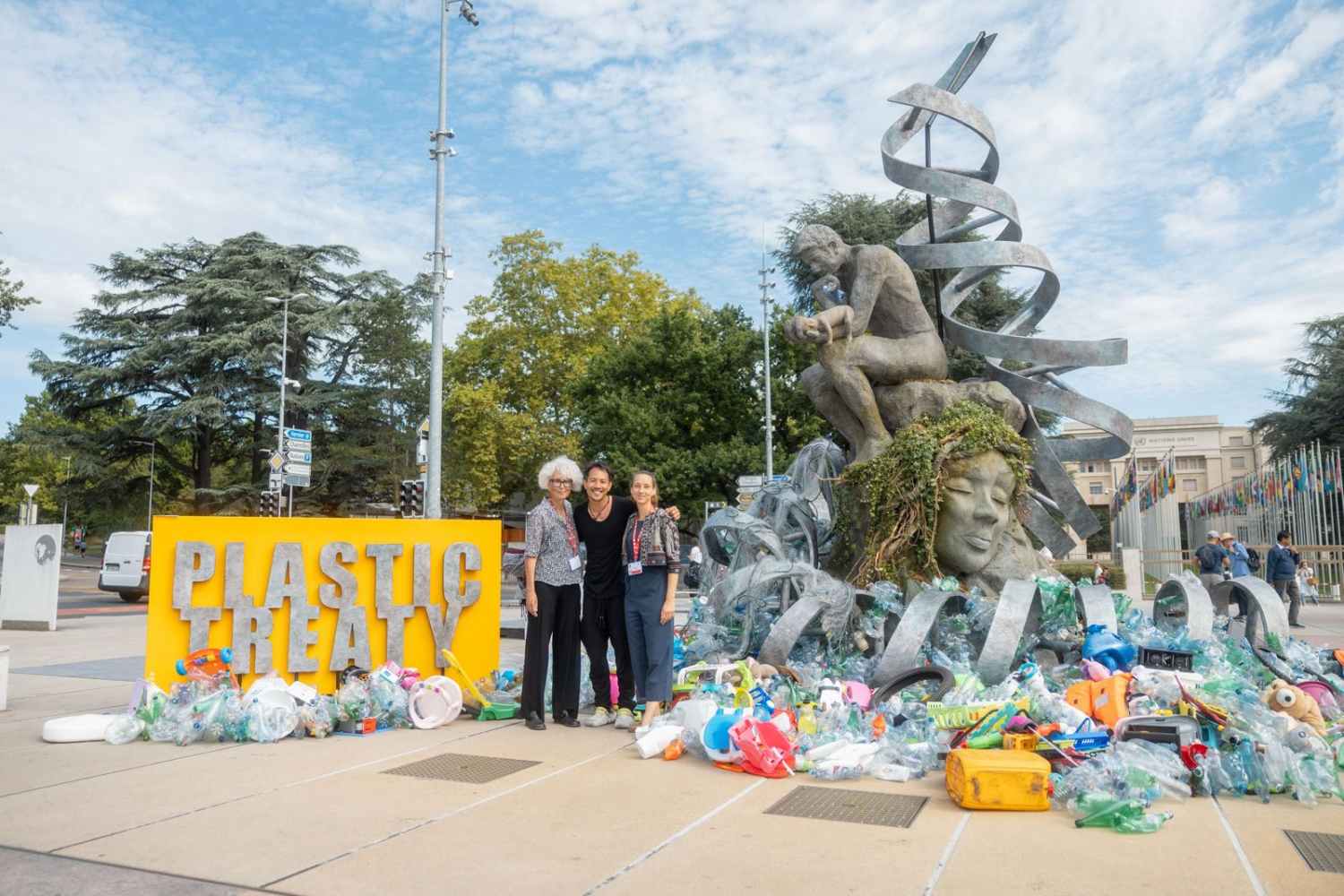
Time is about to expire. From 5 to 14 August, in Geneva, the representatives of 179 countries are gathered for what could be the final negotiation for a global treatise on plastic (inc-5.2). A legally binding agreement that, for the first time, would face the entire plastic supply chain, from its production to its disposal. But the conditional is a must, because after five bankruptcy negotiation rounds, the last in Busan in South Korea, the road is still uphill.
On the delegated table there is a 22 -page document, a draft line to analyze row for row to give shape to a future without plastic pollution. An urgency no longer postponed: the Global Risk Report 2025 has inserted this crisis among the 10 global risks with the most serious impacts for the next decade. The numbers are frightening: only in 2024, humanity produced over 500 million tons of plastic, of which almost 400 destined to become waste.
Health in the center of the debate
To make the scenario even more critical is the link, now proven, between plastic and human health. Shortly before the start of the talks, the prestigious scientific journal The Lancet launched a very heavy alarm: plastic materials cause diseases “in all phases of the plastic life cycle and in all phases of human life”, with children and infants who are the most vulnerable. Global economic losses related to health damage already exceed $ 1.5 trillion per year.
Plastic is connected to spontaneous abortions, congenital malformations, heart disease and cancer. Still, health has become a clash.
Two opposite visions of the future
The Geneva negotiation is split in two. On the one hand, a coalition of over 100 countries that pushes for an ambitious treaty, with legally binding reductions on the production of virgin plastic and the ban on the most dangerous chemicals and superfluous disposable products.
On the other, a group of countries defined as “Like-Minded”, including oil giants such as Saudi Arabia, China, Russia and Iran. This faction firmly opposes any limit to production, claiming that the treaty should focus exclusively on better waste management and recycling. A position that, according to experts, is not enough, given that just 9% of the plastic produced globally today is recycled.
In a more nuanced position there are the United States, which have declared themselves in favor of a less ambitious treaty, without net cuts in production.
Professor Richard Thompson, the academician who first coined the term “microplastics” to give voice to the scientific community. As reported by the British newspaper The Guardian, Thompson, present in Geneva, has launched an appeal to the delegates: “It is really clear that to protect future generations we have to act decisively now (…). I really hope that negotiators can look at the next generation in the eyes and say that they have acted decisively”.
The plastic paradox that “saves life”
The strategy of the producing countries and industrial lobbies, increasingly present at negotiations (in Busan there were 220 representatives of the chemical industry and fossil fuels), is to present plastic as an essential material for health, citing its use in the medical field. The goal is to obtain a total exemption for the health sector, a escapade that would nullify most of the efforts.
But the world of health is not there. Health Care Without Harm, an organization that represents 48 million health workers in 88 countries, has promoted an open letter to reject this narrative, stating that reducing superfluous plastic in the health sector is not only possible, but necessary to protect patients.
While the clock runs around August 14, the question that everyone is asking is if the economic interest of a few or collective health and the planet will prevail. Graham Forbes, chief delegation of Greenpeace, clearly told the Guardian: “The uncontrolled plastic production is a death sentence. The only way to put an end to plastic pollution is to stop producing so much”.
Don’t you want to lose our news?
You may also be interested in:
