
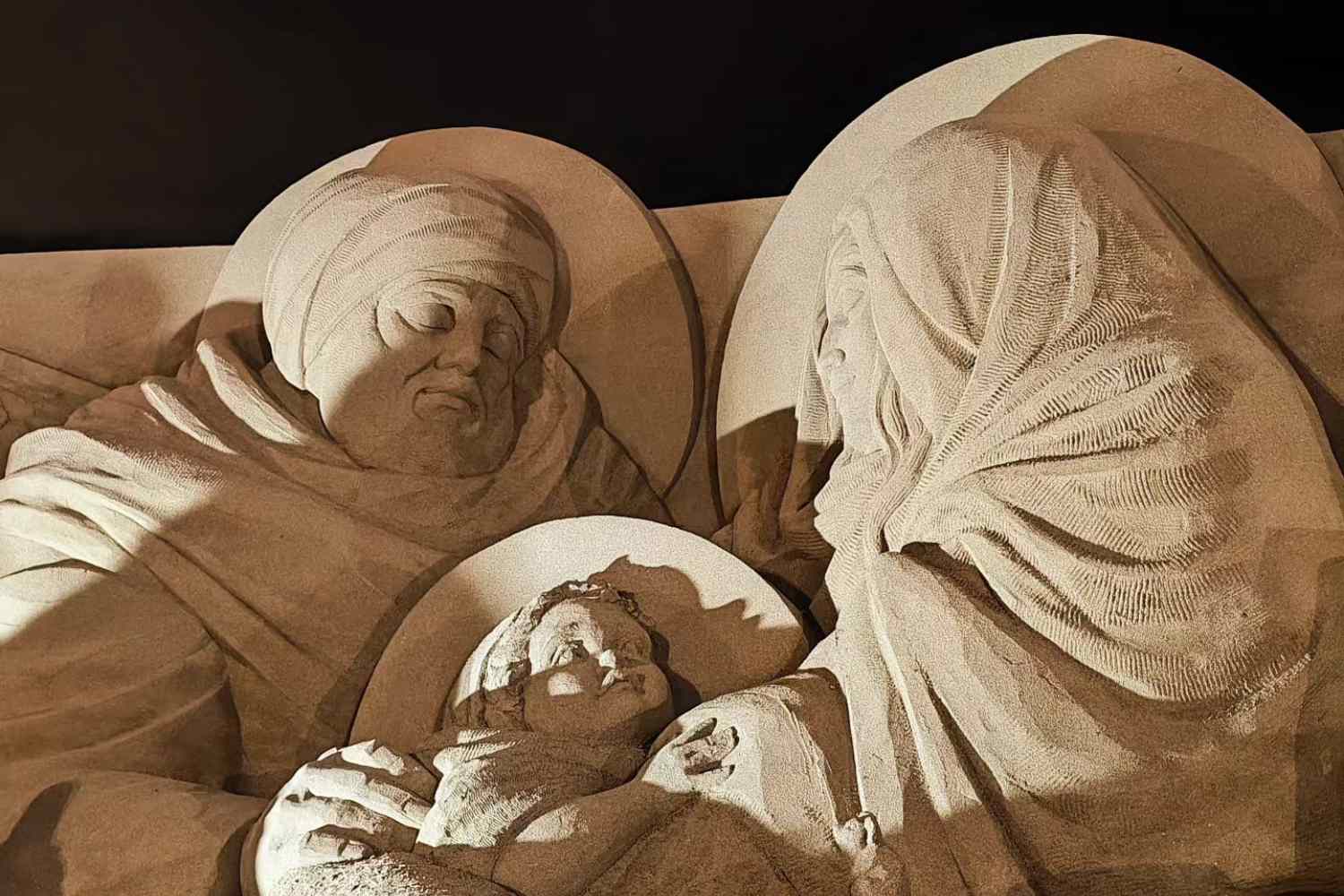
There is something alienating in seeing a nativity scene made of sand, a few meters from the ocean, while in Europe the radiators are turned on. Gran Canaria at Christmas is just this: a short circuit of images that works, which manages to be festive without needing the cold.
The Barra and the star of the Auditorium
Las Canteras beach has its own particular geography. There is this natural barrier, La Barra, which emerges at low tide and disappears when the water rises. Seen from the shore it almost looks like a brush stroke left there by chance. At the north end, the Alfredo Kraus Auditorium with its illuminated skylight completes the scene. Some see it as a comet star, and in fact the analogy holds true.
It is here that every year two thousand tons of sand modeled by international artists take shape. The nativity scene that emerges has become one of those symbols that end up on social media, on stamps, on postcards. Ephemeral sculptures that however remain imprinted, a bit like La Barra itself when it disappears underwater.
A warm Christmas on the beach
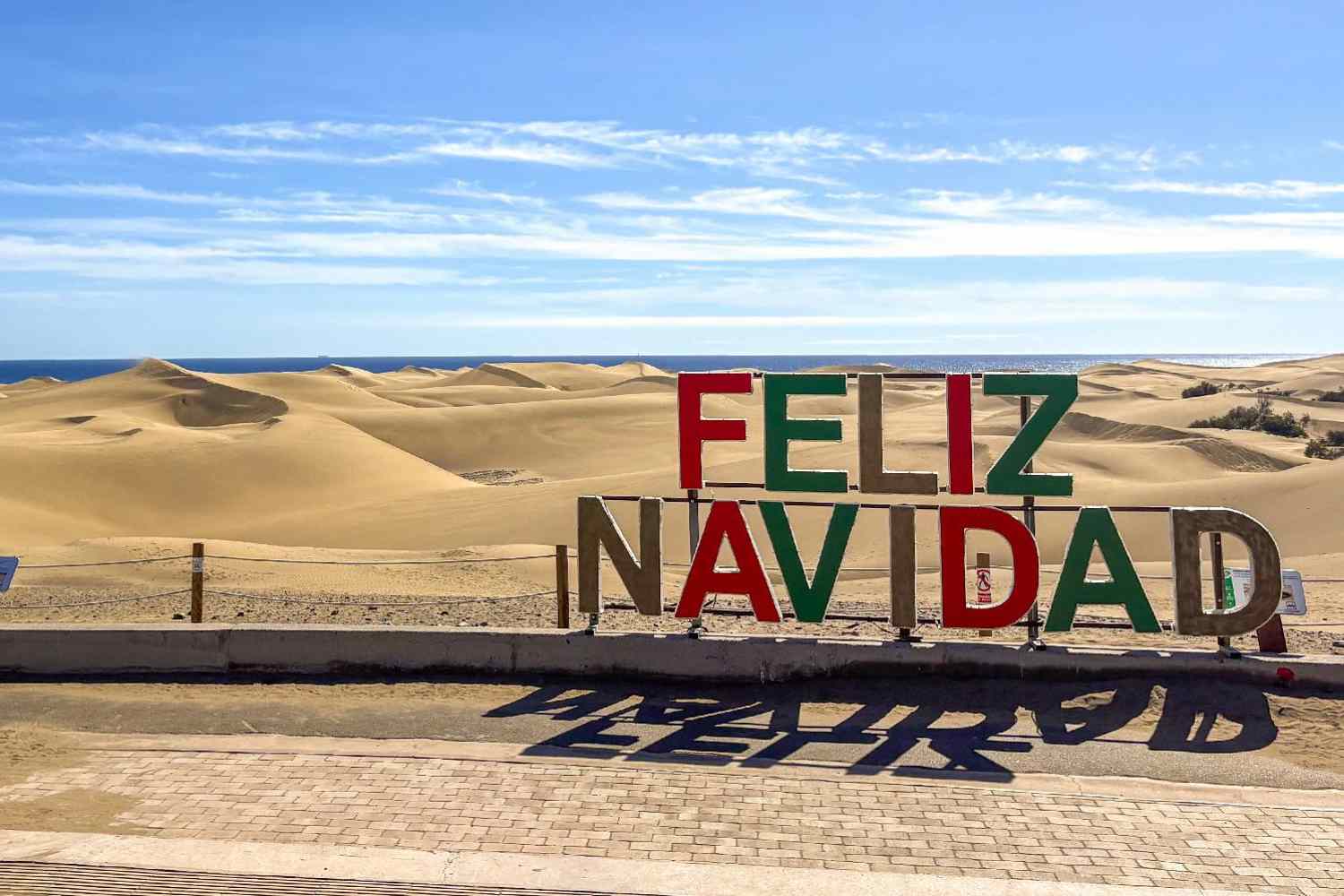
While elsewhere you take coats out of the wardrobe, or indeed hats and down jackets, here you walk along the shoreline. The climate allows you to do things unthinkable for December: dive into the Atlantic, walk trails, explore the interior of the island without suffering from the cold. It’s an outdoor Christmas, which invites you to move instead of hole up.
Las Palmas de Gran Canaria fills with lights, and so do Gáldar, Arucas, Telde. The markets smell of roasted chestnuts – yes, here too – but the surrounding architecture tells another story, that of a place suspended between Europe and America, which does not entirely belong to either one or the other.
What do you eat at Christmas in Gran Canaria
Nougat and marzipan have a different logic here. They come from the upper part of the island, where the almond trees bloom weeks earlier than on the mainland. It’s a detail that says a lot: things follow their own rhythms, they don’t bend to the calendar of other places.
The wines contain the variety of the landscape. Going up towards the mountains or looking towards the coast, everything changes. Even the cheeses are a map: each type carries with it the history of the pasture from which it comes, of the sheep and goats that grazed in that precise point of the island.
Where to go and what to do
There is not just one way to experience Christmas in Gran Canaria. To the south, in the coves of Maspalomas, you can lie in the sun among the dunes while elsewhere it snows. The Maspalomas Lighthouse lights up during the holidays and becomes a meeting point for evening walks.
If you prefer the interior, take the road to Roque Nublo. At 1,813 meters high, this rock formation offers views that completely change your mind about the island. From here you see mountains, pine valleys and, in the distance, the ocean. The path to reach it is accessible and takes about 30 minutes on foot from the car park.
In Las Palmas, the Vegueta neighborhood comes alive with markets and concerts. The Plaza de Santa Ana in front of the Cathedral becomes a meeting point, with stalls selling local crafts and typical sweets. In the alley bars you can taste ron miel, the local honey liqueur, accompanied by cheese tapas from Flor de Guía.
For those who want to walk, the Camino de Santiago de Gran Canaria crosses the island from Maspalomas to Gáldar. There is no need to cover it all: even just one stage takes you through landscapes that alternate pine forests, cultivated terraces and villages where time seems to have stopped.
In Arucas it is worth visiting the Arehucas rum distillery, which has been active since 1884. Guided tours show the production process and end with a tasting. The historic centre, with its neo-Gothic church in volcanic stone, is one of the most photogenic on the island.
Practical information
Temperatures in December fluctuate between 17 and 23 degrees. The ocean water is around 20 degrees, more than enough for swimming. Rain is rare but possible, especially in the higher inland areas.
The sand nativity scene in Las Canteras remains on display throughout the Christmas period, generally from the end of November to the beginning of January. It is accessible for free and is located on Calle Alfredo L. Jones, near the Alfredo Kraus Auditorium.
To get around the island it is best to rent a car. Buses connect the main centers well but limit access to certain more remote areas. The roads are in good condition, even if there are significant curves and slopes inland.
The Three Kings actually arrive in Spain and bring gifts to children and the elderly
