
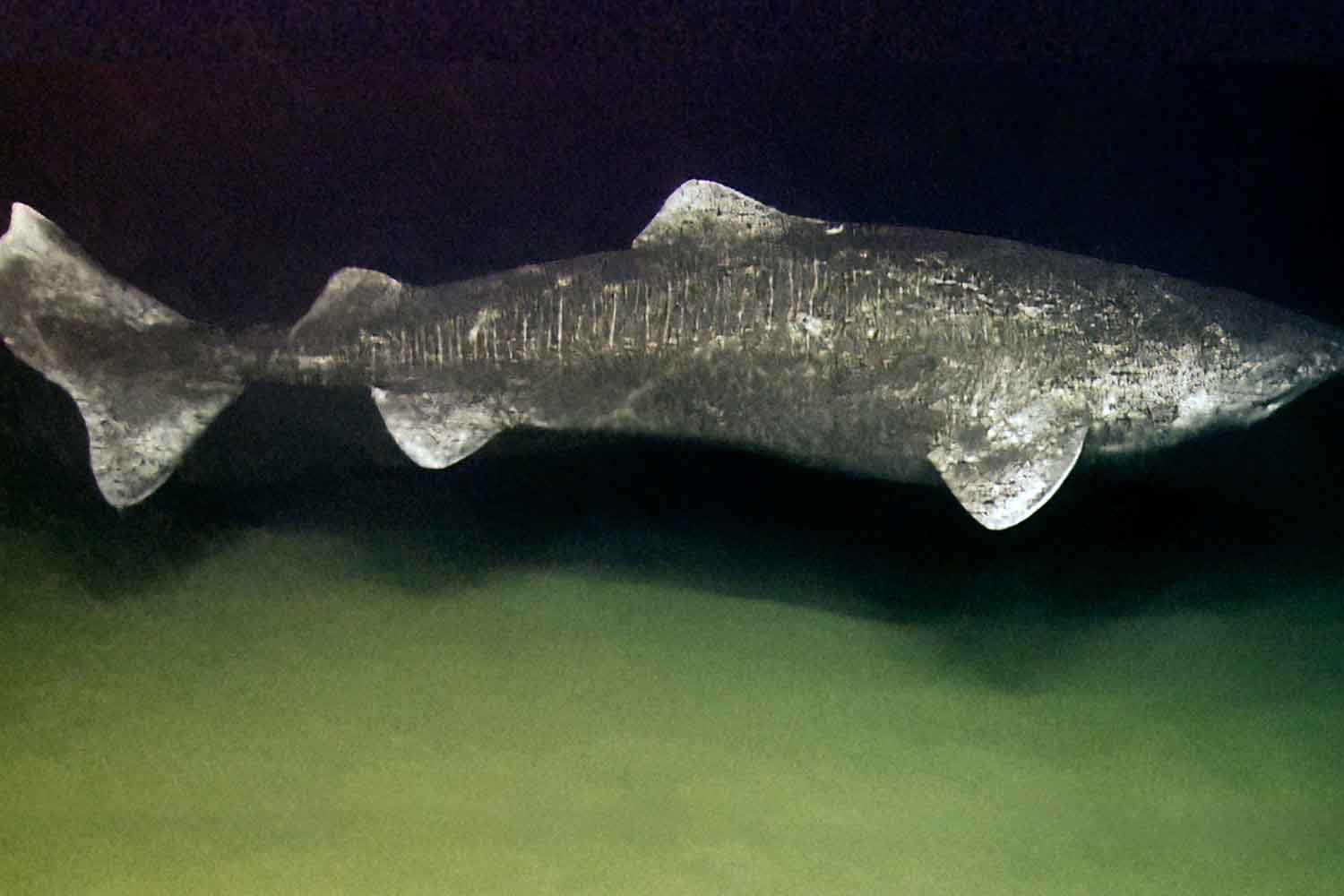
In April 2026, a Greenland shark about three meters long and weighing more than 200 kilos was found dead on the coast of County Sligo, Ireland. It is the first stranding of the species ever documented in the country. From his size he could be between 150 and 200 years old, although the precise age will have to be looked for in the lenses of his eyes. According to our registry it was very ancient. In the very slow life of his species he could still have several decades ahead of him.
Two teenagers had reported the body to the Irish Whale and Dolphin Group, initially mistaking it for a basking shark. The location was difficult to reach and the tide threatened to wash the animal away, so the National Museum of Ireland coordinated the recovery together with local authorities, veterinarians and researchers. A crane lifted it from the shore and transferred it to the laboratory. A rather eventful operation for an animal that spends its life moving at a speed close to that of a very listless walk.
Necropsy made it possible to examine organs, collect tissue, and preserve certain body parts for later study. The cause of death has not yet been clarified. The museum also hopes to prepare the skin to one day display the specimen, turning this rare stranding into a permanent scientific collection.
An age hidden in the eyes
Determining how old a Greenland shark is requires something more precise than a wrinkle on its face. These animals grow slowly and their cartilaginous skeleton does not retain easy-to-count annual rings. The most useful information is found in the nucleus of the ocular lenses, formed before birth and composed of proteins that remain stable throughout life.
In 2016 a study published in Science subjected the lenses of 28 females to radiocarbon dating, ranging in length from 81 centimeters to just over five meters. The results indicated a longevity of at least 272 years. The largest specimen was estimated to be 392 years old, with enormous uncertainty: about 120 years more or less. When you study an animal capable of spanning centuries, even the margin of error takes all the time it needs.
The same work placed the sexual maturity of females at around 156 years, always with a wide range of uncertainty. The estimate cannot be automatically transferred to the male found in Ireland, whose reproductive biology is even less known. However, the dimensions suggest a relatively young individual compared to the large specimens of the species. Old enough to have been born in the 19th century, perhaps still too young to have contributed to the next generation.
The lenses taken during the necropsy will serve to narrow the estimate. It will be rare data, especially because it concerns a male and a size range for which there is still little information available.
He still sees after more than a century
The Greenland shark often carries small parasitic copepods on its eyes, Ommatokoita elongataattached to the cornea like tiny pendants. For years this detail, along with life in the dark depths of the Arctic, has fueled the idea of a nearly blind animal. The eyes tell something else.
A study published in Nature Communications he found an intact and specialized visual system to collect the little light available. The retinas analyzed retained long, dense rods, the cells best suited to vision in the dark, while many genes linked to cones and intense light were inactive. He doesn’t need to distinguish the colors of a sunny afternoon well. He needs to see something where almost nothing is visible.
The oldest specimen examined in the study was estimated to be over 130 years old. The researchers observed no obvious signs of retinal degeneration and detected strong activity of genes involved in DNA repair, a possible support for tissue preservation over time. The six corneas analyzed allowed between 70 and 100% of light to pass through, despite the presence of parasites at the edges. The alleged veil over the eyes therefore seems much less effective than its appearance suggests.
The sample remains small: some detailed cellular analyzes were conducted on a single individual, while the gene expression data came from three adult sharks. The results describe a surprising ability, without turning it into a law valid for every Greenland shark. The eyes of the Irish specimen will be able to offer a new comparison, this time on an animal that arrived spontaneously on shore and was not captured during a research campaign.
The heart bears the signs of time
Living for centuries does not mean passing through them without scars. A study published in Aging Cell found fibrosis, accumulations of lipofuscin, mitochondrial damage and markers of oxidative stress in the hearts of Greenland sharks. Signs that, in many vertebrates, accompany tissue decline with age.
However, the animals examined appeared healthy and physiologically efficient at the time of capture. According to the authors, their longevity may depend on their ability to continue functioning despite accumulating damage. The heart ages. He just seems to tolerate it much better.
Here too caution and other champions are needed. The study compared the heart tissue of the Greenland shark with that of two other species and identified a form of resistance to age-associated damage. It does not prove that every individual maintains a functioning heart for four hundred years, nor does it offer shortcuts against human aging. Four centuries of marine life isn’t waiting to become an anti-aging cream, thankfully.
Each loss weighs for more than a century
We know the longevity of the Greenland shark better than many aspects of its daily life. We do not know precisely where mating and births take place, how long gestation lasts, how many times a female reproduces or how many animals live today between the Arctic and the North Atlantic.
The 2025 Canadian COSEWIC report still considers the size of the global population to be unknown. It estimates at least 3,500 bycatches each year, mostly in trawls, longlines and gillnets. The species grows slowly, reaches maturity late and has a reproductive capacity that is still uncertain: removing an individual from the population could mean losing a century and a half of waiting.
Since 2020, the International Union for Conservation of Nature has classified the Greenland shark as vulnerable. Many accidentally captured specimens are released, but data on subsequent survival is scarce. Accelerated warming of the Arctic could also change habitat, distribution and availability of prey.
The shark that arrived on the Irish coast may have been born when the car did not yet exist. He died in an era capable of sequencing genes and observing retinal cells, while we still don’t know where his species gives birth to its young. The lenses stored in the laboratory will tell how old he was. To truly understand the life he led, it will take much longer. He probably would have.
