
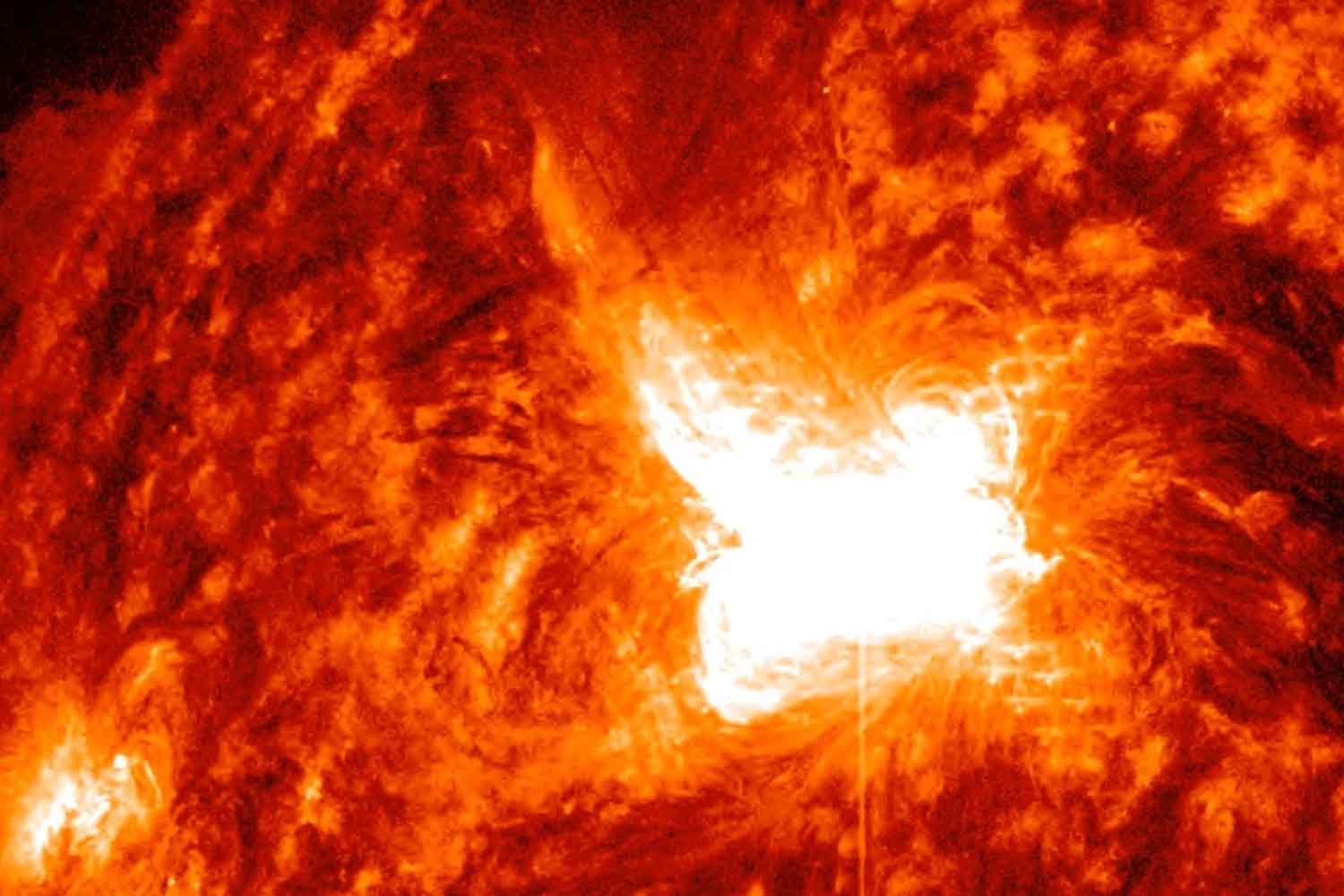
Between on February 1 and 2, 2026the Sun showed a face that was anything but reassuring. The center of attention is the sunspot AR 4366a huge and magnetically unstable region that, in just over 48 hours, generated dozens of solar explosionsincluding powerful eruptions of class and numerous M-class flares. A behavior which, due to its intensity and continuity, inevitably brought the famous man back to the memory of scientists Carrington Eventthe most violent solar storm ever documented in modern times.
A huge and unstable sunspot
The dimensions of AR 4366 speak for themselves: its extension is estimated at about half that of the region that triggered the Carrington Event in 1859but his magnetic complexity it’s enough to make it one of the most dangerous and monitored areas in the whole Solar Cycle 25. Between February 1st and 2nd, this spot released energy almost continuously, producing numerous M-class solar explosions And several class X eruptionsculminating in the powerful X8.1.
An episode that does not represent an isolated case, but the peak of a long phase of agitation. Even in the last hoursIndeed, AR 4366 continued to be heard. According to data released by SpaceWeatherLive.comhave been registered a strong M7.25 class solar flare at 08:06 today, Tuesday 3 FebruaryAnd an M6.77 at 12.36pm yesterday. Clear signs of a region that remains turbulent, restless and potentially explosive.
A detail not to be underestimated
What makes the situation particularly interesting – and worthy of attention for us on Earth too – is the location of AR 4366. The sunspot is indeed emerging moving progressively towards the central area of the solar diskwhile remaining halfway between the equator and the north pole. It is precisely this position that worries the experts the most: when a solar flare occurs near the center of the Sunthe possible coronal mass ejection (CME) can be directed more easily towards our planet.
For this reason, monitoring remains constant. Scientists await i bulletins for the next few hoursalso because the CME associated with X8.1 class solar flare could be reach Earth around February 5.
Northern Lights in Italy: when the dream can become reality (and when not)
When it comes to Northern Lights visible from Italythe enthusiasm is understandable: the idea of seeing the sky turn green and purple above our heads is irresistible. But reality, as often happens with natural phenomena, is a little more complex and fascinating than it seems. In fact, a very intense solar storm is not enough to guarantee the spectacle even at our latitudes.
What makes the difference is a parameter little known to the general public, but fundamental: thegeomagnetic index Kpa scale that goes from 0 to 9 and which indicates how much the Earth’s magnetic field is “shaken” by the energy coming from the Sun. In order for the auroral oval to reach as far as Italy, exceptional values, around Kp 8 or even 9rare events that only occur during extreme geomagnetic storms.
In most cases, even in the presence of powerful solar flares or coronal mass ejections directed towards the Earth, the aurora remains confined to the northernmost regions of Europe. In our country, sightings have only been possible on very few occasions, especially in the North, and during G4 or G5 level storms. At the moment, despite the intense activity of the AR 4366 sunspot, estimates indicate that the incoming energy may not be enough to push the aurora all the way to Italian skies. The dream remains alive, therefore, but for now closer to the northern horizon than above our cities.
The fact remains that AR 4366 continues to be under special surveillance. With such a complex magnetic profile and almost uninterrupted production of solar flares and explosionsthis stain could still surprise us. And when the Sun decides to get agitated, even millions of kilometers away, it’s always worth staying informed.
