
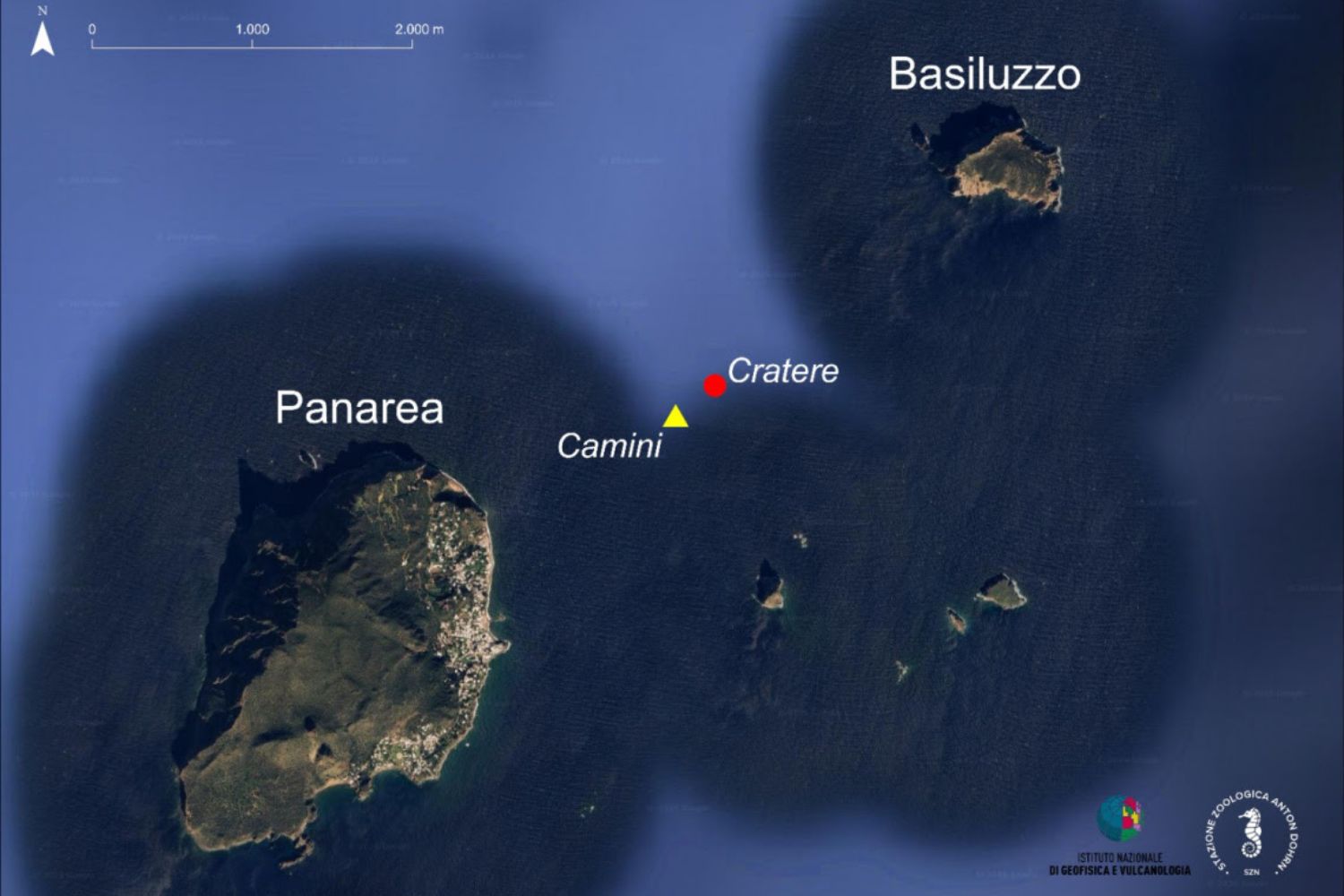
The Aeolian archipelago, jewel of the Mediterranean, continues to reveal its deepest secrets. A recent scientific expedition announced a discovery of extraordinary importance off the coast of Panarea: the identification of a vast underwater crater and new vents of hydrothermal origin. This revelation not only expands our knowledge of the dynamic aeolian volcanic system, but also opens fascinating new perspectives for research, monitoring and studying abyssal ecosystems, crucial for understanding the resilience of life under extreme conditions.
A window onto the volcanic heart of Panarea
The discovery, the result of meticulous work conducted by the National Institute of Geophysics and Volcanology (INGV) in collaboration with the Anton Dohrn Zoological Station (SZN), in particular its Sicily Marine Center and the Calabria Marine Center – CRIMAC, revealed a crater of approximately 100 x 60 meters and numerous hydrothermal vents. These structures are located about a mile from the island of Panarea, at a depth of between 60 and 80 meters. The investigation was started by analyzing data acquired as part of the IDMAR project (Multidisciplinary Infrastructure Distributed on the Sea), financed by the OP FESR 2014-2020. The Multibeam surveys, coordinated by Manfredi Longo of the INGV of Palermo, made it possible to map complex morphologies, subsequently interpreted as potential routes for the ascent of hydrothermal fluids. Confirmation came in July 2026 with a direct investigation using an ROV (Remotely Operated Underwater Vehicle), which revealed intense degassing activity within the crater and a high rate of gas emission from the new vents.
The discovery of this new area characterized by intense activity north-east of the island of Panarea suggests the need to reconsider the extension of the submarine hydrothermal system known so far. This result poses new challenges in the study of the dynamics and energy of the system and, more generally, the state of activity of the Panarea volcanic complex and its impact on the surrounding ecosystem, opening new perspectives for volcanic research and monitoring activities useful for updating hazard scenarios
commented the researchers Antonino Torre, Agostino Semperbello and Alessandro Gattuso, research coordinator and head of the INGV operational headquarters in Milazzo.
Deep ecosystems: life where everything seems impossible
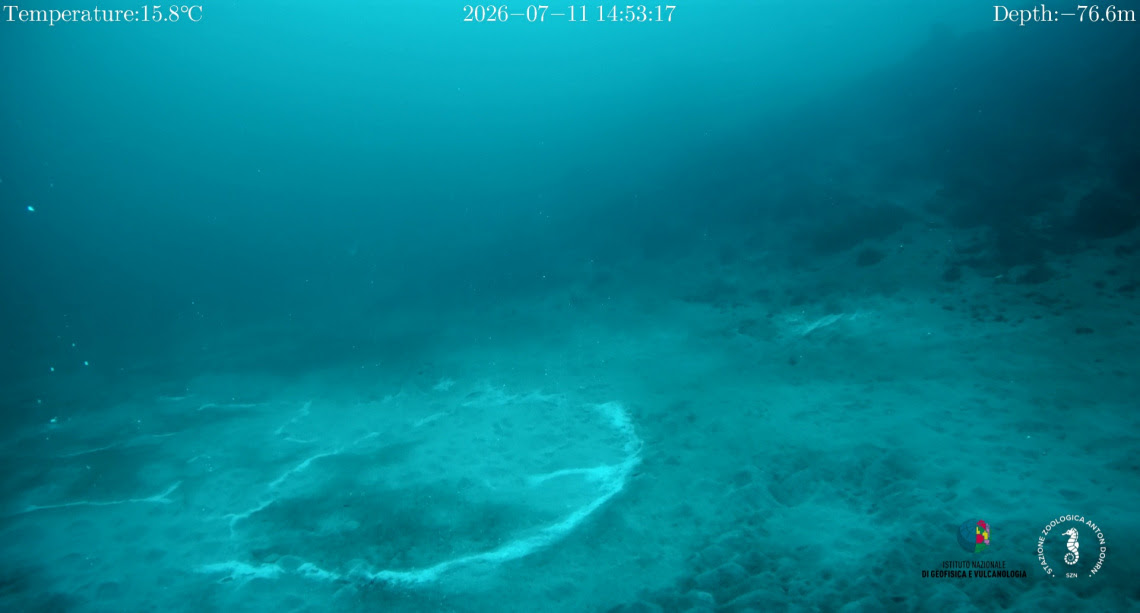
Emissions from the bottom and walls of the crater
The ROV images not only witnessed geological activity, but also offered a novel look at deep sea ecosystems. In the chimney areas, characterized by less hydrothermal activity, one was observed rich benthic communitydominated by green macroalgae of the Udoteaceae family and colonies of the gorgonian Eunicella singularis, an environment reminiscent of the nearby “Smoking Land” area discovered in 2015. On the contrary, in the crater, where degassing is much more intense, the seabed is almost entirely covered by extensive bacterial mats associated with hydrothermal emissions, with an almost total absence of macroalgae and sessile organisms. This clear difference suggests a significant influence of the hydrothermal activity gradient on the distribution of biological communities.
The discovery of this area opens up new scenarios that will be able to give us information on the biodiversity of these complex ecosystems which, given their extension, represent natural laboratories for studying climate change and the adaptations of organisms. The synergy between volcanological and biological and ecological expertise allows a complete interpretation of the energetic complexity of the system,
explained Teresa Romeo, director of the Anton Dohrn Sicily-Calabria Zoological Station.
Future prospects for a sea to be protected
This discovery is not only a scientific achievement, but a starting point for future research campaigns. From a geological-structural point of view, the new area is located along a known tectonic direction (north-east/south-west) that connects Panarea to Basiluzzo, confirming how this structure is a preferential route for hydrothermal circulation and the rise of deep gases. Antonio Paonita, director of the Palermo section of the INGV, underlined how this evidence is the fruit of a long tradition of research and development of innovative technologies for the monitoring and modeling of deep processes.
Understanding these complex hydrothermal systems is crucial not only to update volcanic hazard scenarios, but also to protect the extraordinary biodiversity of deep marine ecosystems. The synergy between geology and biology, highlighted by this research, will allow us to better evaluate risks and simulate future scenarios, offering valuable tools for the protection of our natural heritage. The protection of these unique habitats is a priority for GreenMe and the entire scientific and environmental community.
