
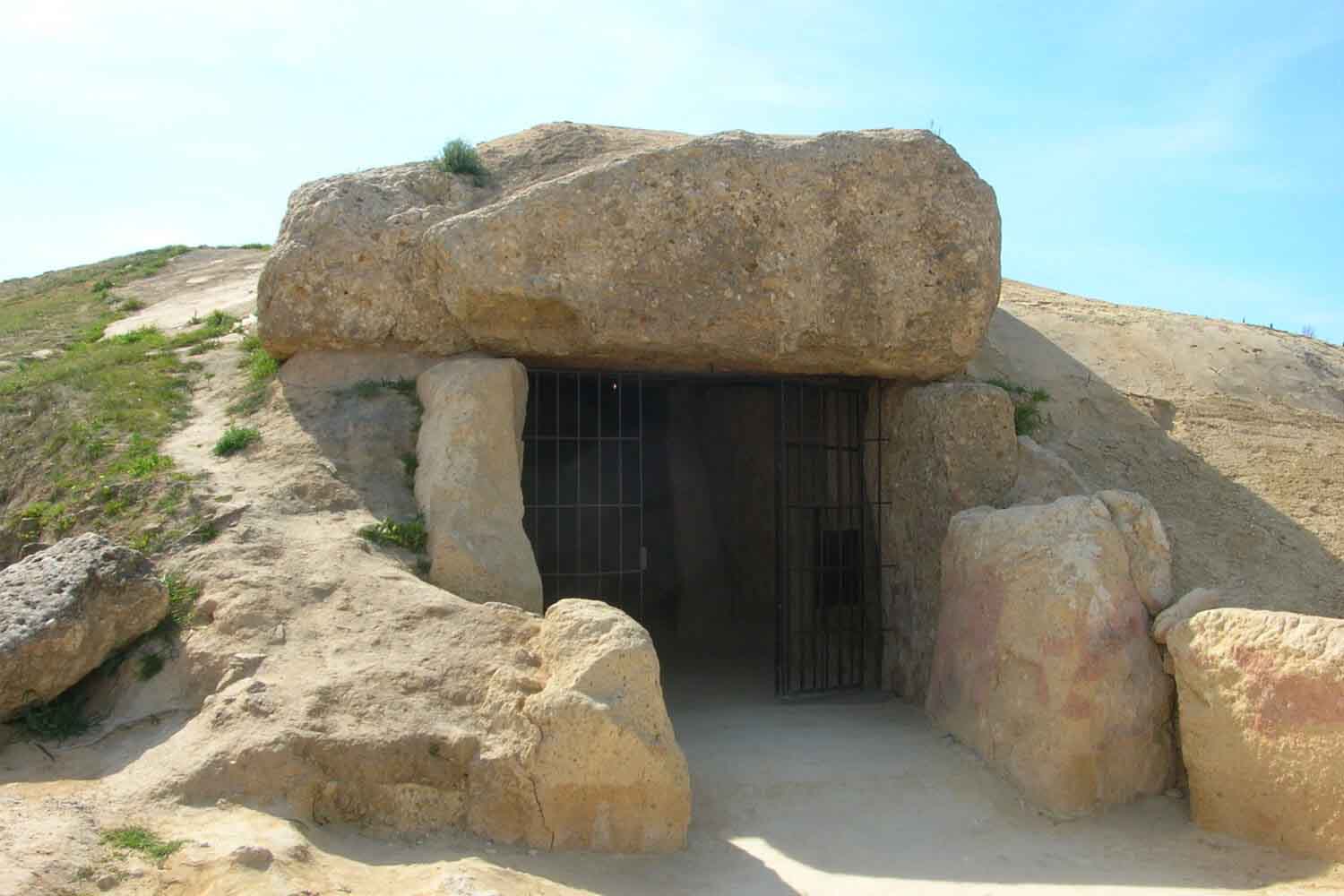
They placed five enormous slabs on top of walls already embedded in the rock. One weighed approx 150 tons. Then, with the roof now closed over their heads, they began to remove the soil and substrate remaining in the chamber. The Menga dolmen, built almost 6,000 years ago near Antequera, in southern Spain, was born following an order that today would seem reversed: first the shell, then the internal space.
We had already talked about the monument in 2023, when a geological study had identified the probable origin of the stones and reconstructed part of their journey from the quarry to the construction site. Those analyzes showed a choice that was anything but random: rocks soft enough to be worked, a quarry located higher up and a downhill route about a kilometer long.
Subsequent research, published in 2024 on Science Advancesadded the missing piece: the probable sequence with which the 32 structural stones were arranged, fitted and covered. It doesn’t just tell how huge blocks were moved. It shows how weight, slope and the rock itself were used to avoid lifting them more than necessary.
The walls descended meters into the rock
The builders dug a large foundation area into the substrate and lowered vertical stones, called orthostats, into it. About a third of some blocks remained below the level of the final floor, squeezed into deep cavities carved into the rock.
The shape of the foundations suggests that the orthostats were lowered gradually using ramps, ropes, wooden structures and counterweights. It is a reconstruction: wood and ropes have disappeared for millennia. However, the depths of the chambers, the angles of the stones and the way in which they touch each other retain traces of the process.
Placing the walls this deep had at least two advantages. It guaranteed a stable base and allowed the work surface to be left still high, almost at the same level on which the roof sheets would have been dragged. The mountain, in practice, temporarily acted as a floor and scaffolding.
The room narrows towards the ceiling
The walls of Menga appear vertical, but they are not. The orthostats were shaped and placed with a slight inward tilt, generally around 84-85 degrees. The chamber is therefore narrower at the top than the base.
This measure reduced the distance that the roof stones had to cover, a crucial detail when working with slabs that are both large and fragile. The lateral edges were also adapted to rest on neighboring blocks: each stone helped to hold the next, forming a connected structure rather than a simple row of independent boulders. Three central pillars helped support the roof.
The largest plate, called C-5, weighs according to estimates 149.6 tons. It is the heaviest stone known among those used as a covering in a Neolithic dolmen. The entire monument reaches an estimated weight of approximately 1,140 tons. Menga was built between 3800 and 3600 BC, over a thousand years before the famous phase of the large stones of Stonehenge, dated around 2500 BC.
The roof came before the floor
After walls and pillars, the builders dragged the roofing slabs over the structure, probably proceeding from the entrance towards the bottom. The soil still present in the chamber allowed the sleds to advance without having to hoist the stones to their final height.
Once each slab was in place, some of the underlying material was removed to recover the slide and lower the block into its intended position. Only after completing the roof was the rest of the chamber excavated to the current floor level. The mound was finally built above the monument, made up of earth and stones arranged to increase stability and limit water infiltration.
The water posed a real risk. The calcarenites chosen for Menga were relatively easy to work, but porous and vulnerable to fracture. The mound therefore also functioned as protection for a material capable of supporting a colossal weight, as long as it was kept away from humidity and incorrect stresses. A 150-ton roof needed attention. Just much less frequent than many modern buildings require.
The authors of the study call this combination of geology, geometry, friction and weight distribution a form of “early science”. There are no plans drawn or texts left by the builders. The precision of the joints, however, shows a practical knowledge capable of holding together over a thousand tons for almost sixty centuries.
In the Middle Ages someone chose to return there
The history of Menga continued well beyond the Neolithic. A study published in 2026 on Journal of Archaeological Science: Reports examined the burials of two adult men located in the atrium of the dolmen between the 8th and 11th centuries AD. At the time, the monument was already around 4,000 years old.
The bodies had been arranged following the central axis of the building, a sign that the position inside Menga had been chosen carefully. The DNA was highly degraded and only one of the two individuals provided sufficient data: his profile included Iberian, North African and eastern Mediterranean-related ancestral components, compatible with the complex history of medieval Spain. Genetics does not allow us to establish the religion of the two men nor the precise reason for the burial.
However, it shows that the dolmen continued to attract people long after the community that had built it had disappeared. Its meaning could change, be forgotten and then recomposed. The stones stood still long enough to offer each era an ancient monument to interpret in its own way.
