
For years we have thought that the consciousness it was a kind of trademark of human beings. Something that there distinguishes from anything that flies, crawls, swims or pecks. A sort of mental superpower that makes us “special“And yet, the more science advances, the more that presumed uniqueness loses pieces. It’s like finding yourself in front of a cracked mirror: you keep looking at yourself, but the reflected image is no longer so different from what you see moving out there, among feathers, claws and little paws.
At the Ruhr University Bochum, a group of philosophers and neuroscientists have begun to dismantle the idea that consciousness originated with man. If anything, it could be the opposite: we could be the last arrivals on a very long road traveled by much older creatureswho have learned to manage danger, to interpret the signals of the world and, in some cases, even to recognize themselves in a mirror.
From the primordial spark to the mirrors of crows
Two scholars, Albert Newen And Carlos Montemayorhave proposed a model that they define ALARM: a name that gives a good idea. Consciousness, in their vision, does not appear as a mystical revelation, but it grows gradually. At the beginning there is the simple reaction to danger, that internal bell that makes you run away when something is wrong. It’s a type of awareness that doesn’t need large frontal lobes: all you need is a basic brain, the kind of structure also present in animals we consider “simple.”
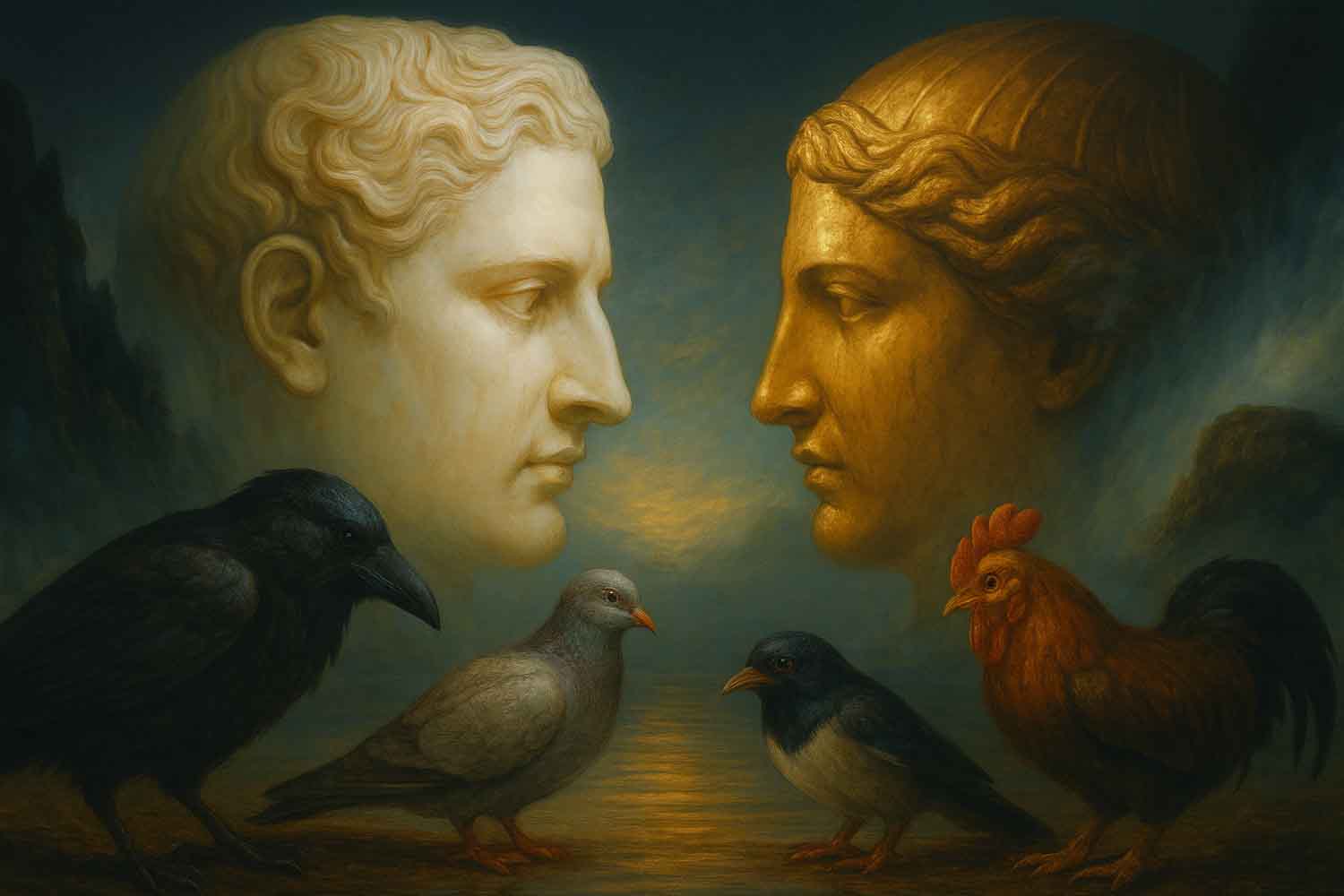
From that first level we move on to ability to focus on what really matterssuch as associating smoke with fire or distinguishing a signal in the midst of chaos. Only afterwards comes the part that we like to talk about so much: self-awareness, the gaze that turns inward. The one that makes us say “I am me”. But it is not an exclusive competence. Chimpanzees have it, dolphins too, and even some magpies seem to recognize themselves in the mirror. And this is where the birds. With an almost irritating naturalness, they disprove everything we thought we knew.
THE pigeonsfor example, observe the same image and interpret it in two different ways, alternating responses as if reality were an opinion and not a fact. It’s a behavior that, until now, we only associated with mammals with much more complex brains. THE crows they go further. If they have to decide whether a dim light has appeared or not, their neurons record the decision, not the actual stimulus. It’s a form of subjective experience: they’re not just seeing something, they’re interpreting what they see.
Even i roosterswith their tough air, have an interesting relationship with mirrors. If a predator appears, they alert their community, but in front of their own reflection they remain silent. They don’t mistake him for another individual. It is as if they understand that that shape is not “another”, even if it does not necessarily mean that they recognize themselves as individuals.
These behaviors force science to change its tone. Consciousness does not depend on a large brain, but on how it is wired. And the birds, with their NCL, a hyperconnected nerve centerpossess all the necessary conditions to give life to complex and surprising forms of awareness.
In the end, the picture that emerges is very different from what we told ourselves. Consciousness is not the final jewel of human evolution, but an ancient mosaicbuilt piece by piece. A mechanism that animals have modeled in different ways, exploiting what they had available.
It is fascinating to think that that inner flash that makes us say “I am here” could have been born long before us. And that today we find it in the silences of the roosters, in the hesitations of the crows, in the doubts of the pigeons. Creatures that perhaps don’t speak our language, but have their own way of inhabiting the world. And perhaps, even to understand it.
