
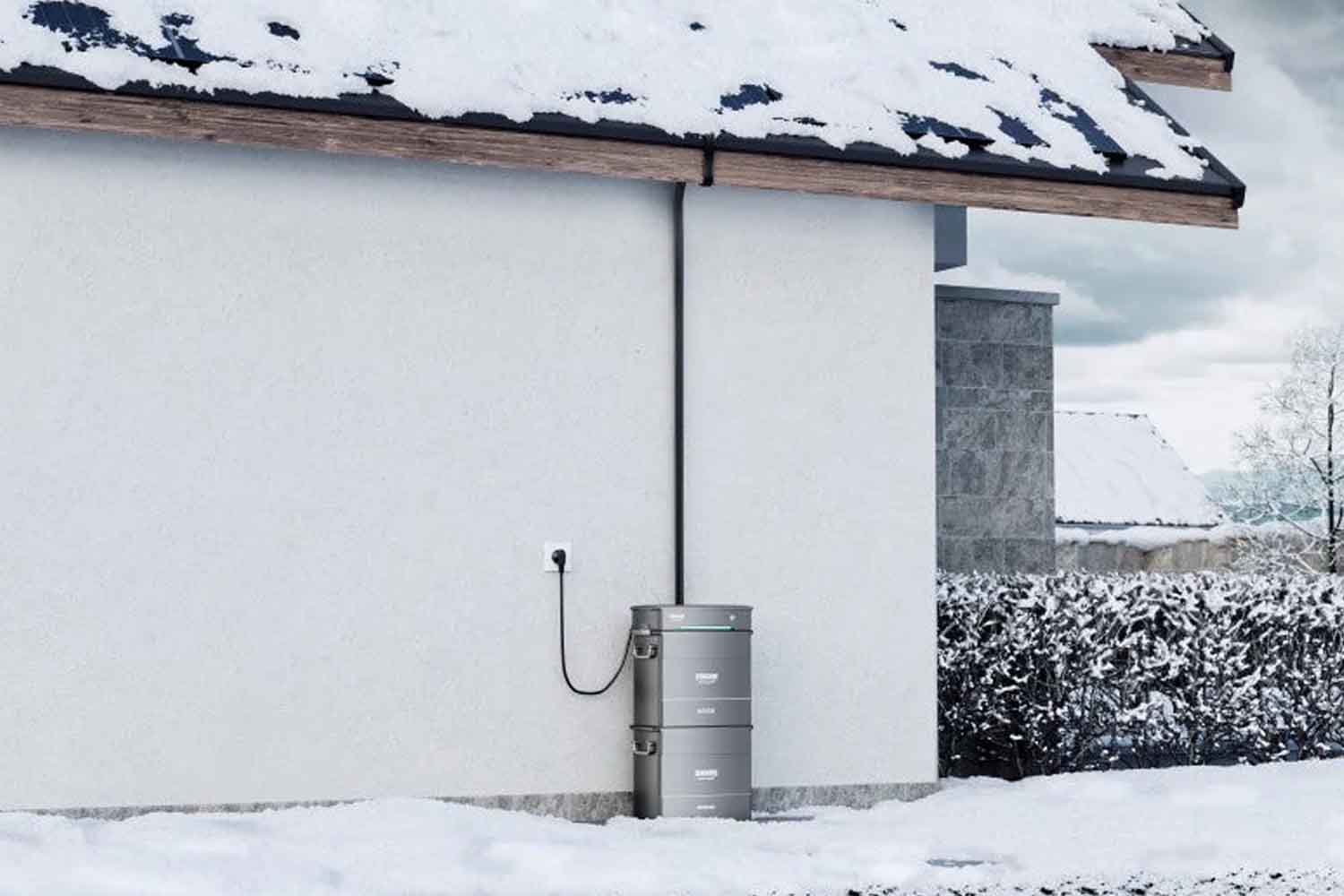
When the sky turns gray and the air pinches our cheeks, we tighten the scarf. Home batteries, on the other hand, are tough. They are not delicate creatures, no, but they have a rather obvious Achilles’ heel: the cold. Every year, with the arrival of winter, the same questions also arrive. Will it get ruined? Will it lose capacity? Should I turn it off? And the truth is that yes, he suffers a little. And I don’t say this to scare you, but because knowing it helps you manage it.
In recent years, in Europe, the market for storage systems has exploded: by 2026 it is expected to reach 41.9 GWh of installed capacity, destined to exceed 118 GWh in 2029. In Germany, in 2023 alone, more than half a million families have chosen home storage to support their photovoltaic system. The trend is growing in Italy too, driven by the desire for energy autonomy and, increasingly, by a healthy instinct for sustainability.
The point is that if a home system works very well in spring and summer, winter changes a lot of cards on the table. And ignoring these changes can turn a valuable investment into a long series of headaches.
Because the home battery suffers from the cold much more than we think
Anyone who has a photovoltaic system knows the seasonal routine: in summer production soars, in winter it struggles. An 800 W panel, in the cold season, brings home between half a kWh and one and a half kWh per day, compared to the entire bright afternoons that August gets us used to.
For the battery it’s a double whammy: less energy input and internal chemistry that slows down. Below zero, capacity can halve in a few hours. It’s not a fault: it’s physics. Electrochemical reactions become slow like me on Monday morning.
The most serious risk, however, remains the deep discharge. It happens when too little energy comes in and the battery continues to do its job without receiving enough to compensate. It is the situation that, more than anything, wears her out. And it is not surprising that the first to raise an alarm, every year, are the users of the forums: percentages that do not increase, autonomy halved, systems that attach themselves to the network to survive. Nine times out of ten it’s not a defect: it’s the wrong environment, or a setting that needs adjusting.
What to do to protect your battery in winter
Italy is not Norway, it’s true. But the cold, in damp garages, in uninsulated cellars or on balconies in the wind, definitely arrives. And the batteries don’t care whether they are in Bologna or Cuneo: below zero they behave the same way. The first useful gesture is to choose the right place. A battery installed in a utility room, a dry garage or a frost-free cellar lives a simpler, longer and more stable life. Anyone who keeps it outside should think about an adequate enclosure, not to “pack it up”, but to protect it from humidity and wind. Technically, very little is needed: a stable temperature and no water.
Another important precaution is to avoid extremes. You don’t want to let your battery run down to the bone when it’s two degrees outside. Many inverters today allow you to set a minimum threshold below which you cannot go. It’s a gesture that makes the difference: it doesn’t just protect her from the cold, but from herself.
When winter gets serious, it may make sense to partially recharge it from the mains, at least on the darkest days. It’s not a defeat: it’s a way to preserve the health of the storage and not find ourselves in March with half the capacity. Maintenance, then, is much simpler than it seems. Every now and then a check is enough: no condensation on the container, no loose cables, no anomalous charging behavior. Small rituals that avoid major traumas.
Finally, there is the “smart” side: more and more systems know how to self-regulate, manage gentler cycles, prevent overdischarge, or even fish from the grid when the photovoltaic is asleep. It’s the part of winter we like best: the part where technology does the heavy lifting while we just keep an eye on it.
You might also be interested in:
