
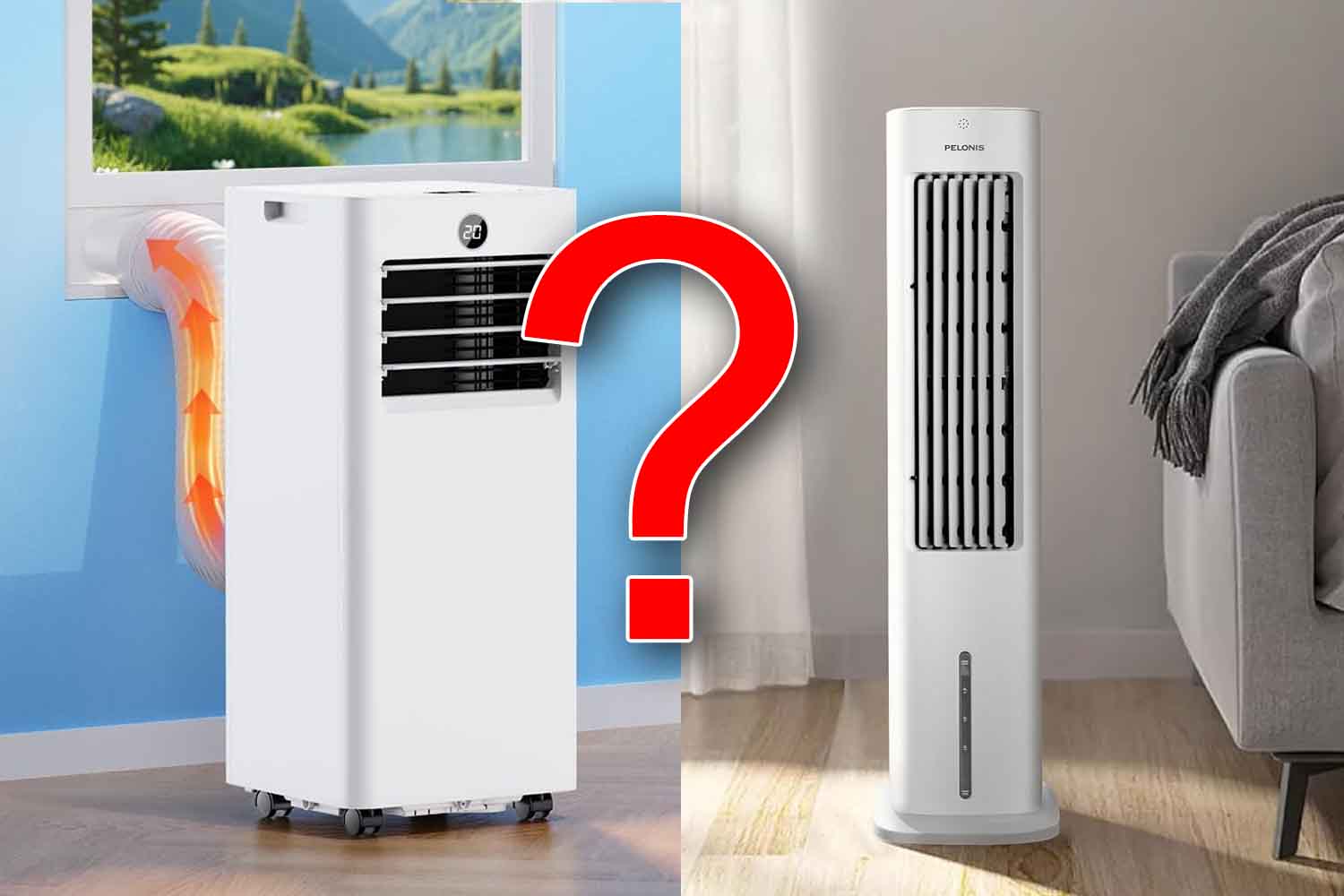
When the heat enters the house, it does so with a certain arrogance. It places itself on the sofa, climbs through the shutters, remains stuck to the sheets and transforms the fan into a spoon that spins warm air. At that point the thought runs there: buy a portable air conditioner, perhaps immediately, perhaps without installation, perhaps without piercing walls or calling technicians at the exact moment in which half the city had the same idea.
Then the confusion begins. Online you can find portable air conditioners with tubes, appliances without tubes, water coolers, mini air conditioners, evaporative fans, promises of very cool rooms and images of living rooms that seem to have come out of an advertisement filmed in Iceland. The difference, however, lies in a very concrete question: where does the heat removed from the room go?
A portable hose air conditioner is a real air conditioner. It uses a refrigeration circuit, cools the internal air and discharges the heat through the pipe connected to the window. That bulky tube, ugly to look at and always a little awkward to arrange, is precisely the part that allows the machine to do its job.
An appliance sold as a portable tubeless air conditioner, in most cases, instead belongs to another category: it is an evaporative cooler. Use water, fan and sometimes ice to give a feeling of cooler air. It consumes much less, costs less, can be moved easily, but it doesn’t work like an air conditioner. It adds humidity to the environment and above all offers localized relief, useful if the airflow reaches close to the body.
The tube is used to throw the heat out
The portable air conditioner with tube has a simple logic: it takes heat from the room and expels it outside. For this reason it works better with the door closed, the window sealed with a suitable kit and the shutters lowered during the hottest hours. If the tube remains inserted in a half-open window, with half a crack open towards the outside, some of the hot air returns and the appliance works worse. Result: more noise, more consumption, less cool.
Horsepower is often measured in BTUs. For a small or medium-sized room, a 9000 BTU model may be sufficient, while for larger rooms, very exposed to the sun or attics, it goes up to 12000 BTU. The choice must be made by looking at the square footage, exposure, insulation, the presence of large windows and the number of people who use the environment. A sunny room at three in the afternoon requires much more effort than a shaded room.
On the energy label of air conditioners you need to read some data before the price: consumption for 60 minutes of operation, nominal power, noise level in decibels and EER value, i.e. the index that indicates the relationship between cooling capacity and energy absorbed. The higher the EER, the better the efficiency of the appliance. ENEA explains that the air conditioner label shows these elements, including the consumption in kWh for one hour of operation in the indicated mode.
In everyday life, a portable tube air conditioner can absorb approximately 0.8 to over 1 kWh per hour, depending on the model and conditions of use. To understand how much it costs in your bill, simply multiply the hourly consumption indicated on the label by the hours of use and the cost of your kWh. An appliance that consumes 1 kWh per hour, turned on four hours a day, brings about 4 kWh per day. The difference is made by the settings: expecting 20 degrees in a hot room means asking the machine for a marathon, with all due respect to the bill.
Portable Air Conditioner 7000BTU, 4 IN 1 Portable Air Conditioner with Silent Cooling, Ventilation, Dehumidification, 24H Timer, Low Consumption, Installation Kit, for Home Office Rooms
The tubeless cools the air around you, not the room
The evaporative cooler has another job. The air passes through a wet filter or water system, the evaporation absorbs some heat, and the fan returns a cooler draft. In a dry environment it can provide relief, especially near the desk, bed or sofa. In a humid city, during a muggy evening, it risks making the air heavier.
Evaporative coolers are especially suitable in hot and dry climates, because they add humidity to the air and cool less than a real air conditioner. In very dry inland areas they may make sense. In many cities on the plains or along the coast, with already high humidity, the benefit can become modest and at times annoying.
The advantage remains in consumption. Many tubeless air coolers draw a few dozen watts, often less than 100 W. A much lower electrical expense than a portable air conditioner. But the comparison must be made honestly: they consume less because they make less. They are useful as an alternative to the fan, with a more pleasant current, water to top up and filters to clean. To really lower the temperature of a closed room, you need an air conditioner that discharges heat to the outside.
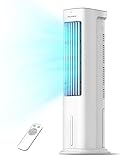
PELONIS Evaporation Air Cooler, Mobile Air Conditioner, 5L with Remote Control, 355m³/h, Without Exhaust Pipe
Consumption and bills: where the game is played
The consumption of the portable air conditioner depends on the power, efficiency, the set temperature and how well the house retains the coolness. ENEA, in its smart guide to summer air conditioning, invites you to go step by step, first favoring the simplest and most economical solutions to reduce the heat in the home: screening the windows, ventilating during the coolest hours, limiting internal heat gains, using ventilation and dehumidification well. The guide is available here: ENEA advice for summer air conditioning.
The dehumidification function deserves attention. Sometimes the biggest problem is not just the temperature, but the humidity which makes the heat feel more oppressive. An air conditioner that dehumidifies well can provide comfort even without setting low temperatures. Turning it down a few degrees and removing humidity is often enough to sleep better or work without feeling like you’re melting into your chair.
The European Commission reminds you that eco-design requirements, minimum energy performance, noise limits and product information apply to air conditioners and fans sold in the EU: the price on the tag tells only part of the story. Noise, hourly consumption, efficiency and cooling capacity weigh every day, especially if the appliance remains on for many hours.
Which one is best to buy
The portable air conditioner with tube is convenient when you really need to cool a room and a fixed split cannot be installed. It is the most sensible choice for a bedroom, a smart working study, a small or medium living room to be made livable in the worst hours. Before purchasing, it is best to check the power suitable for the room, consumption in kWh for 60 minutes, EER, noise and the presence of an effective window kit. A very powerful model with a poorly mounted hose can perform less than a smaller, carefully installed appliance.
The tubeless portable air conditioner, intended as an evaporative cooler, is convenient when the budget is small, the environment is quite dry and you are looking for relief close to the body. It’s good for those who want something cooler than a fan, with low consumption and no pipes in the window. It should be chosen knowing that it does not replace an air conditioner and that it requires water, cleaning and attention to humidity.
If the house is owned, the heat returns every summer with ferocious punctuality and the investment is possible, the fixed split inverter usually remains the most efficient and silent solution for regular use. The laptop with tube is a useful compromise, especially when renting or when work cannot be done. The hoseless cooler is a light aid. Three different objects, placed too often on the same shelf.
You might also be interested in:
