
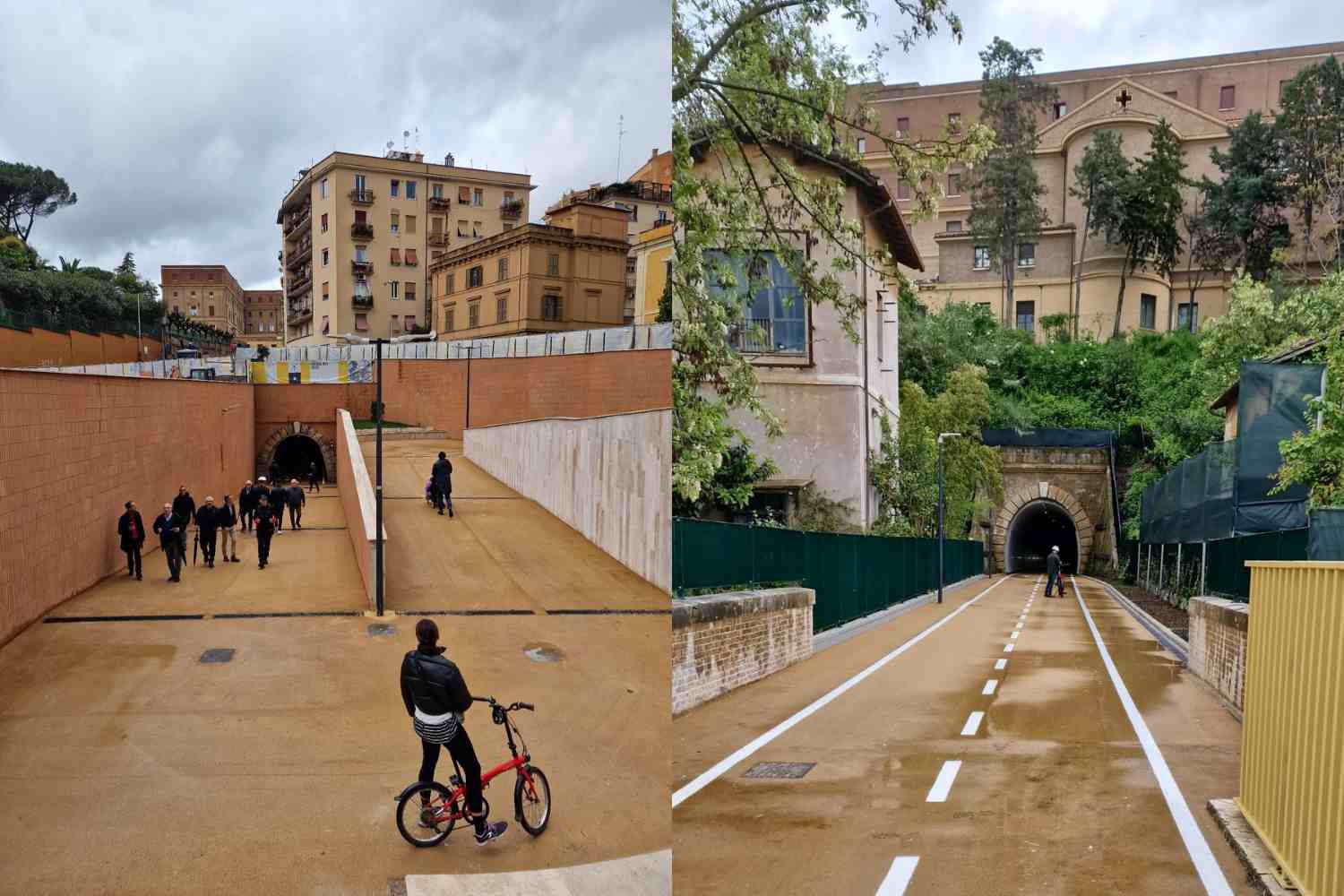
Rome wins a prestigious European recognition in the field of sustainable mobility. During the 12th edition of the European Greenways Awards, held in Bilbao, the Monte Ciocci – San Pietro cycle/pedestrian path won the Special Jury Prize. Rome’s Mobility Councilor, Eugenio Patanè, was present to receive the award for the Capital.
The route was awarded for being an “Example of sustainability and collaboration between entities” and for its ability to redevelop the urban heritage. The infrastructure, designed and built by Rete Ferroviaria Italiana (RFI, FS Group) at a cost of 6.5 million euros (Jubilee 2025 funds), was inaugurated last April and was included among the essential and non-deferrable interventions for the 2025 Jubilee.
Reuse and connections
The awarding of the prize was motivated by the innovative use of existing structures. The jury recognized the merit of having used “an old railway bridge and a tunnel, both part of the disused Rome-Viterbo railway line, to create safe access to the Vatican”. This choice guarantees a new and safe official terminus of the Via Francigena, both for pilgrims and for the local community and cycle tourists.
Councilor Patanè commented on the recognition, highlighting that the project represents a model of “regeneration of an urban heritage and collaboration between public bodies”. The work was able to make the most of an extraordinary opportunity not only for the jubilee event, but above all to improve the daily mobility of citizens.
A path that mends the territory
1.2 kilometers long, the track starts from Monte Ciocci and, through the Fornaci viaduct and the historic tunnel of Villa Alberici (undergoing consolidation and redevelopment), reaches San Pietro. A stretch of 1.2 km which, joining the 5 km already existing between Monte Mario and Monte Ciocci, brings the overall length of the route to around 8 kilometers of gentle mobility.
The value of the route, as well as landscape, naturalistic and historical, lies in its function of “reuniting” pieces of territory that were previously distant due to connecting fractures. Patanè underlined that it is a “new path that allows you to combine different means of transport to make a leap in quality in active and sustainable mobility”.
In practical terms, the cycle path connects directly with the Passeggiata del Gelsomino and offers a fundamental connection with Via Anastasio II and the Valle Aurelia station of the A metro line and the San Pietro Vaticano station. This intermodality promotes the use of bicycles for home-work trips and to reach the city center, improving sustainable mobility at the service of commuters, citizens and arriving pilgrims.
