
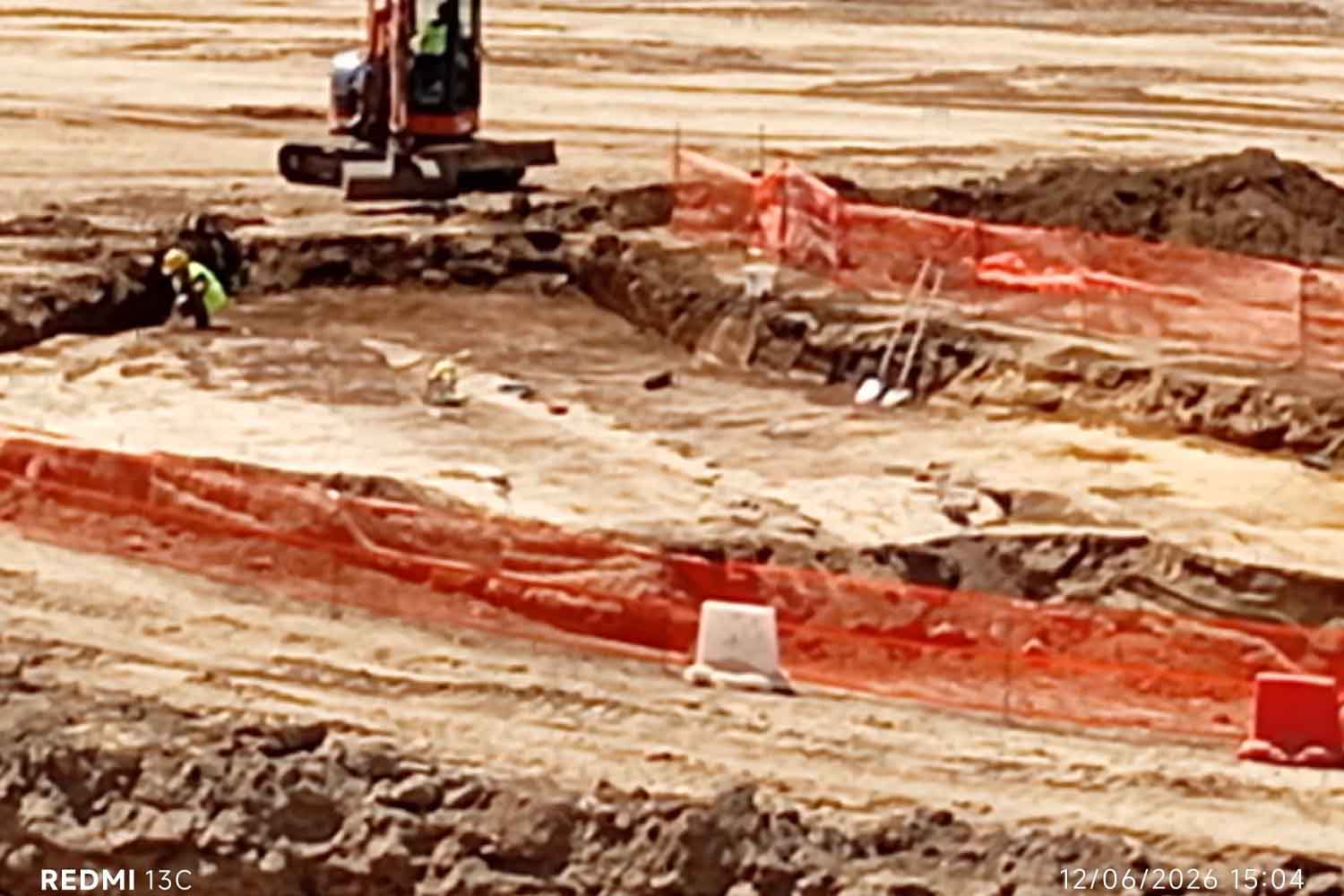
In the construction site of the new waste-to-energy plant in Romein Santa Palomba, a portion of paved road has emerged. The discovery occurred on Wednesday 10 June during excavation operations, in the presence of the archaeologist in charge of supervision. Roma Capitale confirmed the discovery, explaining that cleaning activities have been carried out in the area to allow the surveys to be carried out and that the Special Superintendency of Rome for Archaeology, Fine Arts and Landscape has carried out an inspection.
While awaiting decisions and any requirements, the works are temporarily suspended at the point concerned. The administration speaks of a “very limited and perimeter” area, but the discovery has rekindled the concerns of the committees that have been contesting the work for months and asking for greater guarantees on the archaeological and environmental protection of the site.
The discovery comes less than a month after the start of work on the waste-to-energy plant, which started on 15 May 2026. The plant, according to Campidoglio, will have to treat 600 thousand tons per year of undifferentiated and non-recyclable waste, with an expected investment of around one billion euros. For Roma Capitale it is one of the central infrastructures to close the capital’s waste cycle. For those who oppose the project, however, Santa Palomba remains an area to be protected also for its possible historical and naturalistic value.
The second reported section
The news of the first discovery was also relaunched byUnion of Committees against the incineratorwhich in a post published on its channels talks about a Roman road that emerged “in the center of the AMA site”. According to activists, the discovery would confirm the need to stop the construction site and proceed with more in-depth checks before authorizing new works in the area.
On June 15, on the first day of the indefinite surveillance in front of the construction site, the committees released a new update: according to their reconstruction, a second section of the paved road close to Casale della Massimetta. The two segments, they argue, would present the same orientation. Again according to the Union of Committees, this second discovery would indicate that the excavations carried out in the previous weeks would have affected approximately 200 meters of ancient road. At the moment, this is a complaint from activists, which requires official checks by the competent bodies.
In the second statement, the committees speak of archaeological damage which, in their opinion, could have been avoided if the previous reports had been taken into consideration. For this reason they are asking for the assessment of responsibilities and the suspension of work on the entire construction site, not only in the point already affected by the first temporary stop.
The complaints and the request for protection
The activists recall that they have already presented a complaint to the Minister of Culture Alessandro Giuli and claim to have delivered a second one after the new update. According to what was reported by the committee, the complaint was also forwarded for information to the President of the Republic and the Prime Minister, with the request to intervene to avoid further damage to the archaeological heritage.
At the center of the concerns is the continuation of activities on the site. The committees speak of an intense passage of trucks and excavations which, according to them, are continuing despite the discovery. Official clarifications are also needed on this point: the note from Roma Capitale in fact speaks of a temporary suspension at the point of discovery, while at the moment there is no general blockade of the entire construction site.
The committees’ request goes beyond the single stretch of paving. For months the Union against the incinerator has been relaunching the proposal to build an incinerator in Santa Palomba archaeological-naturalistic park dedicated to Ettore Ronconitransforming the area into a space for protection and valorization instead of an industrial hub for waste treatment. At the moment, it is a political and territorial proposal, not an approved administrative act.
An already contested construction site
The waste-to-energy plant project was awarded to the group led by Acea Ambiente with Suez Italy, Kanadevia Inova, Vianini Lavori and RMB. The RenewRome company will operate the plant for 33 years. Alongside the industrial part, the project also includes an area called Circular Economy Park, with spaces for research, coworking, greenhouse, public garden and panoramic tower.
Precisely this overlap between large infrastructure, agricultural territory, possible archaeological presences and civic opposition makes Santa Palomba a delicate case. The discovery of the paved road does not automatically lead to the blocking of the work, but requires an evaluation phase by the competent bodies. The Superintendency’s checks will establish which requirements to adopt and how to proceed at the point concerned.
For now there remain two elements to keep separate. The first is the official confirmation of a portion of paved road found during excavations, with temporary suspension of work in that area. The second is the complaint from the committees, which speak of a second stretch and a possible much more extensive loss. Before moving forward, we need public answers about what was found, how broad the archaeological context is, and what protections will apply. In a work of this size, even a few meters of paving cannot become a marginal note.
