
What we consider today to be bulky and difficult to dispose of waste could become one of the most interesting building materials of the future. In fact, a new type of light and safe insulation is born from disused mattresses, obtained thanks to the use of mushrooms. A solution that talks about circular economy, waste reduction and bio-innovation, perfectly in line with the values of those who dream of greener cities and more sustainable homes.
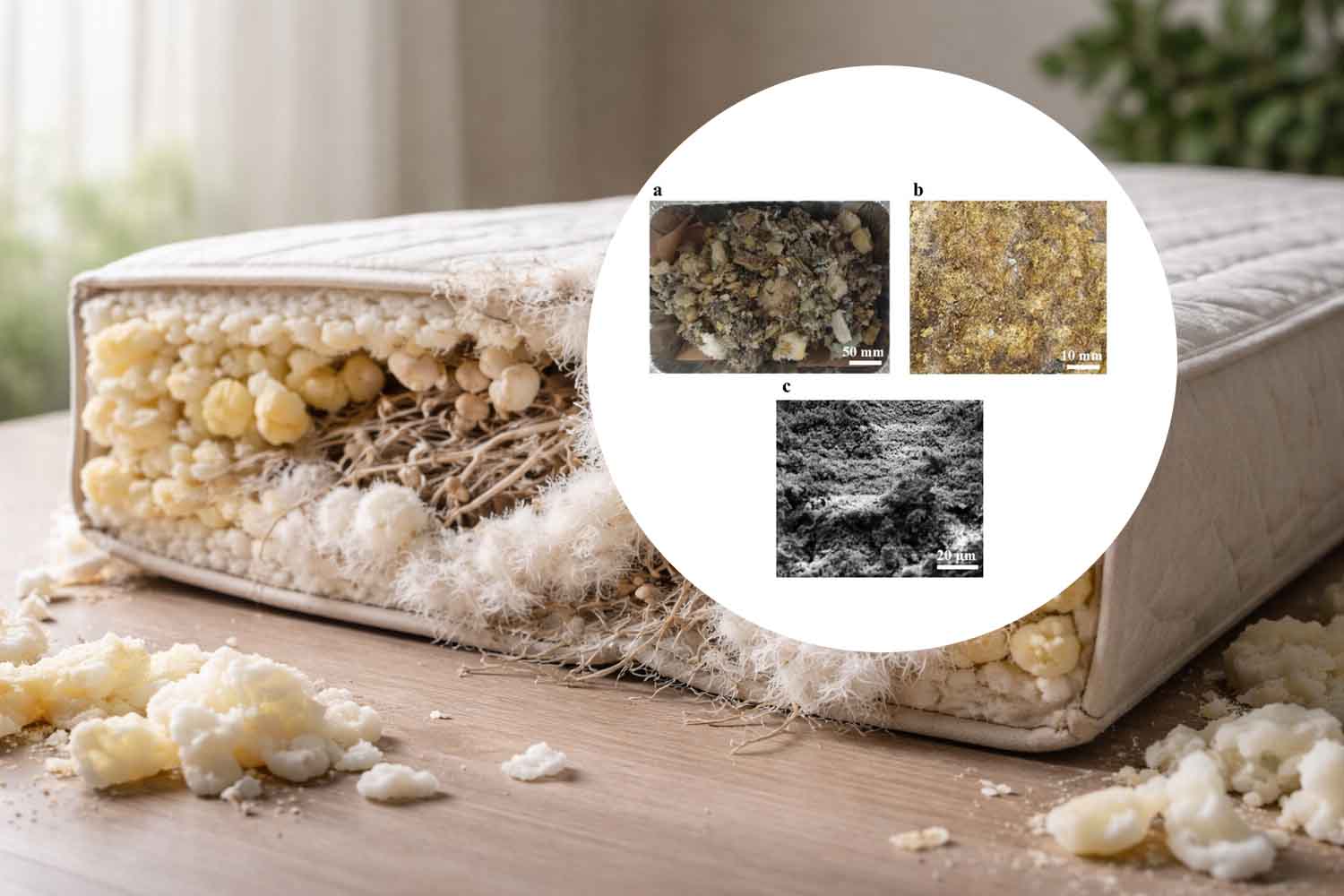
The discovery comes from Swinburne University of Technology, where a group of researchers experimented with a completely new way of recovering end-of-life mattresses. The heart of the project is the mycelium, or the root system of mushrooms, which is grown together with the foam of shredded mattresses.
During growth, the mycelium “embraces” the waste material and compacts it, creating a solid but surprisingly light bio-composite. The result is a natural insulating panel, which comes from waste and is transformed into a concrete resource for sustainable construction. The study was published in the scientific journal Scientific Reports, confirming the reliability of the results.
Why mattresses are a huge (and underestimated) environmental problem
Mattresses are among the most difficult household waste to recycle. They are bulky, made of different materials and designed to last many years. Precisely for this reason they often end up in landfill. In Australia, around 1.8 million are thrown away every year. Of these, as many as 740,000 are still disposed of without any recovery, generating around 22,000 tonnes of waste which can take up to 120 years to decompose.
Numbers that make you think and explain why finding alternative solutions can no longer be postponed. Giving these materials a second life means reducing landfill and reducing the environmental impact of an often ignored sector.
Amazing performance against heat and fire
The most interesting part concerns the performance of the new material. During growth, mycelium forms natural mineral compounds capable of resisting extreme temperatures. Laboratory tests have shown that the material remains stable even close to 1,000 °C, a fact that also opens up important scenarios in terms of fire resistance.
From a thermal insulation point of view, the performances are very similar to those of traditional insulating materials already used in homes. This means that we are not talking about a fascinating but unusable experiment, but rather about a solution that could really enter the construction market.
A natural, safe and industry-compatible process
Another fundamental aspect: safety. The mushrooms used are closely related to strains already used in the food and pharmaceutical industries. Furthermore, the process relies on common and widely used chemicals, reducing risks to health and the environment.
According to the researchers, this approach demonstrates how biology can dialogue with materials science, offering practical, low-impact solutions to complex environmental problems.
Looking ahead, there are many possible applications. This material could be used as lightweight insulation, fireproof insulation, building panels, or even 3D printing elements in the construction industry.
It is a concrete example of how the circular economy can stop being a slogan and become a real answer: less waste, less consumption of virgin resources and more intelligent solutions inspired by nature.
You might also be interested in:
