
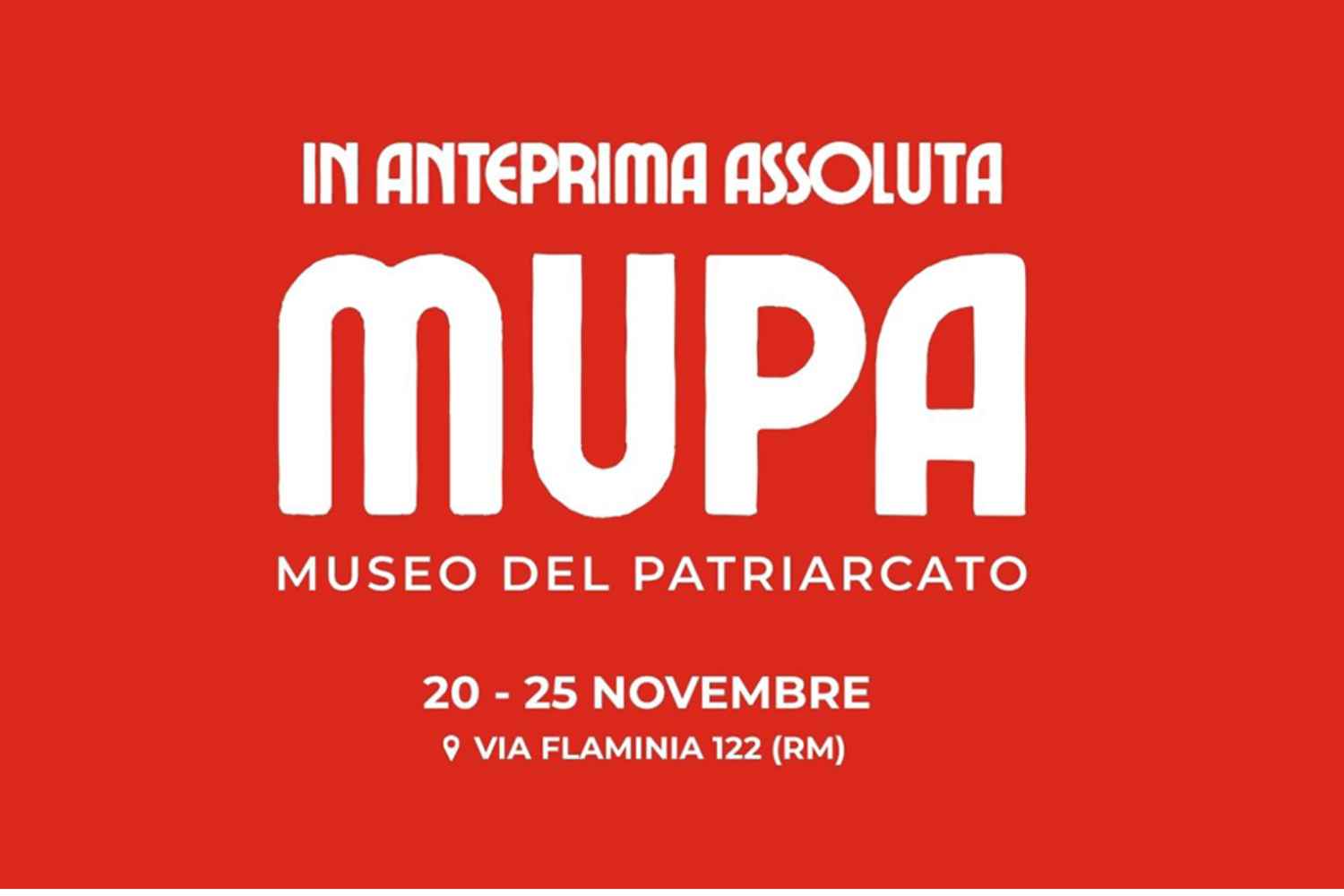
The MUPA – Museum of the Patriarchate opens in Rome in via Flaminia 122, an immersive project that invites the public to explore the cultural and social roots of patriarchal Italy between the 20th and 21st centuries. The exhibition does not limit itself to telling the past, but reconstructs with authentic finds, works and testimonies the daily life of a system of power based on gender discrimination, showing how stereotypes and violence are intertwined with family life, language and collective behaviour. It is an experience that transforms memory into awareness, with the aim of making patriarchy a definitively closed chapter.
A museum that becomes a space for reflection and participation
Hosted in the AlbumArte Space in Via Flaminia 122, the MUPA will be open to visitors until 25 November, on the occasion of the International Day for the Elimination of Violence against Women. More than a traditional exhibition, the project presents itself as a lively and participatory place: meetings, performances, laboratories and workshops will allow visitors to interact with the topics addressed and to reflect on the role that each can have in cultural change. Here is the complete program.
Patriarchal Italy under the lens: data and contradictions
The MUPA installation is intertwined with the results of the research “Why it doesn’t happen”, promoted by ActionAid, the Pavia Observatory and B2Research, which photographs the perception of violence and inequalities in the country. The data reveal a worrying picture: one in three men considers economic violence acceptable, and almost half of young men among Millennials and Gen Z consider it a justifiable practice.
25% of those interviewed justify verbal or psychological violence as a reaction to “female provocations”.
Control over one’s partner is also perceived as legitimate by 55% of Millennials, while physical violence is justified by almost two out of ten men. From the denial of the problem among Boomers to its normalization among younger people, a common thread emerges: the absence of effective primary prevention in Italian public policies.
A museum to change the collective mentality
The Patriarchate Museum is not just an exhibition: it is a political and cultural act. It tells of a past that must no longer be repeated, but also a present that requires concrete transformations.
In a country where gender inequalities continue to shape society, the MUPA becomes a place of awareness and responsibility, an invitation to overcome an anachronistic model and build a culture based on equality, respect and freedom of every person.
