
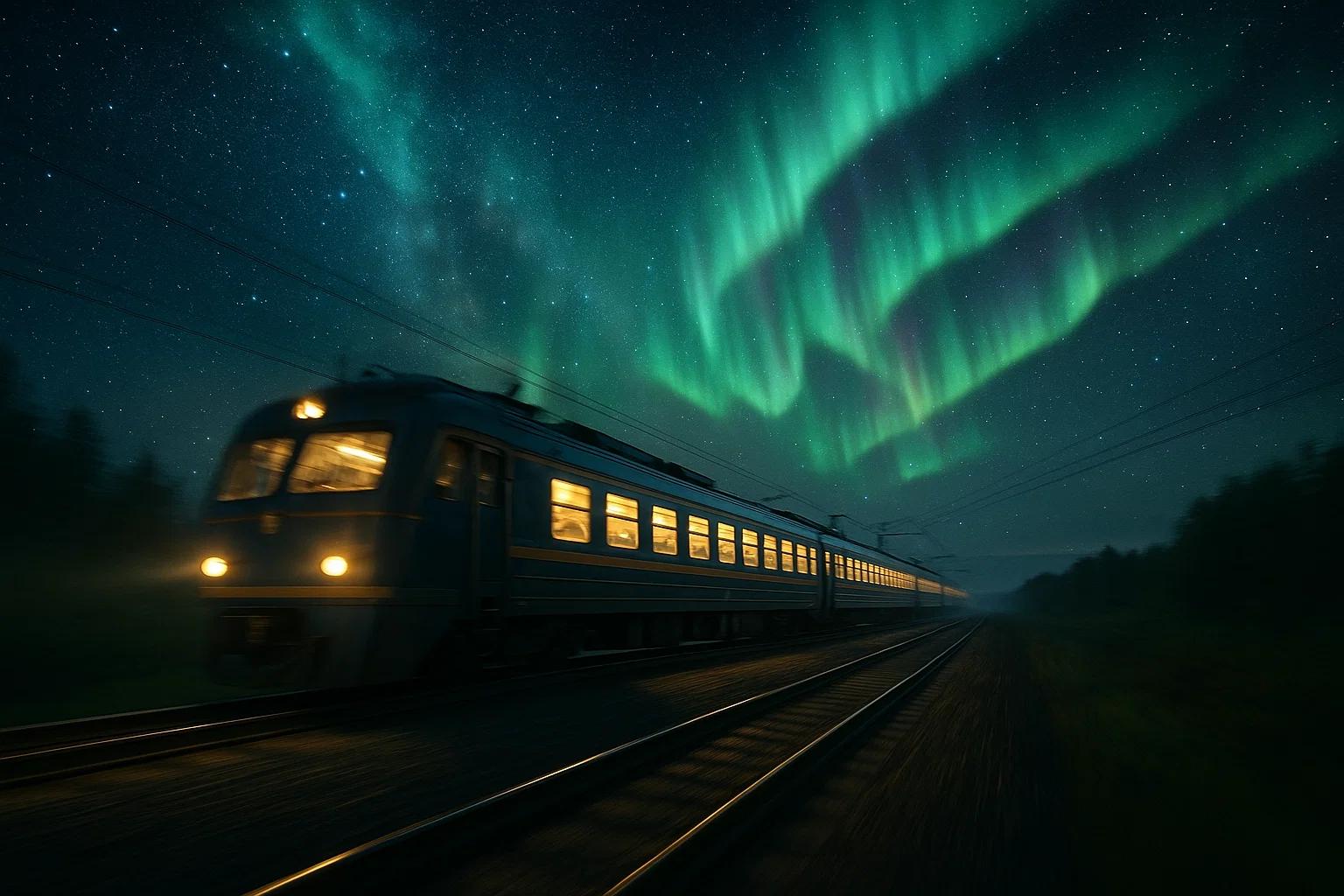
Norway raises the bar of experiential tourism with a project that combines engineering, sustainability and scientific dissemination: the first night train in the world designed exclusively for the observation of the Northern Lights. Not a simple means of transport, but a mobile observatory that crosses the Arctic regions during peaks of geomagnetic activity, offering passengers a privileged point of view on one of the most enigmatic natural phenomena on the planet.
Glass walls
The peculiarity of the train lies in its structure: carriages equipped with a roof and walls entirely made of glass, with reclining seats oriented upwards which allow you to keep your gaze fixed on the vault of heaven without interruptions. Internal lighting has been reduced to the bare minimum, a crucial technical choice to eliminate reflections on the glass and preserve the quality of observation. It’s a detail that makes the difference: in traditional means of transport, artificial light compromises night vision and creates annoying optical barriers.
The timing of the launch is not random. The eleven-year solar cycle is reaching its peak of activity between 2024 and 2026, a period in which solar storms and the resulting auroral manifestations reach particularly high intensities. The polar winter nights, with their prolonged darkness, provide the perfect canvas for this spectacle of charged particles and magnetic fields.
View this post on Instagram
Science in motion
What really sets this initiative apart is the integrated scientific component. During the journey, passengers are not passive spectators: sensors installed on the train monitor geomagnetic activity and cloud cover in real time, while a dedicated satellite connection transmits updated data on sky conditions. Information is processed and communicated through multimedia interfaces that explain the physical mechanisms underlying auroras: the flow of solar particles, the interaction with the Earth’s magnetosphere, the excitation of atoms in the upper atmosphere.
It is an approach that transforms the experience from simple contemplation to understanding. Passengers walk away from the trip not only with memorable photos, but with a new scientific awareness of what they observed.
The train is powered by wind and hydroelectric networks
Vygruppen, the Norwegian state company managing the project, has placed sustainability at the heart of the initiative. The train is powered entirely by the Norwegian energy network, characterized by a prevalence of hydroelectric and wind sources. At a time when Arctic tourism is under increasing pressure for its environmental impact, the choice of zero-emission technologies represents a clear message: it is possible to explore fragile ecosystems without compromising them.
The Arctic is experiencing a phase of growing tourist attractiveness, fueled by the desire to explore extreme environments and witness exceptional natural phenomena before climate change permanently alters its characteristics. Tromsø, already the informal capital of auroral observation with a 50% probability of sightings on winter nights, now becomes the fulcrum of an even more complex offer.
Beyond the journey
The project is part of a Norwegian tradition of tourist railway excellence, from the famous Bergen-Oslo lines to the spectacular Flåm Railway. But there is something more here: the answer to an emerging demand in contemporary tourism, that of immersive experiences where the journey itself becomes a moment of awareness and not a simple geographical movement.
The controlled environment of the train eliminates the climatic challenges of outdoor observation—polar temperatures, wind, the need for heavy equipment—without sacrificing the authenticity of the experience. It is a delicate balance between comfort and nature, technology and contemplation.
With this project, Norway does not limit itself to offering a new tourist service: it redefines the quality standards in naturalistic observation, demonstrating that technological innovation and environmental respect can coexist in an experience that educates while exciting.
