
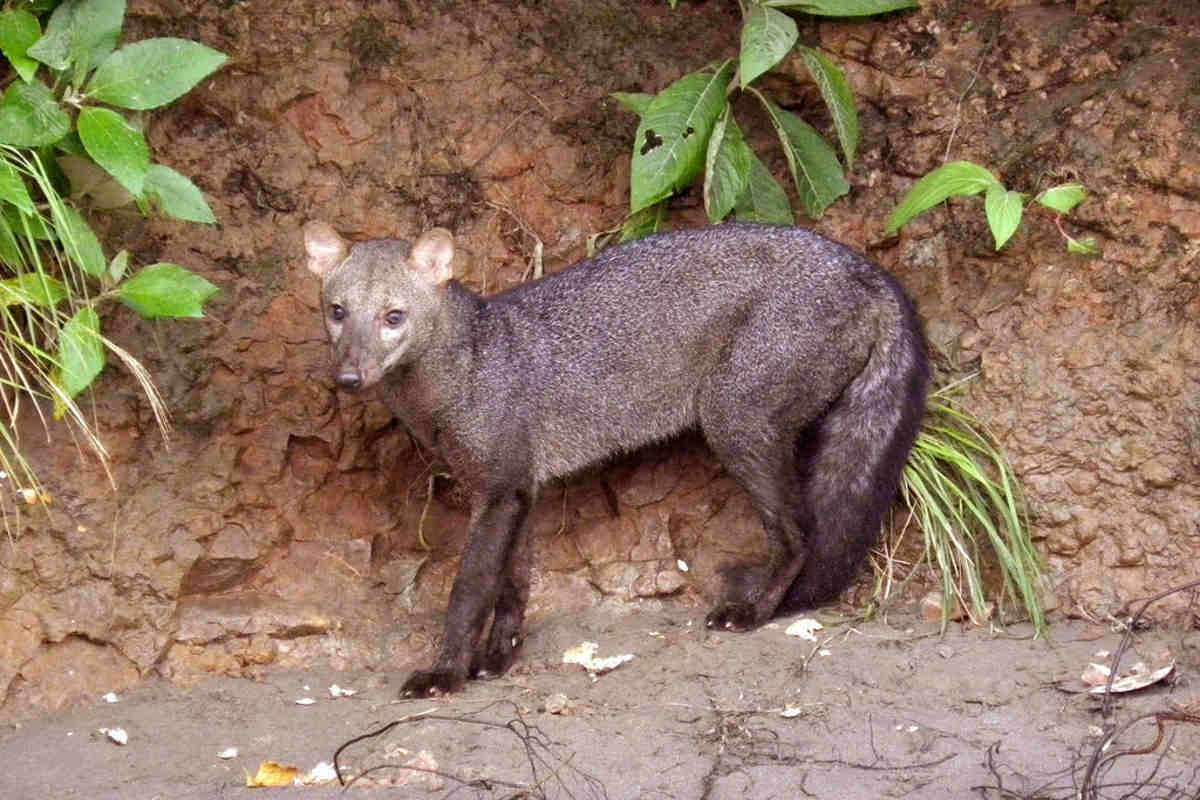
The myth of the invisible canid
For a long time, the inhabitants of the Amazon forests have told of a mysterious, almost invisible canid, a phantom presence capable of fueling local legends and even comparisons with mythological creatures such as the Chupacabra. This is Atelocynus microtis, known in Italian as atelocino or short-eared dog, a small predator that until recently remained shrouded in mystery due to its elusiveness.
The study: 25 years of camera traps between Bolivia and Peru
Today an analysis published in the journal Neotropical Biology and Conservation sheds new light on this species. The work, the result of a quarter of a century of field observations carried out between Bolivian and Peruvian territories (in particular in the Madidi-Tambopata and Llanos de Moxos areas), is based on 34 survey campaigns with camera traps which allowed almost 600 images of the animal to be collected. The results have disproved the idea of a rare species: the density found, equal to 15 specimens per 100 km², places the atelocine even above the jaguar in numerical terms, even if it remains less numerous than medium-sized carnivores such as the ocelot.
The portrait of the atelocine: webbed paws and sight in the dark
From a physical point of view, the animal has a medium-small build, with a body-tail length of up to about one meter, a height at the withers of around 35 cm and a weight of 9-10 kg, with females generally larger than males. The muzzle resembles that of a fox and the ears are short and rounded. The fur, thick and dark, varies between black, brown and dark gray on the back, lightening towards reddish shades on the belly. Two traits make it particular from an evolutionary point of view: a slight webbing between the fingers, useful in muddy environments, and a reflective layer behind the retina (the tapetum lucidum) which guarantees efficient vision even in the dark.
Diurnal, solitary and far from rivers: the surprising habits
The camera traps have also corrected a misconception about its habits: it is not a nocturnal animal as previously thought, but is mainly active during the day, with a peak between 6 and 12. It is a predominantly solitary hunter – rarely have two individuals been sighted together – who feeds mainly on small fauna (mammals, reptiles, amphibians, fish, birds, insects) supplementing their diet with fruit. Curiously, although its semi-webbed legs would suggest a connection with water, it prefers highland forests away from rivers: it is probably this choice of remote habitat that has made it so difficult to observe for so long.
A solid but not safe population
The authors of the study warn, however, that these encouraging numbers do not mean that the species is safe: its survival depends on the conservation of the Amazon forest, and for this reason they believe it is essential to strengthen protected areas and support models of sustainable development in indigenous territories, as a barrier to deforestation.
