
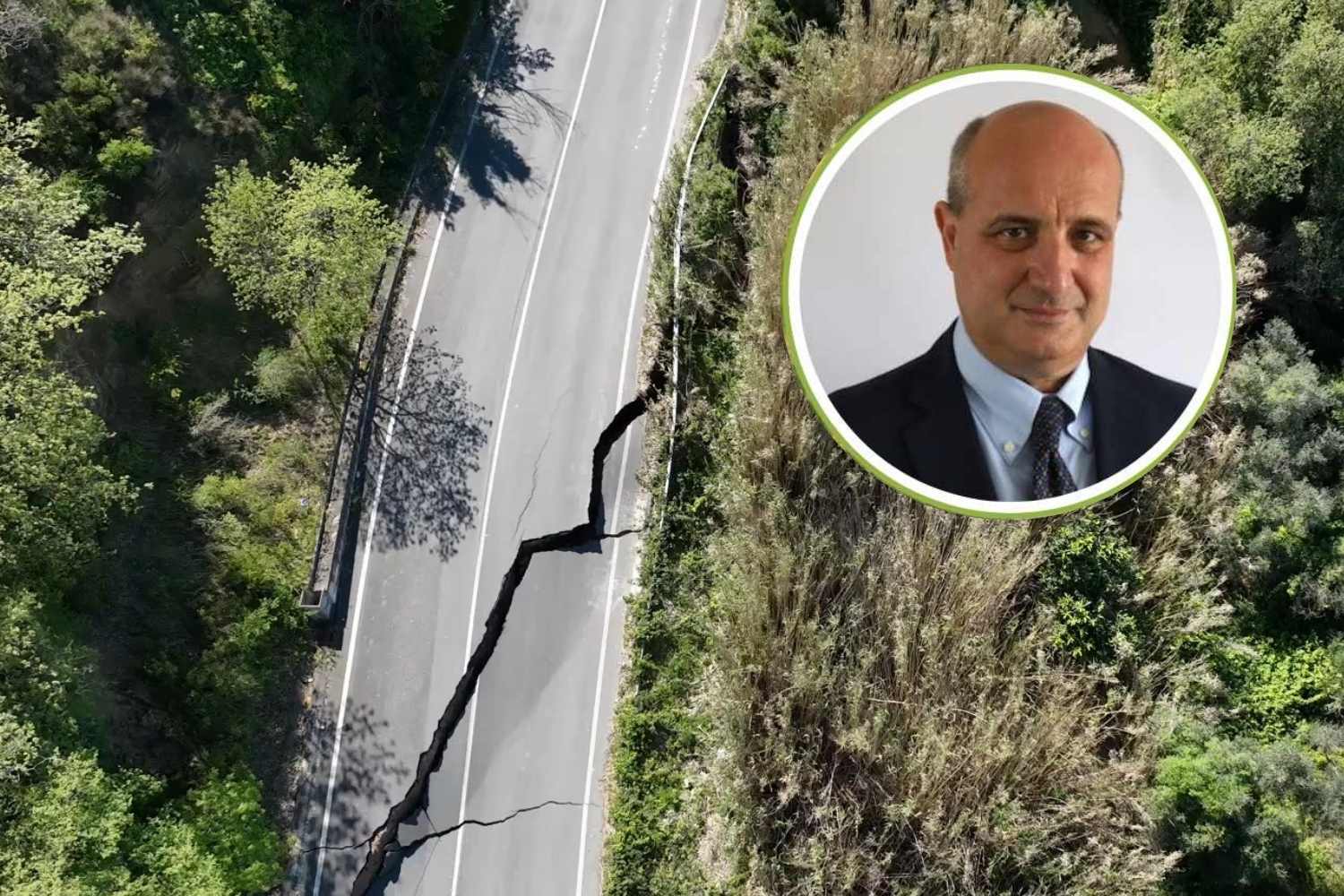
On the morning of 8 April 2026, Nicola Casagli was already in Molise. The day before, April 7, the historic Petacciato landslide had been reactivated after cyclone Erminio had dumped over 200 millimeters of rain on the area in a few days. In a few hours the A14 motorway was closed, the Adriatic railway line was interrupted – with the tracks misaligned by about ten centimeters – and some homes in the town were evacuated as a precaution. Casagli, professor of applied geology at the University of Florence and president of the National Institute of Oceanography and Experimental Geophysics (OGS), is one of Italy’s leading landslide experts. He told us what he saw.
#Landslide Petacciato, province of #Campobasso: area monitoring also underway with drones #firefighters. Motorway traffic banned as a precaution #A14 between the Vasto Sud and Termoli junctions, and the related Adriatic railway section (#7April 2.30pm) pic.twitter.com/5vg6Fxzxys
— Fire Brigade (@vigilidelfuoco) April 7, 2026
Professor, what did you expect to find during the inspection?
I expected to see what I actually observed: the Petacciato landslide is a historic, famous landslide, highly studied by those who do my job. I had never dealt with it personally but I had read all the works, the publications, I had seen presentations at conferences. This is a huge landslide – typical of the Adriatic coast – very similar to that of Ancona, which in 1982 caused enormous damage. It is reactivated on average once every ten years. It’s one of what geologists call “intermittent landslides.” You can imagine it like a switch: it goes off, it remains dormant for years until something turns it back on. In this case, rain.
Was the triggering cause, then, the rain dumped by Cyclone Erminio?
It’s a bit like what happened in Niscemi: both were reactivations that occurred in the vicinity of a hurricane or cyclone. But it’s not the water brought directly by the hurricane that makes the difference. Autumn and winter rains are the main predisposing cause: deep landslides do not respond so much to intense rainfall but to their prolonged accumulation.
Is it correct to say that the problem is the amount of water that accumulates underground?
Exactly. And in Petacciato the situation is particularly delicate. The town is built on sandy and gravelly soils, cemented but still permeable, which rest on blue clay. Inside these clayey levels there are others, of sand and silt, which absorb water. And this water goes under pressure.
In technical terms, what is this phenomenon called?
Piezometric rise or artesian pressures within underground aquifers: in artesian wells the water rises on its own, without pumps. The same thing happens here. There is water under pressure underground up to a hundred meters. And it is precisely this pressure that, by increasing, reduces the resistance of the clay, triggering the movement.
You had access to the monitoring data. What did they tell you?
This is a heavily monitored landslide — and was before this reactivation. There is a deployment of monitoring instruments that I had never observed in an Apennine landslide: there are those from the motorway, those from the railway, those installed throughout the town. The monitoring system was used mainly to monitor the infrastructure and was also used to activate preventive evacuation in the country. And in this phase it is used to follow the deceleration of the landslide, which is stopping. When I saw her yesterday she was still moving, but only a few centimeters a day — one or two. If it doesn’t rain, there’s no reason to leave again.
How long will it take?
On average, this type of landslide has a return time of about ten years. This means that it can reactivate in a month, in a year – with low probability -, in five years with medium probability, in ten years with higher probability.
Can something be done to contain this risk, or are we faced with an unstoppable phenomenon?
They are already doing it. An extraordinary commissioner is dealing with it – appointed by special law and with special powers – who has commissioned a project to consolidate the landslide. Landslides like this, exactly like that of Niscemi or that of Ancona, are very large and unstoppable. Despite this, it is possible to slow them down, significantly postponing the return time, thanks to risk mitigation works.
What do these mitigation works consist of?
The project is already done — I don’t know if it is public, but the documents were on the table of the mayor of Petacciato. These are deep drains: large diameter pipes that intercept the water deep in the aquifer. They are called subhorizontal drains: they collect water from wells connected to each other to expel it. The objective is to reduce water pressures underground, the main cause of instability.
How big is this landslide?
The width of the landslide is about 2 kilometers, the length is similar. The perimeter, i.e. the slope that marks the limit of the landslide upstream, probably reaches 4 kilometres. We can consider it the largest single moving landslide in Europe.
Is it similar to that of Niscemi?
Niscemi is shorter but much wider. The depths are similar: 80 meters compared to 85 meters at Petacciato. There is, however, a fundamental difference: Niscemi is not a single landslide but three distinct landslides which over time have merged to form a single moving body.
One last thing: there is concern that the melting of the snow – abundant this winter in the Adriatic hinterland – could reactivate the landslide in the coming weeks.
This is an urban legend that I’m happy to debunk. I took a helicopter flight over the mountains, where I could see a lot of snow. The Petacciato landslide, however, does not have a mountain basin. The melting of the snow will therefore bring water into the streams and create floods but will not influence the Petacciato landslide. Water from the mountains will not permeate the deep clay layers there. It’s true, geology loves to surprise, but here we would be referring to a possibility that I feel comfortable excluding.
