
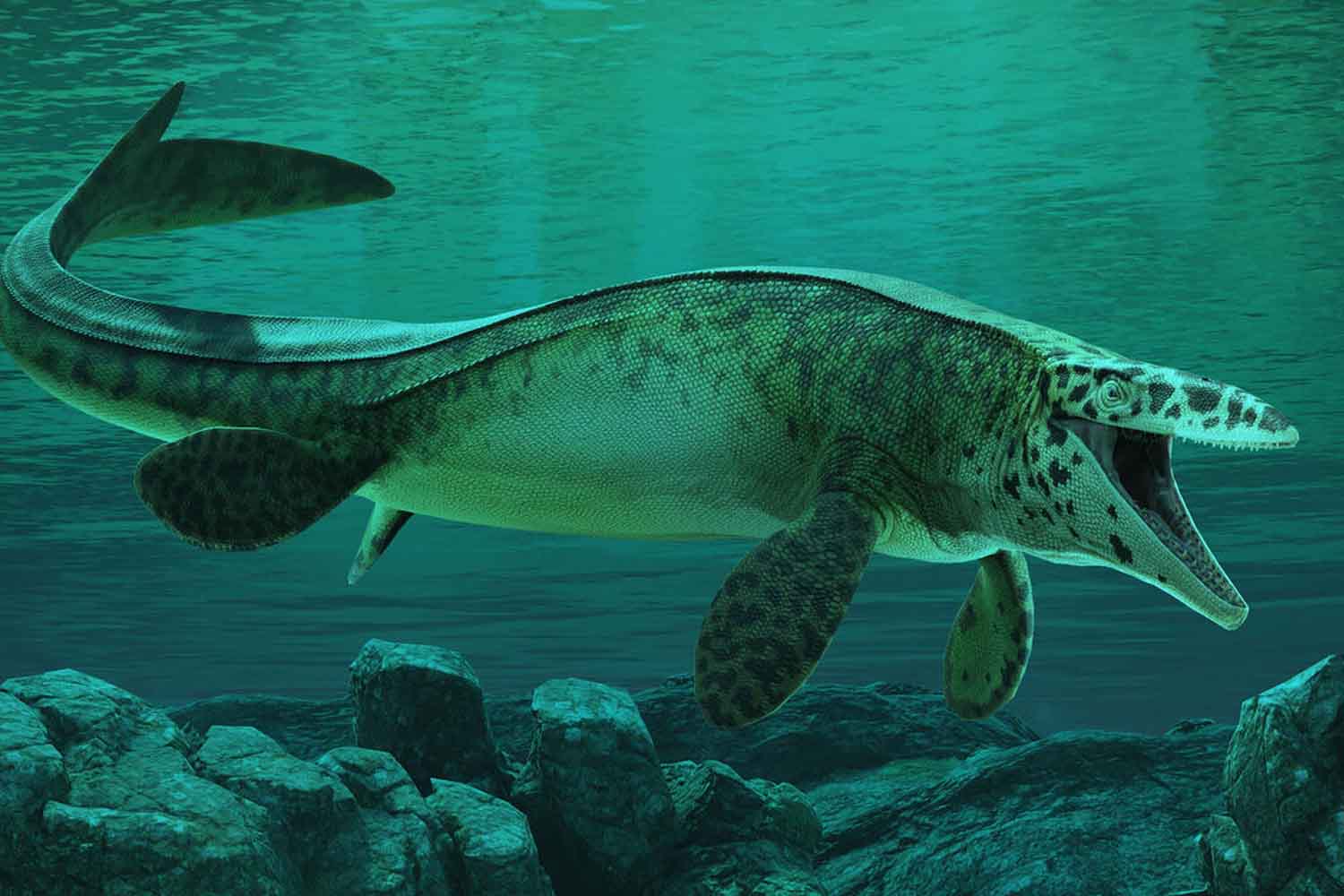
In some museums the past remains still only for those who look at it in a hurry. Behind a display case, in a warehouse, next to a tag written many years before, it can happen that an animal that has already been studied changes its name again. It happened with an enormous marine reptile from the Cretaceous, which remained for a long time within the large family of Tylosaurus proriger and now recognized as something different: Tylosaurus rexinevitably abbreviated to T. rex. The name immediately brings to mind the tyrannosaurus, the one with wide open jaws and tiny arms that has entered everyone’s imagination. Here, however, we are at sea. And the sea, eighty million years ago, was a very lively place. The study was published in Bulletin of the American Museum of Natural History and describes a new species of mosasaur based on fossils found mostly in North Texas.
View this post on Instagram
Mosasaurs were large marine reptiles, distant relatives of lizards and snakes, capable of dominating the oceans of the Upper Cretaceous. They swam in warm seas, preyed on other marine animals and occupied a top position in the food chain, well before the Chicxulub asteroid ended the game for many life forms about 66 million years ago. The new Tylosaurus rex falls into this world: a predator up to approx 13 metersabout the size of an American school bus, with finely serrated teeth and anatomical adaptations that suggest particularly strong jaw and neck musculature.
The giant was already there
The most interesting part of the discovery has little to do with a spectacular expedition into the desert and a lot to do with a more patient gesture: reviewing fossils already collected. Paleontologist Amelia Zietlow began to notice something off while observing a specimen attributed to Tylosaurus proriger. The comparison with the holotype of that species, described more than 150 years ago and preserved in the collections of the Museum of Comparative Zoology at Harvard, opened the crack: several fossils classified under the same name seemed to belong to another animal. Bigger, newer, more specialized.
The geographical and temporal difference did the rest. Most specimens of Tylosaurus proriger comes from the area of present-day Kansas and is dated to ca 84 million years ago. The fossils attributed to the new Tylosaurus rexon the other hand, come mainly from Texas and are approximately younger 4 million years. A distance which, in paleontology, can contain an entire piece of evolutionary history. The new species reached sizes ranging from approximately 7.6 and 13 metersWhile T. proriger it was smaller. The serrated teeth, rare in mosasaurs, add an almost kitchen knife detail: cutting, holding, hurting.
The name rex it also comes as a tribute to John Thurmond, a paleontologist who had already intuited the particularity of the tylosaurs of north-eastern Texas at the end of the 1960s. He had considered them strange enough to deserve attention, large enough to suggest a different species. Much later, that old intuition returned in updated research, with new tools and comparisons. Paleontology often works like this: a discovery can begin with a fossil found decades earlier and mature when someone decides to look at it with less accustomed eyes.
The Black Knight
The symbolic specimen of this story is preserved at the Perot Museum of Nature and Science in Dallas. He is called “The Black Knight”the Black Knight, and the nickname seems to come out of a fantasy novel, even if here the material is bone, sediment and trauma. This is the holotype fossil of the new species, discovered in 1979 near an artificial reservoir near Dallas. It is huge, exposed to the public, and bears signs that are difficult to ignore: the tip of its snout is missing and a fracture in the lower jaw. According to the researchers, such damage would be compatible with bites or clashes with individuals of the same species.
This detail changes the tone of the discovery. Tylosaurus rex it was big, sure. He had unusual teeth, sure. But those wounds also reveal an animal probably involved in violent clashes with its own kind. Ron Tykoski, curator of vertebrate paleontology at the Perot Museum and co-author of the study, spoke of evidence of intra-specific violence at a level never before observed in other specimens of Tylosaurus. Translated without overloading the scene: these predators could fight each other in a brutal way, perhaps for territory, food, mating or hierarchies.
The comparison with the great white shark helps to give a measure, with all the necessary precautions. The researchers indicate that the new mosasaur could reach about twice the length of the largest modern great white sharks. The scene must be imagined in the Western Interior Seaway, the ancient inland sea that crossed North America during the Cretaceous: water where today there are plains, cities, roads, museums. An animal as long as a bus, with serrated teeth and a neck capable of sustaining powerful bites, swam there. Texas, before oil and highways, already had its giants.
The discovery also has a more technical impact. The study updates a dataset used for years to reconstruct the evolutionary relationships of mosasaurs, which has remained almost unchanged for about three decades. This means that Tylosaurus rex it also serves to bring order to the kinship between these marine reptiles, not just to add a new name to a list. Some famous specimens, previously attributed to T. prorigerare now being reclassified under the new species, including fossils exhibited in important university and museum collections.
Then there is an almost tender detail, in a story full of jaws and fractures: many of the fossils studied were found by enthusiasts and non-professional seekers in North Texas. The work of museums and universities served to conserve, compare, verify and give scientific form to those findings. A long chain, made by different hands. Someone finds a bone, someone else catalogs it, years later a researcher notices that something doesn’t add up. And an eighty-million-year-old predator changes its place on the tree of life.
The fame of mosasaurs also owes a lot to cinema and video games, which transformed them into spectacular aquatic monsters. In the case of Tylosaurus rexthe digital reconstruction came with the collaboration of Alderon Games, which created a model for Path of Titans with scientific advice. Pop culture does its job: it magnifies, simplifies, makes immediate a creature that no one will ever see alive. Science, meanwhile, does a slower and less noisy job: it measures, compares, corrects. Sometimes he comes up with a perfect name for titles. Sometimes that’s enough to make an entire sea resurface.
The Tylosaurus rex it remains there, within this double image: imaginary monster and laboratory fossil. A gigantic, violent animal, magnificent in the way a creature built to hunt can be. No movie theater roar. Just jagged teeth, broken bones and a rewritten time card.
