
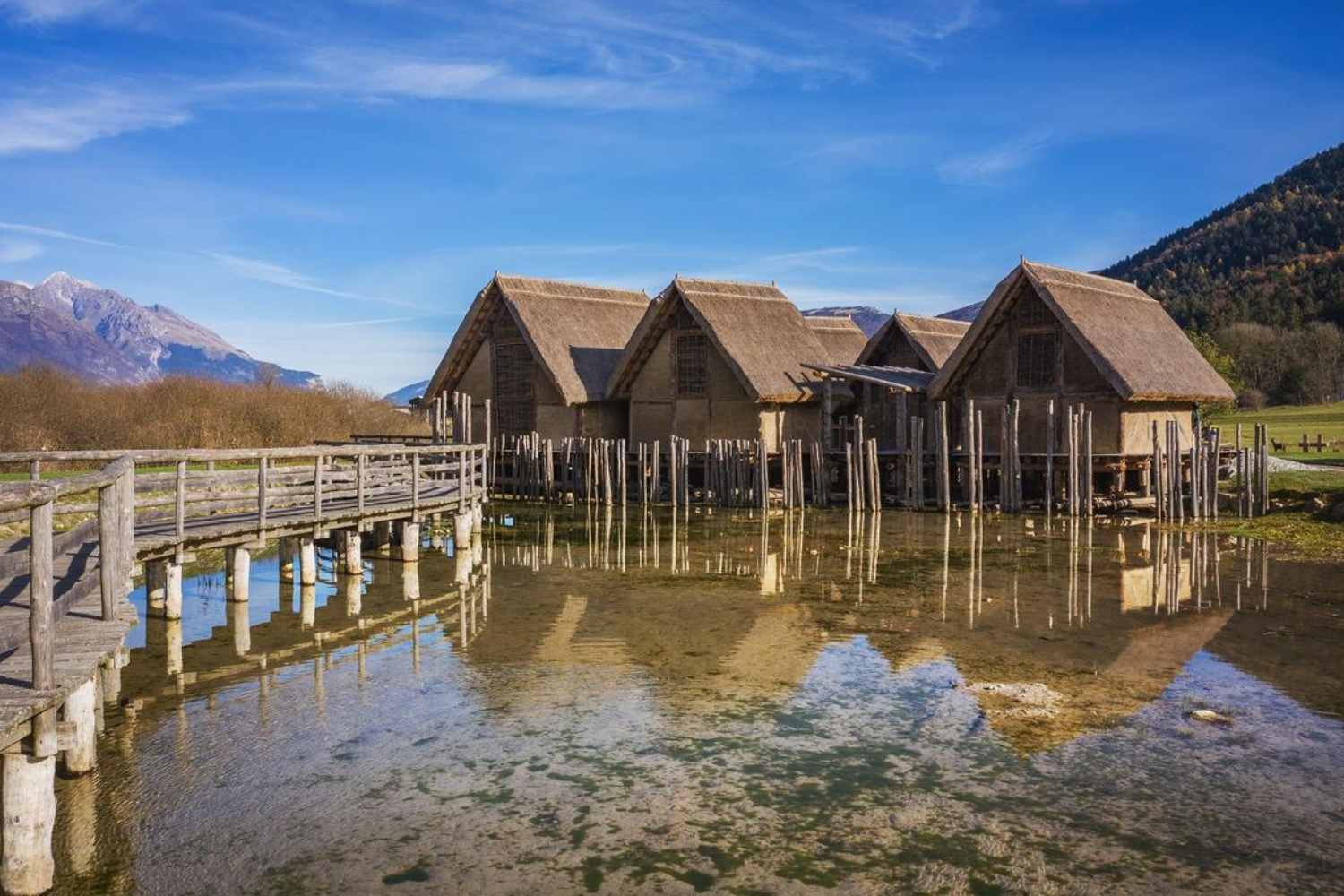
There is a place in Trentino where the past is not buried underground, but preserved in the water. We are in Fiavé, in the Giudicarie Valleys, between Lake Garda and the Brenta Dolomites, where the ancient Carera lake once extended.
View this post on Instagram
Here, between the late Neolithic and the Bronze Age, prehistoric communities built their villages on the water, driving thousands of poles into the seabed and raising their homes on wooden platforms. An ingenious system, almost an architectural audacity, which today gives us one of the most extraordinary prehistoric testimonies in Europe.
World Heritage Site — three times
It is no small record, Fiavé is one of the 111 sites that have made up the UNESCO recognition dedicated to the “Prehistoric pile-dwelling sites of the Alps” since 2011, together with nearby Ledro and other areas distributed between Italy, Switzerland, Austria, Slovenia, Germany and France. But the territory of the Giudicarie also carries a second recognition: that of a UNESCO Biosphere Reserve. And a few kilometers away the Brenta Dolomites stand out, also a World Heritage Site. Three international seals that tell how this corner of Trentino is full of natural, cultural and historical value.
View this post on Instagram
How it was discovered
The story begins in the mid-nineteenth century, almost by chance. During peat extraction work in the former Carera lake basin, workers began to come across poles and fragments of processed wood. Something ancient was surfacing. But it was only between 1969 and 1976 that the investigations became systematic, involving two distinct areas of the peat bog and the adjacent Dos Gustinaci. The research resumed in 1981, this time with the contribution of Italian and foreign institutes, museums and universities. What emerged was a sequence of overlapping settlements, a stratification that chronicles centuries of life, adaptation and transformation.
The poles that can still be seen
The archaeological area of Fiavé can be visited freely, immersed in the Fiavé-Carera nature reserve. Walking along the equipped path, you can still glimpse the remains of the poles that supported the prehistoric structures: dark, silent wooden stumps that emerge from the peat bog like silent witnesses of a vanished world. Information panels accompany the visitor in reading the site, connecting what can be seen with the naked eye with the scientific research that has allowed each layer to be dated and interpreted. From the museum to the archaeological area you can walk in about thirty minutes along a signposted route that starts from via 3 Novembre. By car, follow the provincial road 421 towards Passo del Ballino, with parking at Dos Gustinaci.
The Archeo Natura Park: three thousand years ago, life-size
A few steps from the archaeological area stands the Parco Archeo Natura, twelve thousand square meters where the past becomes a concrete experience. The entrance is greeted by installations that evoke the “forest of poles” – the definition of the first archaeologists who investigated the site – and a walkway suspended over the water leads to the five huts reconstructed in full scale, three of which can be visited.
These are not imaginative reconstructions: every detail was obtained from the scientific data that emerged from the excavations. Life-size domestic and wild animals evoke farming and hunting practices. Panels, films and multimedia devices in the visitor center complete a journey designed to be immersive, not didactic. The park is equipped with rest areas and spaces dedicated to families.
The Pile Dwelling Museum
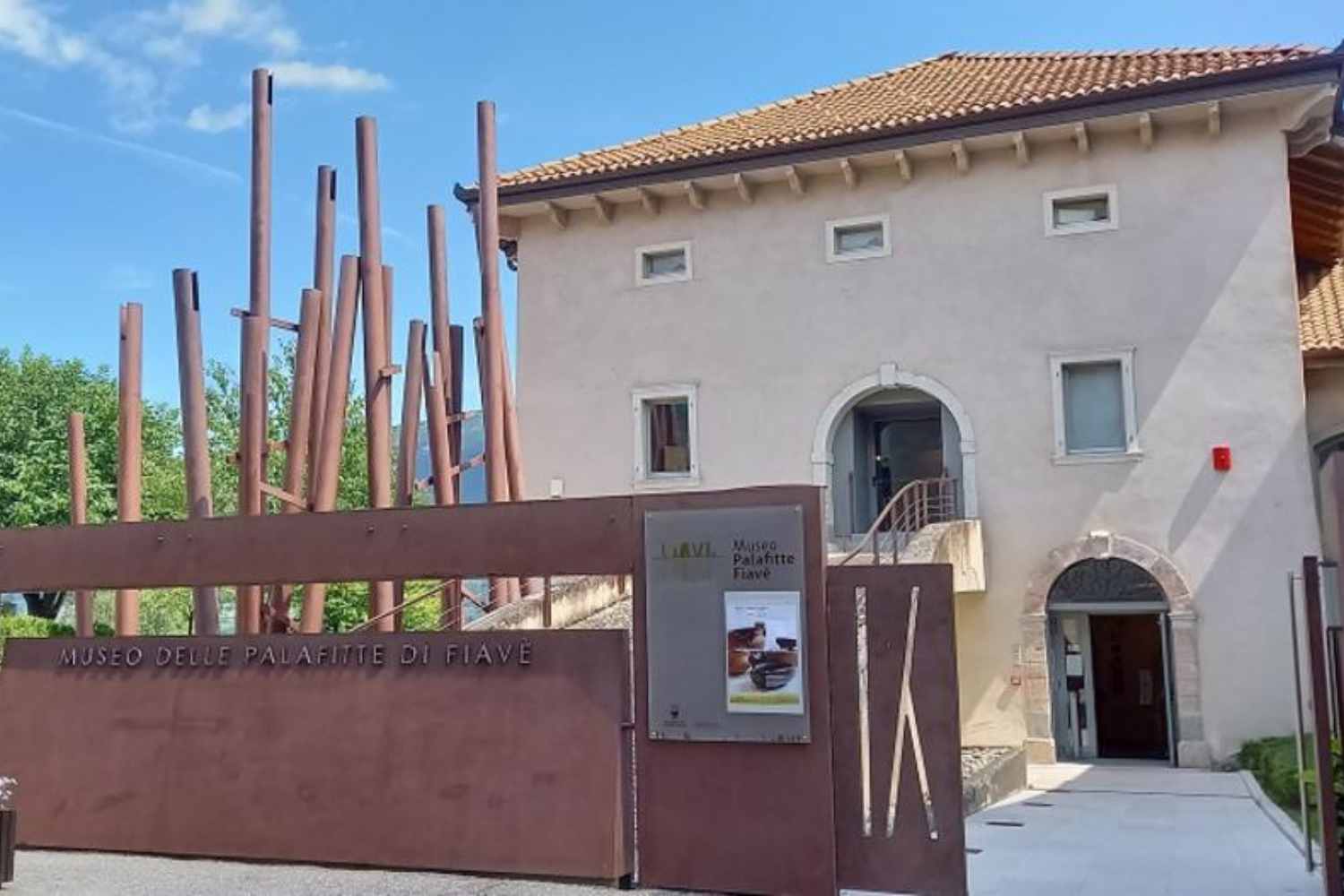
In the historic center of Fiavé, housed in the ancient Casa Carli, the Pile Dwelling Museum closes the circle. It is here that the finds that emerged from the excavations find their voice. The collection of wooden objects is among the most important in Europe for its antiquity and state of conservation: cups, ladles, buckets, ax handles, sickles with flint inserts, a bow with arrows.
Alongside the wood, there are ceramic pottery, bone and horn tools, bronze jewellery, Baltic amber and small gold decorations. The peat bog has even preserved food remains (ears of cereals, hazelnuts, dogwood, apples and pears) which allow us to reconstruct the diet and seasonality of the activities. The protagonist of the second floor is the large model of the Fiavé 6 village, which reconstructs in detail the log structure, the poles, the platforms and the palisade. Over seventy miniature figures show the village in movement: those who cut the trunks, those who work the wood, those who organize the living spaces.
During the opening months, the archaeological center of Fiavé comes alive. The Educational Services of the Archaeological Heritage Office offer a rich program of participatory visits, days of demonstrative archaeology, educational workshops, meetings with archaeologists, animated readings, shows and exhibitions. An offer designed for all ages, with the aim of transforming the visit from a passive experience to a moment of authentic discovery. Because the Fiavé stilt houses are not just a site to look at: they are a story to go through.
