
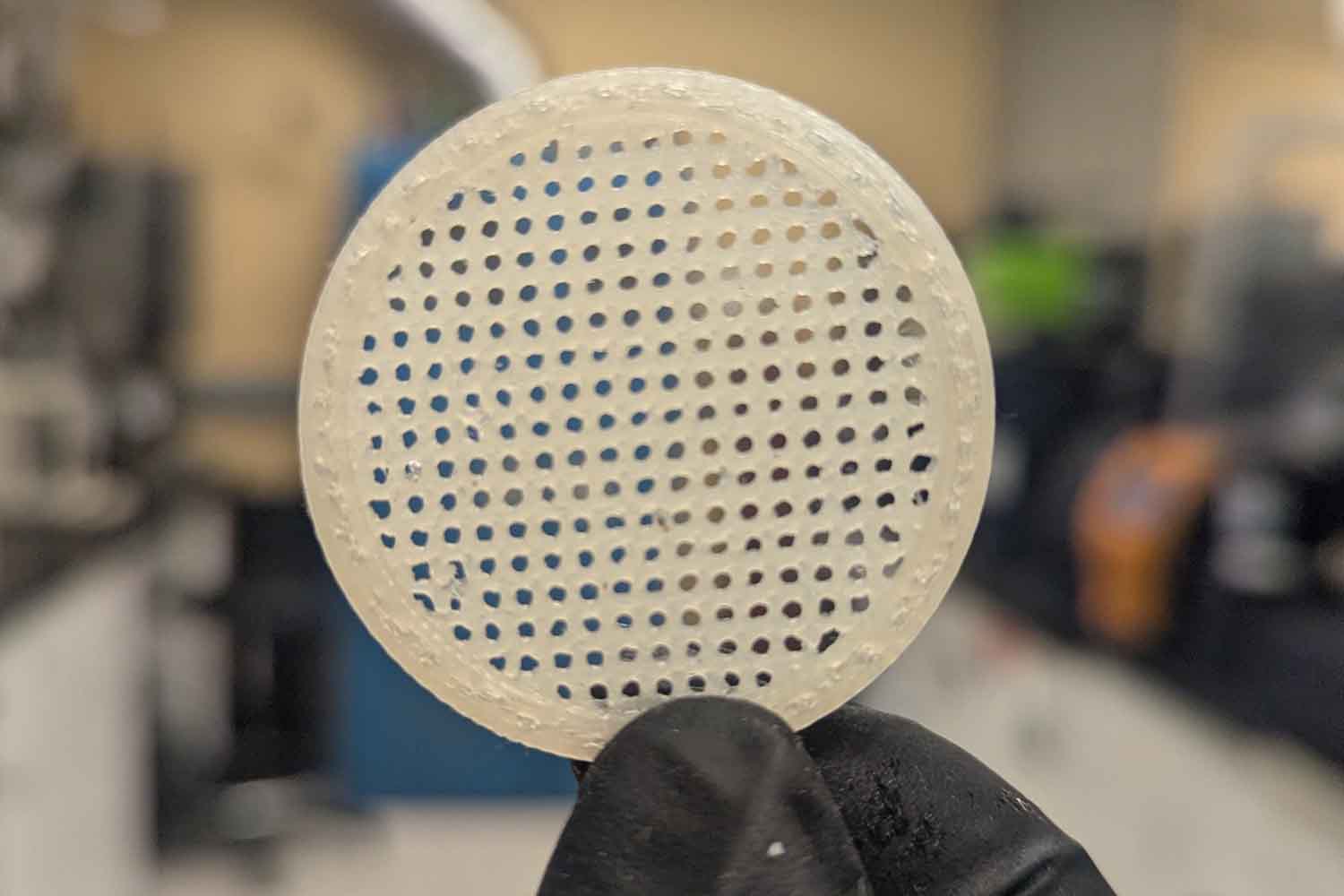
Twenty 3D printed discs, just 3.9 centimeters wide and one millimeter thick, removed the 90% of microplastics during a laboratory test. The filter developed at the University of Waterloo in Canada works by gravity and uses a fairly simple combination: a surface full of tiny pores and an adhesive coating that helps the particles stick together as the water passes through.
That 90%, however, belongs to a very precise test. In the study published on Separation and Purification Technologyresearchers Ethan Crawford and Tizazu Mekonnen worked with 100 milliliters of water containing ground polystyreneat a concentration of 100 parts per million. Fibers released from clothes during real laundry, with different shapes, materials, detergents and flow conditions, still have to pass through the filter. And it’s probably the most interesting test to do.
From smooth disc to 90%
The filter starts from PLA, the polylactic acid widely used in 3D printing. Each disk has a grid of one-millimeter square holes; By overlapping pieces with staggered openings, water is forced into a less direct path and increases the likelihood that a particle will encounter the surface. Alone, however, the printed piece does little. In an eight-disc configuration, the smooth surface barely removed the 16% of microplastics.
Crawford and Mekonnen then mixed polyethylene glycol, or PEG, into the PLA, which is intended to disappear after printing. The discs are immersed in boiling water for an hour, three consecutive times: the exposed PEG melts and leaves behind an irregular surface, crossed by micro and nanometric pores. With this modification the efficiency, again with eight disks, rises to 37%.
Something was still missing to prevent the particles from touching the filter and leaving with the water. The researchers tested two pressure-sensitive adhesive coatings: polydopamine and poly(2-ethylhexyl acrylate), P2EHA. The second worked better, bringing the removal to 51%.
Then they began to lengthen the column: 12, 16 and finally 20 discs. With twenty porous elements coated with P2EHA we arrive at the famous one 90%. The number, therefore, does not belong to a single miraculous disk: it requires a stack of filters and the water needs to meet enough surface along the way. Ethan Crawford’s thesis at the University of Waterloo also shows how particle size matters.
The smaller ones keep running away
@univerity of Waterloo
Before filtration, approximately 90% of the particles analyzed measured less than 20 micrometers and 43% less than six. After passing through the system, among those remaining in the water 80% were under 10 micrometers. However, none of the particles observed after filtration exceeded 50 micrometers. The filter works much better when the plastic is large enough to bump the surface and stick to the liner. The smallest particles weigh very little, are carried by the flow and can pass through the column without encountering enough adhesive material.
The same authors point out two other limitations. It was present in the tests Tween 20, a surfactant added to keep polystyrene particles dispersedwhich may have changed the interactions between plastic, filter and coating. Furthermore, neither the maximum quantity of microplastics that the system can accumulate nor its efficiency after multiple uses have yet been determined. These are decisive questions if you want to go from a laboratory column to something that can work every day under a sink or next to a washing machine.
The washing machine test
The laundry connection comes straight from the researchers. In fact, in scientific work they indicate tests on among the next steps real wastewater from washing machinesmuch closer to the conditions in which a similar filter could be used. The University of Waterloo also cites domestic systems and industrial water treatment among possible future applications.
Here the material to be captured changes a lot. The Canadian test uses pieces of Styrofoam; a load of laundry can be especially freeing stretched microfibres of polyester and other synthetic materialstogether with detergents, textile residues and dirt.
The size of the problem is far from tiny. According to the European Environment Agency, in Europe approx 13,000 tons of textile microfibres reach surface waters every year, equal to approximately 25 grams per person and 8% of primary releases of microplastics into waters.
Filters applied to washing machines can already greatly reduce the release of microfibres, while the most advanced wastewater treatments reach even higher percentages. However, some of the captured plastic ends up in sewage sludge and the smallest particles continue to be the most difficult to stop.
The 90% obtained at Waterloo should therefore be read for what it is: a very promising laboratory result on a specific polystyrene suspension. The interesting part comes now. The project will have to keep that number, or something close to it, in front of real fibers, soap, wash cycles and filters that cannot be replaced after one hundred milliliters of water.
The washing machine, from this point of view, will be a slightly less accommodating judge than the laboratory.
