
Even before the extreme thirst, the weight comes. The water bottle in the backpack, the jerrycan on the pickup, the bottles stuck wherever they happen, the water calculated as something not to be missed. Those who walk for long periods, work outdoors or move in isolated areas know it well: water is never just water, it is autonomy. A group of engineers from the University of Texas Austin tried to move this problem to a very common, almost banal object: a jacket. A fabric has been integrated inside the garment capable of capturing humidity from the air and conveying it to removable units, which are then heated in a small foldable collector to obtain drinking water. The result, still a prototype for now, is a jacket that produces water from the air in modest but already measurable quantities: between 400 and 900 milliliters per day, depending on the available humidity.
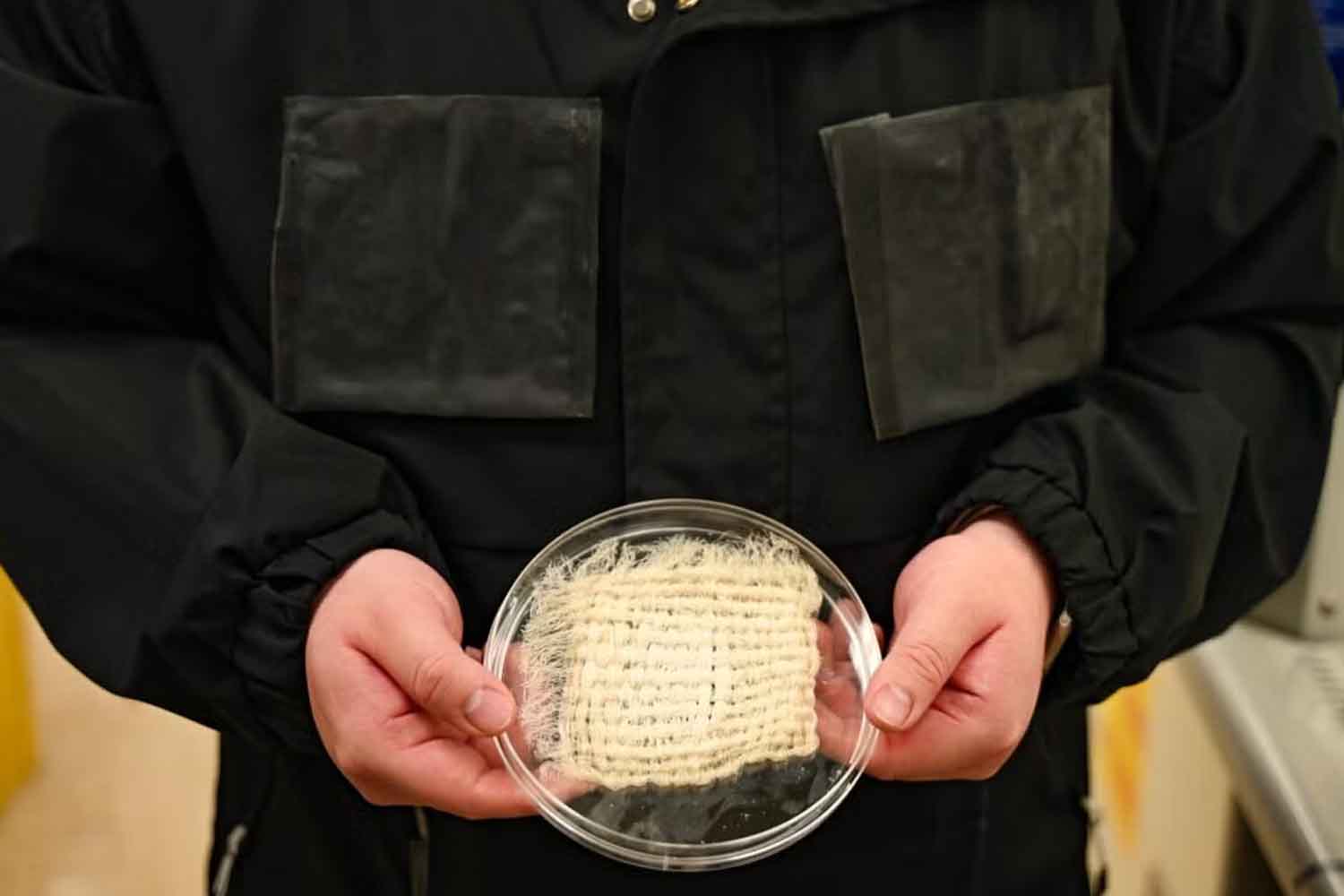
The scene has something of a survival novel, but the mechanism is less spectacular and more interesting. There is no magic bottle hidden in the lining, nor a promise of a summer gadget. The work is all in the fibres. The fabric absorbs water vapor, moves it to the surface of the fibers and then towards the inside of the structure, up to the removable parts that collect the water. The decisive step, the researchers explain, concerns transport: it is not enough to have a material that “drinks” humidity, a rapid way is needed for that humidity to become liquid and be recovered without remaining trapped in the fabric. Compared to conventional materials for atmospheric water harvesting, the new textile architecture showed a three- to tenfold improvement when scaled up.
A small reserve to wear
The 400-900 milliliters per day are a useful quantity, not a decisive one. On a hot day, during physical exertion, an adult may need much more water. This prototype doesn’t eliminate the need to carry supplies, turn a desert crossing into a breeze, or replace serious water infrastructure. However, it can become an additional reserve, a kind of safety margin for those who spend many hours away from reliable sources: hikers, campers, long-distance runners, agricultural workers, emergency teams, soldiers, operators working in remote areas.
The interesting leap is in the form. Collecting water from the air is often imagined as a stationary apparatus: a box, a panel, an absorbent bed mounted somewhere. Here the idea changes posture. The device doesn’t wait in a corner, it wears itself. A part of what we carry on us becomes an active surface, capable of intercepting the humidity already present in the environment. It’s a small difference only in appearance, because it opens the door to backpacks, tents, emergency covers, temporary shelters and camp equipment capable of collecting water while performing their main function. The researchers themselves indicate these objects among the possible applications in addition to clothing.
The fabric that captures moisture
@University of Texas
At the heart of the work is a family of hydrogel materials, designed to absorb water from the air and release it when heated. In the case of the jacket, the novelty is the hierarchical construction of the fibers: the surface captures the vapor, the internal structure guides it, the removable units make it recoverable. It is a solution that tries to respond to one of the most common limitations of this technology: many materials work well in the laboratory, on small samples and controlled conditions, then lose effectiveness when they have to become real, flexible, repeatable objects, robust enough to withstand use.
The same team also worked on a separate, solar-powered device tested in two very different conditions: the arid climate of the Chihuahua Desert, New Mexico, and the more humid environment of Austin, Texas. In those tests the system collected 1.3 liters of clean water per day at both locations, equivalent to 4.3 liters per kilogram of moisture-capturing material per day. The result was published in Nature Water and tells the point well: to get out of the laboratory you don’t just need a good material, you need a system that brings together absorption, release, sun, temperature, real humidity and operating times.
In tests on the portable device, the difference between Austin and the desert wasn’t just a matter of more or less dry air. The useful operating window changed. In the wetter climate a certain pace of collection and release was fine; in the desert it was necessary to adapt the strategy, switching to different cycles to better exploit the favorable hours. Humidity changes with night, day, wind, clouds, season, location. Such technology must be able to live with it.
Where it might be useful
The jacket that produces water from the air is not created for the commuter who forgets his water bottle in the office, even if the image is nice. Its natural terrain is different: arid areas, territories with fragile infrastructures, field expeditions, emergencies after floods, fires, earthquakes or interruptions to the water network. In those contexts even a few hundred milliliters can weigh. Not as a single solution, of course. As part of a larger package, yes.
The matter becomes even more concrete if we think about the objects that already accompany those who work or move outdoors. A backpack with moisture-trapping inserts, a tent that absorbs steam during the night, an emergency shelter capable of returning a little water in the morning: these are scenarios still to be developed, but less imaginative than they seem. The point remains the scale. A person can be satisfied with a small integration. A community needs litres, continuity, simple maintenance, sustainable costs, microbiological safety and durable materials. The road between prototype and reliable product always passes through there, where beautiful ideas encounter dust, heat, inexperienced hands and bad days. But the transition is interesting: in a world where access to water becomes increasingly fragile, even a jacket can stop being just a jacket.
