
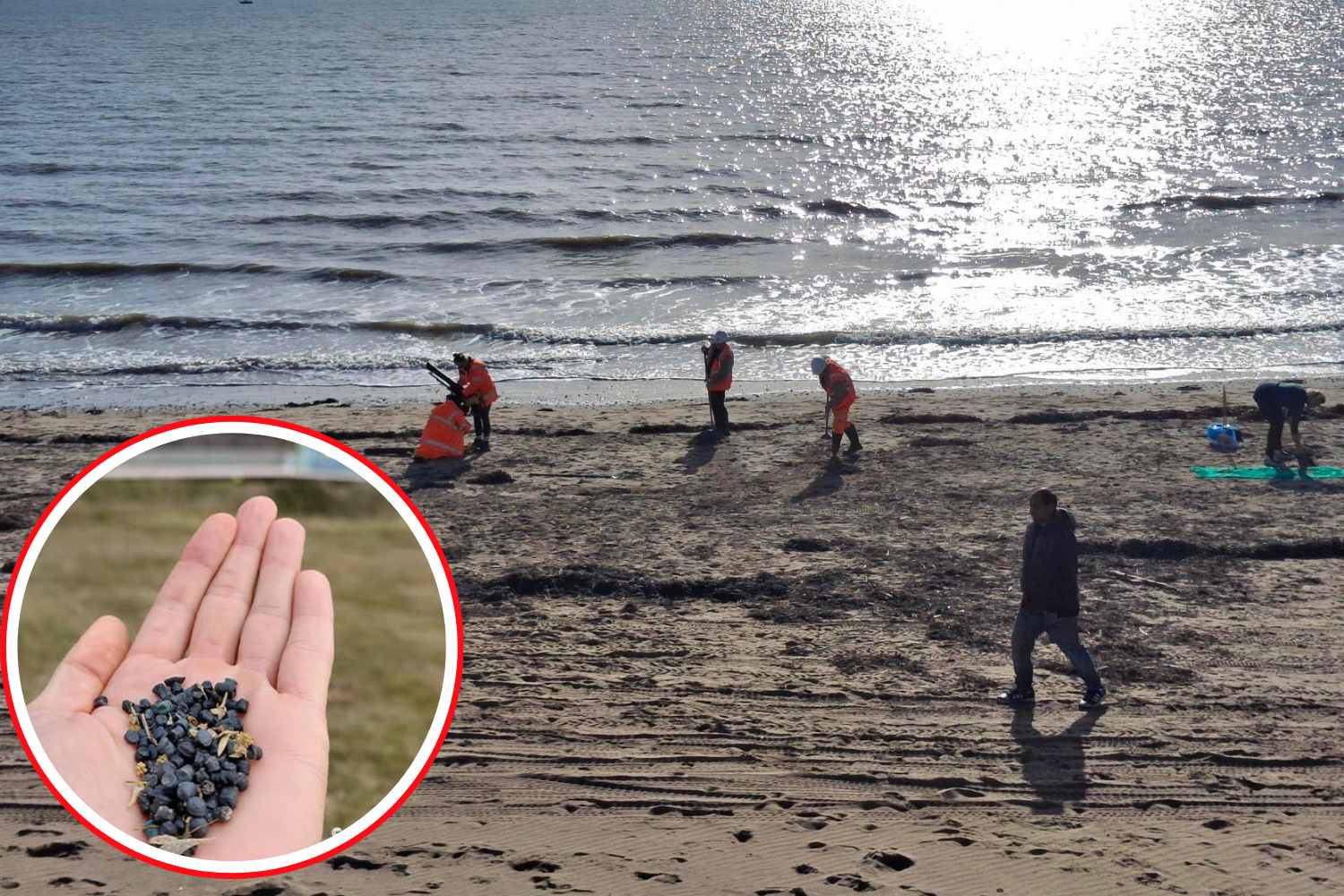
East Sussex, famous for the beauty of Camber Sands, a coastline loved for its vast golden dunes and a rare habitat home to dolphins, porpoises, seals, terns and cormorants, was hit in November 2025 by an environmental disaster that has few precedents. Six hundred and fifty million plastic microspheres have invaded the coast, even spilling into the very delicate Rye Harbor Nature Reserve.
Plastic beads found washed up on the beach at Camber Sands have also been discovered at Rye Harbor Nature Reserve and in Dungeness, Kent.
More here: https://t.co/yxaaMXFrkO pic.twitter.com/UTBqgQhRKj
— BBC Kent (@BBCRadioKent) November 18, 2025
On Monday 10 November 2025, Southern Water, the UK water company, formally admitted responsibility for the “catastrophic biosphere spill”. The accident, as also reported by The Guardian, was caused by a mechanical failure, specifically a defect in a filtration filter at the Eastbourne sewerage plant. The filter, which was supposed to prevent this from happening, failed during heavy rains, allowing the granules used in the last stage of wastewater treatment to spill into the sea.
Like many, we’re concerned by plastic beads at Camber Sands. After a rapid investigation, we believe they may have come from Eastbourne Wastewater Treatment Works after a screen failure during heavy rain. We’re truly sorry and committed to the clean-up. https://t.co/8Z3MzSmzOe pic.twitter.com/WeSR6Y6OWv
— Southern Water (@SouthernWater) November 10, 2025
The Southern Water spokesperson said: “We are very sorry about what happened and are doing everything we can to investigate and resolve the issue.”
The ton of pollution
The gravity of the incident was immediately clear to those who live on the coast. Andy Dinsdale, founder of the Strandliners group, which campaigns against plastic pollution, called it “the worst pollution I have ever witnessed”. It took the company itself two weeks to detect the leak, a delay that allowed millions of biospheres to settle freely on the coast, turning a technical failure into an “environmental catastrophe”, as Helena Dollimore, Labor MP and Co-op for Hastings and Rye, called it.
The MP called for an independent investigation, criticizing that Southern Water had initially “categorically denied any involvement” when asked about the biospheres and added that “Southern Water cannot be trusted to get its records right”.
The problem with these biospheres is not just their physical presence. Their composition makes them an invisible but persistent threat. These pellets contain a high amount of polycyclic aromatic hydrocarbons (substances linked to cancer) and can carry toxins such as lead, antimony and bromine. Once in the sea, they attract algae, taking on a smell that makes them attractive to marine fauna. Ingested, these granules can poison creatures, build up in their internal systems, or even block them, potentially leading to death.
Threat to marine life and the food chain
The impact on wildlife is the most pressing concern. Rye Harbor Nature Reserve, where the pellets were found, is a crucial ecosystem. The Sussex Wildlife Trust said it was “shocked to see millions of bio-spheres washing up on the coast” and confirmed that the impact on nature is not yet quantifiable.
“The impact on wildlife is appalling. Not only do they remain in the environment for decades, if not hundreds of years, but their size, shape and buoyancy can make them easily mistaken for food by many different species of marine wildlife, with profound implications for food chains,” the Sussex Wildlife Trust said.
In the days following the incident, citizens of Sussex reported the deaths of several stranded seals and a porpoise. Although it is not yet clear whether these deaths are directly linked to the spill, concern about the impact on local marine life is very high, particularly affecting dolphins and seals.
Volunteers spent days trying in vain to clean up the beach, using rakes, shovels and brushes to remove the tiny pearls. The desperation comes from the fact that, if left in the environment, they fragment into microplastics which are almost impossible to extract from the sea and the food chain.
The urgency of binding laws
The Camber Sands incident has highlighted a serious regulatory gap in the UK. Environmental Investigation Agency (EIA) law and policy specialist Amy Youngman described plastic pellets as “essentially an oil spill in solid form, but with added chemical toxicity.”
While political attention has so far focused on pellet losses due to shipping, this event demonstrates that pellet pollution can also arise from land-based infrastructure such as wastewater treatment plants, a “critical regulatory blind spot”. The EIA reports that in the UK there is no “binding national legislation to prevent pellet losses like this” nor a transparent and mandatory reporting regime.
Chris Dixon, head of the EIA’s ocean campaign, lamented that “at a time when water companies are raising prices and continuing to pump sewage – and now plastic – into the environment, this is another blow to Britain’s coasts.”
The EIA urgently calls on the UK Government to adopt binding national legislation to prevent, contain, report and clean up pellet losses across the entire supply chain and from all sectors. It is also calling for a full and independent investigation into Southern Water’s operations by the Environment Agency, which has already said it will not hesitate to take “enforcement action where appropriate” and is working with Rother District Council on the clean-up.
Meanwhile, cleanup remains complex. The use of vacuum cleaners raises questions about its appropriateness, given that removal methods can only act on debris deposited on shore, while millions of granules have already dispersed into the marine environment, destined to circulate for decades or even return “to us through the food we eat or even the air we breathe”.
The appalling pollution incident caused by Southern Water at Camber Sands is completely unacceptable and they should be held to account.
Minister for Water, Emma Hardy MP, met with the @EnvAgency and volunteers to thank them for their work supporting the clean-up. pic.twitter.com/PglzzalACM
— Defra UK (@DefraGovUK) November 14, 2025
Water Minister Emma Hardy reiterated that “the immediate priority now must be to address any environmental damage and minimize further impacts”. However, community and environmental organizations are demanding more: they are demanding that the company invest in a comprehensive nature restoration program to restore fragile ecosystems, rather than paying dividends or bonuses, and that the regulatory framework finally reflects the 360-degree reality of the plastic pellet problem.
