
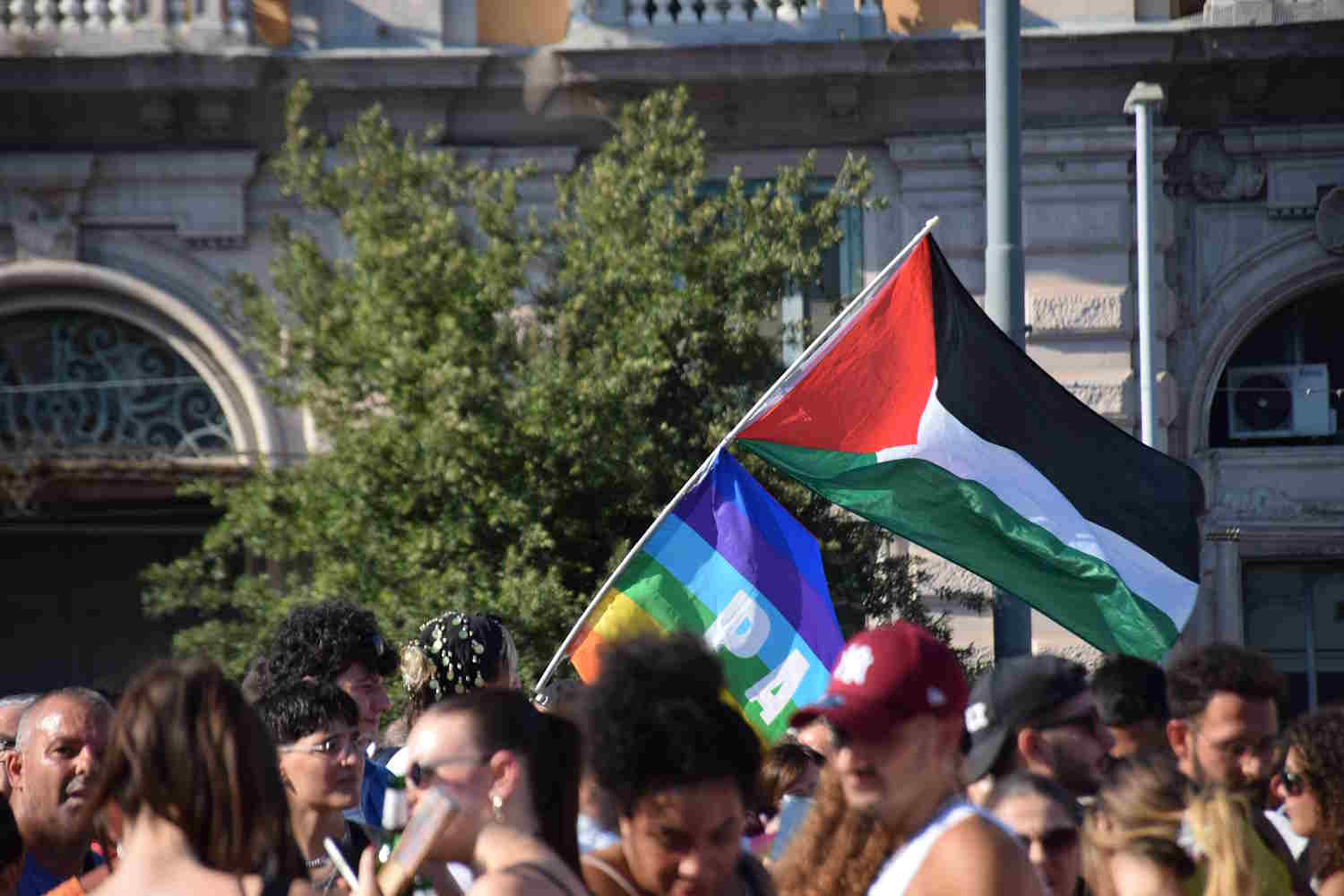
A very complicated global geopolitical context and in the beautiful middle Thousands of people who die of hunger. From many sides the words “recognition of the state of Palestine“. But what does it really mean?
In recent days, French president Emmanuel Macron has announced that the France will become the 147th country out of a total of 193 members of the United Nations to officially recognize Palestine as a sovereign state.
Fidèle à Son Engagement Historique Pour Ue Paix Juste et Duble au proche-orient, j’ai décidé que la France …
Posted by Emmanuel Macron On Thursday, July 24, 2025
After him, he immediately followed the United Kingdom of Starmerremaining faithful to the commitment for the two -states solution and the right to self -determination of the Palestinian people.
My Statement on the Humanitarian Crisis in Gaza and Our Plan for Peace Including the Recognition of in Palestinian State
My Statement on the Humanitarian Crisis in Gaza and Our Plan for Peace Including the Recognition of in Palestinian State.
Posted by Keir Starmer On Tuesday, July 29, 2025
Today, the same news also comes from the Genoa City Council. But what impact can really have such a choice?
Not everyone knows that this is an act that follows a long series of awards that, since 1988, have seen more than 140 countries joining the initiative. Among these, in recent years, an growing number of European countries has taken a position, including the Spain, there Slovenia and theIrelandwho took this step in May 2024. The European Union as a whole, however, remains divided (and what is the novelty?), With some Member States, including Italy and Germanystill reticent.
What seems certain is that France’s decision raised further political discussions, as underlined by Antonio Tajaniour Foreign Minister, who declared that Italy recognizes Palestine only when the latter officially recognized Israel.
What does it mean to recognize a state according to international law
According to what Treccani explains, recognition is a unilateral act carried out by a subject individually, or by several subjects collectively, through which we take note of a given situation of fact or by law.
However, it does not have a constitutive value of the legal personality of a state, since this depends, in accordance with the principle of effectiveness, on the fact that the new entity acts in full independence in international relations, on a plan of equal with other international subjects. The recognition of States has rather political value, testifying to the will of the pre -existing states of entertaining international relations with the recognized state. It detects from a legal point of view as the states that proceed to recognition thus show that all the conditions provided for by international law for the formation of a new state exist; In this sense, the recognition produces a preclusive effect, preventing the state that has carried out it to subsequently contest the recognized situation, or to affirm that the state recognized defects of legal personality.
In international law, therefore, the recognition of a state It is a binding political and non -legal act. In practice, it means that a country takes note of the sovereignty and of theauthority of another state on a defined territory. The recognition, therefore, is a signal of diplomatic relationships formal and commitment to deal with that nation internationally. However, it is not a legal obligation according to international regulations.
A fundamental aspect of recognition is the Resolution of territorial disputes. In general, a recognized state enjoys some rights, such as access to international treaties, the possibility of being represented at the United Nations and other international organizations, and the opportunity to sign bilateral agreements. However, the recognition of a state does not necessarily imply the approval of its internal policy or the legitimacy of its actions.
In the case of Palestine, the recognition by other states reflects the acceptance of his aspiration to self -determination and the right to constitute itself as an independent state, with capital a Jerusalem Est and territory that includes the West Board and the Gaza Strip. However, there are still many states that maintain an ambiguous position.
Which countries recognize Palestine today
The recognition of Palestine as an independent state dates back to November 15, 1988when Yasser Arafatpresident of the Palestinian National Authority (ANP), unilaterally proclaimed Palestine’s independence during the first Storage. On that occasion, Palestine was recognized by about 80 countriesincluding many Member States of the Arab League And of the Soviet block.
From 1988 to today, the number of countries that officially recognize Palestine has continued to grow, with a strong increase in Latin America and in Africa. Globally, 147 countries They officially recognized Palestine, while Palestine was admitted to how State non -member observer of the United Nations in 2012. Among the countries that are part of the G20ten have already recognized the state of Palestine, including Argentina, Brazil, China, India, Indonesia, Mexico, Russia, Saudi Arabia, South Africa And Türkiyein addition to the already mentioned Spain.
Italy, together with Canada, Australia and some members of the European Union ,. However, the situation is evolving, and some states are starting to change their positions. In 2024, theGeneral Assembly of the United Nations has voted a resolution that gives Palestine the status of “Was qualified to become a member “ of the United Nations, with 143 votes in favor, 25 abstentions (including Italy) and 9 contrary votes, including the United States.
The growing tension on the question of recognition reflects the unsolved conflict between Israel and Palestine, with the international community divided on how to reach a two -states solutionin which both Israelis and Palestinians can live in peace and security.
In short, the recognition of Palestine can be a symbolic move that, however, we know it well, does not resolve the complex political and territorial issues related to the Israeli-Palestinian conflict. Although the international recognition of Palestine is growing, the lasting peace It remains a distant goal, especially in a context where the division between the Palestinian factions, such as the government of Hamas In Gaza, and the continuous Israeli occupation make it difficult to achieve a fair solution.
Our wish? That the international community can once and for all to start a peace process based on direct negotiations only between the two parties, thus creating the conditions – after decades – for one peaceful coexistence and mutual and urgent respect for human rights.
