
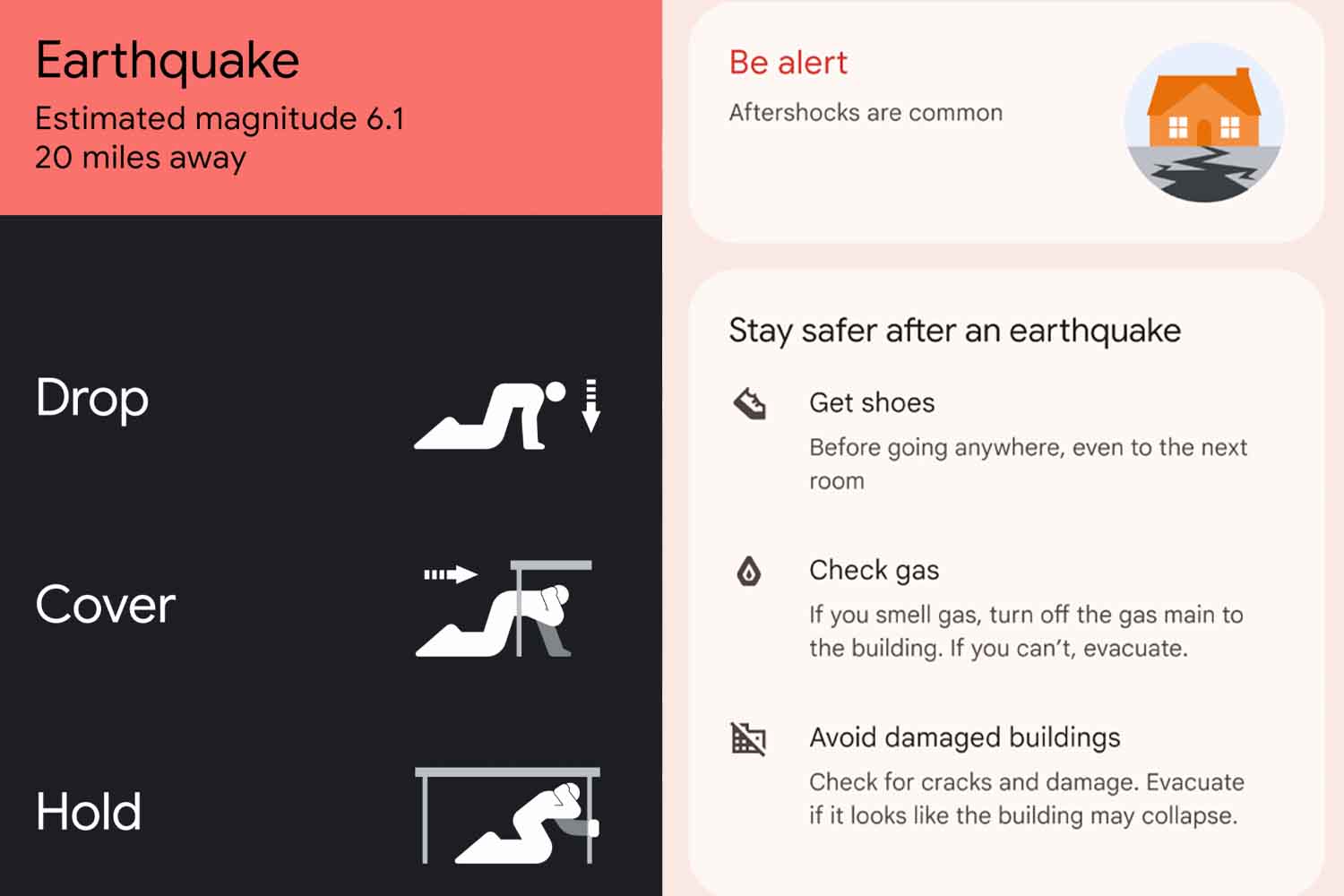
The phone vibrated before the earth. Before the walls, before the stairs taken on the fly, before that noise that comes from the floor and erases every ordered thought. In the north of Venezuelahit by two very violent shocks a few seconds apart, some smartphones with the system Android they showed a I notify in advance of the strongest shock. TO Macaracuayneighborhood in the eastern area of Caracasthe margin reported by several residents would have been around thirty seconds. Not much, on a normal day. During an earthquake, a huge amount of time.
The seismic sequence was reconstructed by INGV starting from USGS data: a first shock indicated as M 7.2, followed 39 seconds later by a second event of magnitude 7.5, with an epicenter approximately 23 kilometers south-east of Yumare, in the State of Yaracuy. Northern Venezuela is located along the complex margin between the Caribbean plate and the South American plate, crossed by active fault systems capable of generating destructive earthquakes. A complicated geological context, where a few seconds beforehand can become an open door, a flight of stairs, a person taken out of the house.
The telephone does not predict the earthquake, it feels it before us
Of course, theearthquake alert does not predict the earthquake. He doesn’t announce it before it happens, he doesn’t read the future, he doesn’t have the powers of a disaster movie with the brilliant technician in front of twenty monitors. It does something much more concrete: it intercepts the first signs of an earthquake that has already begun and tries to warn those who are furthest from the epicenter before the strongest waves arrive.
The official explanation from Google Crisis Response is quite clear. Smartphones contain small accelerometers, the same sensors that allow the phone to understand when we rotate the screen. If a stationary phone registers vibrations consistent with an earthquake, it sends a signal to the servers along with an approximate location. The system compares many signals arriving from the same area and understands if an earthquake is really happening.
The technical point lies in seismic waves. P waves arrive first, travel faster, and generally cause less destructive shaking. The S waves arrive later, they are slower and much more capable of shaking buildings, glass, furniture and streets. The goal of the Android Earthquake Alerts System is precisely this: to use the first information, the very rapid one, to send a warning before the heaviest shaking. Depending on the distance from the epicenter, the advantage can last a few seconds or reach tens of seconds.
A network of mini-seismometers already turned on
The powerful part of this technology is quantity. Google explains that, outside of California, Oregon and Washington, where Android also distributes alerts generated by the official ShakeAlert seismic system, the mechanism uses a distributed approach: phones become a network of sensors. The more compatible devices register compatible vibrations at the same time, the more the system is able to confirm the event and estimate its position and magnitude.
The paper Global earthquake detection and warning using Android phones, published on Sciencedescribes precisely this architecture: a global network of Android smartphones used to detect earthquakes, send alerts and collect feedback from users. In three years of operation, the system has detected an average of 312 earthquakes per month in Turkey, with magnitudes from 1.9 to 7.8, and has sent alerts to 98 countries for events with a magnitude of at least 4.5. The data collected also shows an interesting detail: 85% of people who received an alert then felt the shaking.
Not all alerts are the same. Google distinguishes between Be Aware Alertdesigned for weak or light shaking, and Take Action Alertintended for more serious situations. The second turns on the screen, makes a loud sound and can overcome the “Do Not Disturb” mode. Translated: the phone tries to make itself heard precisely when every second counts.
Because in Venezuela the warning arrived first
In the Venezuelan case, the advance margin reported in Caracas arises from the distance between the person receiving the alert and the point where the earthquake begins. The P waves start immediately, reach the closest sensors first and give the system the possibility of sending a notification to areas that will be hit by the strong shaking a few moments later. Caracas is located east of the epicentral area indicated by INGV and USGS; in some areas of the capital, that natural delay between the fastest and most damaging waves may have translated into a useful window.
However, caution is needed. Real-time estimation of a large earthquake is a difficult job. In the first seconds there is little data, the magnitudes can be updated, the position can be corrected, the distribution of the shaking changes based on the subsoil, the distance, the shape of the fault, the buildings. Google itself insists on the continuous improvement of the system, precisely because the challenge lies in the balance between speed and precision. Waiting too long makes the alert useless. Notifying too early, with fragile data, increases the risk of error.
In the middle there is a technology that does not replace public seismic networks, civil protection, well-built buildings, emergency plans and risk culture. He supports them. It expands them where traditional sensors are missing. It brings a notice to an object that millions of people already have in their pockets, on their nightstands, next to their beds.
A notification doesn’t stop the earth, but it moves people
THE’Android earthquake alert it should be read like this: as a handful of seconds gained within an event that remains uncontrollable. A warning can allow you to move away from a window, exit a dangerous point, duck and protect yourself, interrupt a risky manoeuvre, pick up a child, avoid the lift, reach a safer space. No technology erases the violence of an earthquake. Some, however, reduce the blind time between what is happening underground and what the body is about to feel.
In northern Venezuela, those phones did exactly that: They turned a nearly invisible sensor into a signal. No miraculous promises, no impossible predictions. Only one message arrived before the strong shock. Sometimes useful technology comes in this unspectacular form: a screen that lights up and tells you to move.
