
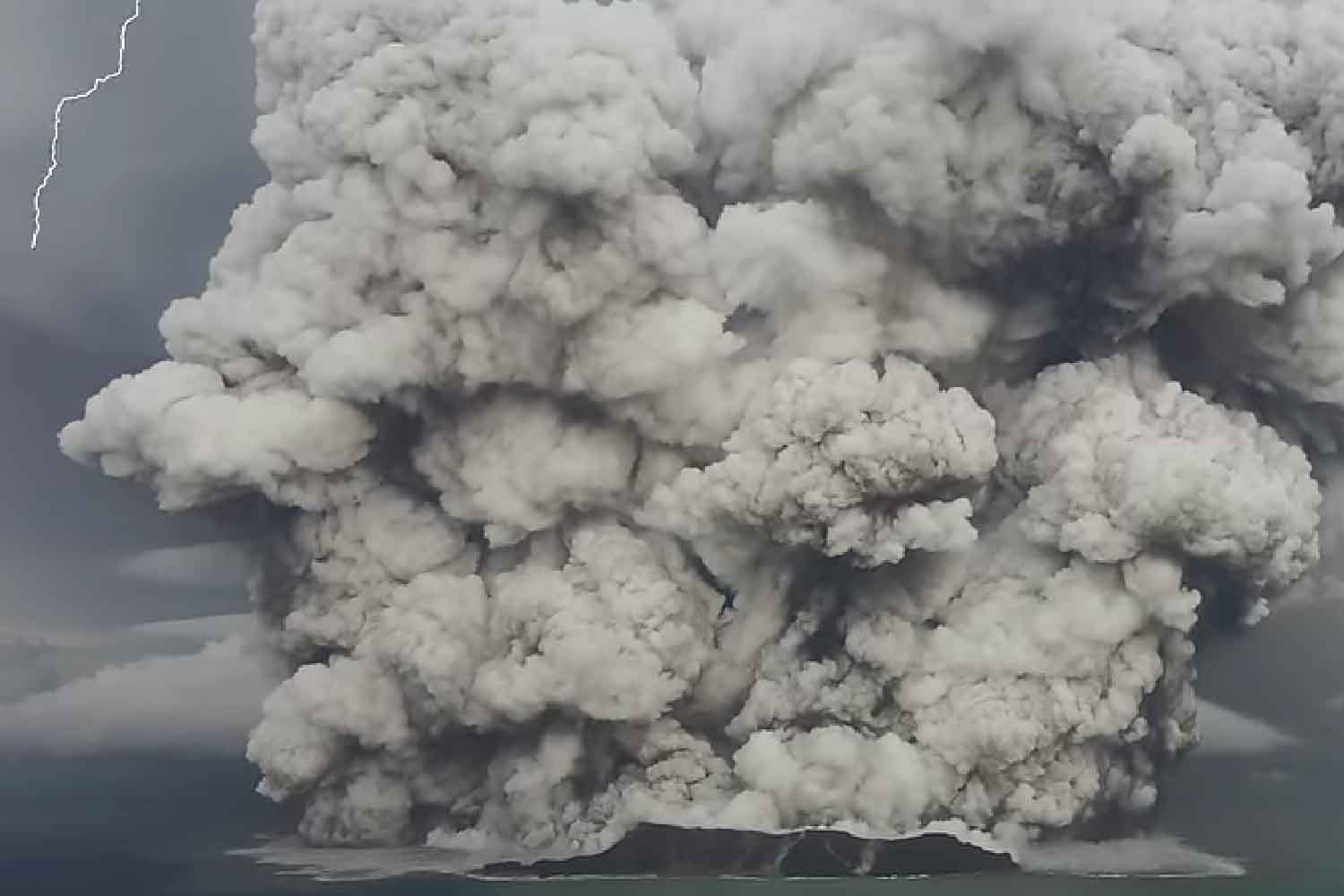
In January 2022, the Hunga Tonga-Hunga Ha’apai underwater volcano, in the South Pacific, did what volcanoes do when they stop being a landscape and become an event: it sent material into the atmosphere with rare violence, pushing water, ash and gas up to the stratosphere. The news, however, arrives now and has an almost counterintuitive flavor. That same eruption would also have triggered a chemical process capable of removing part of the methane released during the event. A kind of atmospheric cleaning inside the cloud, observed from space and until now never documented in this way. The study was published on Nature Communications.
The researchers arrived at this conclusion by following a precise trail: formaldehyde, also referred to as HCHO. When methane is degraded in the atmosphere, formaldehyde appears as an intermediate product, destined to last a short time, just a few hours. Yet, in the cloud produced by Hunga Tonga, satellites detected anomalous and very high concentrations, which persisted for days. The cloud was followed for about ten days, all the way to South America: an important detail, because such a short-lived substance should have disappeared much sooner. The most coherent explanation is that inside that volcanic plume the methane continued to be oxidized, day after day.
The trail in the cloud
The strongest data concerns quantity. The study speaks of an increase in formaldehyde of up to 12 parts per billion at about 30 kilometers above sea level, inside the eruption plume, and estimates methane oxidation equal to 900 ± 220 megagrams per day. According to the authors, this implies that the volcano released at least 330 gigagrams of methane into the stratosphere. They are technical numbers, of course, but they tell us something quite clear: in the cloud there was not only emission, there was also a consumer reaction.
The proposed mechanism passes through three very concrete ingredients: sea salt, volcanic ash and sunlight. The eruption, being underwater, dragged huge amounts of salt water upwards along with the volcanic material. When solar radiation hit this mixture, it would have promoted the production of highly reactive chlorine atoms. Those atoms can react with methane and help break it down, leaving behind the very formaldehyde observed by satellites. The authors speak of an iron-chlorine chemical photo on sulphate-coated volcanic ash as a plausible mechanism, while pointing out that dedicated models and laboratory studies will be needed to fully confirm this.
The interesting thing is that a similar process had already been identified in a completely different context: Saharan dust blown over the Atlantic, mixed with sea salt and hit by the sun. In that case, aerosols of iron salts capable of generating reactive chlorine are formed. Seeing the same pattern appear in the stratosphere, inside a volcanic cloud, changes the scale of the matter quite a bit. We are no longer faced with a superficial curiosity, but with an atmospheric chemistry that can occur in much more extreme conditions.
Why methane matters
Atmospheric methane is one of the most important greenhouse gases after CO₂. It is responsible for about a third of the warming we are experiencing and, over twenty years, it has a climate-altering power about 80 times greater than that of carbon dioxide. Its stay in the atmosphere is shorter, around a decade, and it is precisely this that makes it so central to short-term climate strategies: reducing it now can have visible effects in shorter times than CO₂ alone.
This does not turn the volcano into a climate solution, nor does it authorize imaginative shortcuts. Hunga Tonga had very unique conditions: it was an underwater eruption, it brought salt water into the stratosphere, it had an off-scale plume composition, and it produced a rare combination of materials. The same authors point out that the mechanism may not be as relevant in other eruptions, precisely because Hunga Tonga offered an almost unrepeatable mixture of salt, ash, light and altitude.
The value of the study also lies elsewhere: in the possibility of measuring the removal of methane. Technologies designed to artificially accelerate the degradation of atmospheric methane are still a delicate field, full of technical, environmental and governance unknowns. The main problem is to demonstrate that the methane has really been removed, how much has been removed and with what side effects. This is where TROPOMI comes into play, the instrument on board the European Sentinel-5P satellite, created to monitor atmospheric gases such as methane, formaldehyde, nitrogen dioxide, ozone, carbon monoxide and sulfur dioxide.
In this case using TROPOMI was not easy. The formaldehyde had to be recovered inside a stratospheric volcanic plume, therefore outside the ordinary conditions of the instrument. The researchers had to correct the satellite’s sensitivity for the unusual altitude of the signal and consider interference from high concentrations of sulfur dioxide. Without that data cleaning work, the cloud might have seemed like an unreliable anomaly. Instead he held.
A broader consequence remains: if atmospheric dust, including volcanic dust, can influence the methane balance, then that balance needs to be looked at more carefully. Until now, these dynamics were not fully considered in estimates of how much methane enters and exits the atmosphere. The volcano did not save the climate, it did not erase the problem, it did not offer a magic wand. It left a chemical signature in the sky, and that signature says the atmosphere is more complicated than we thought.
You might also be interested in:
