
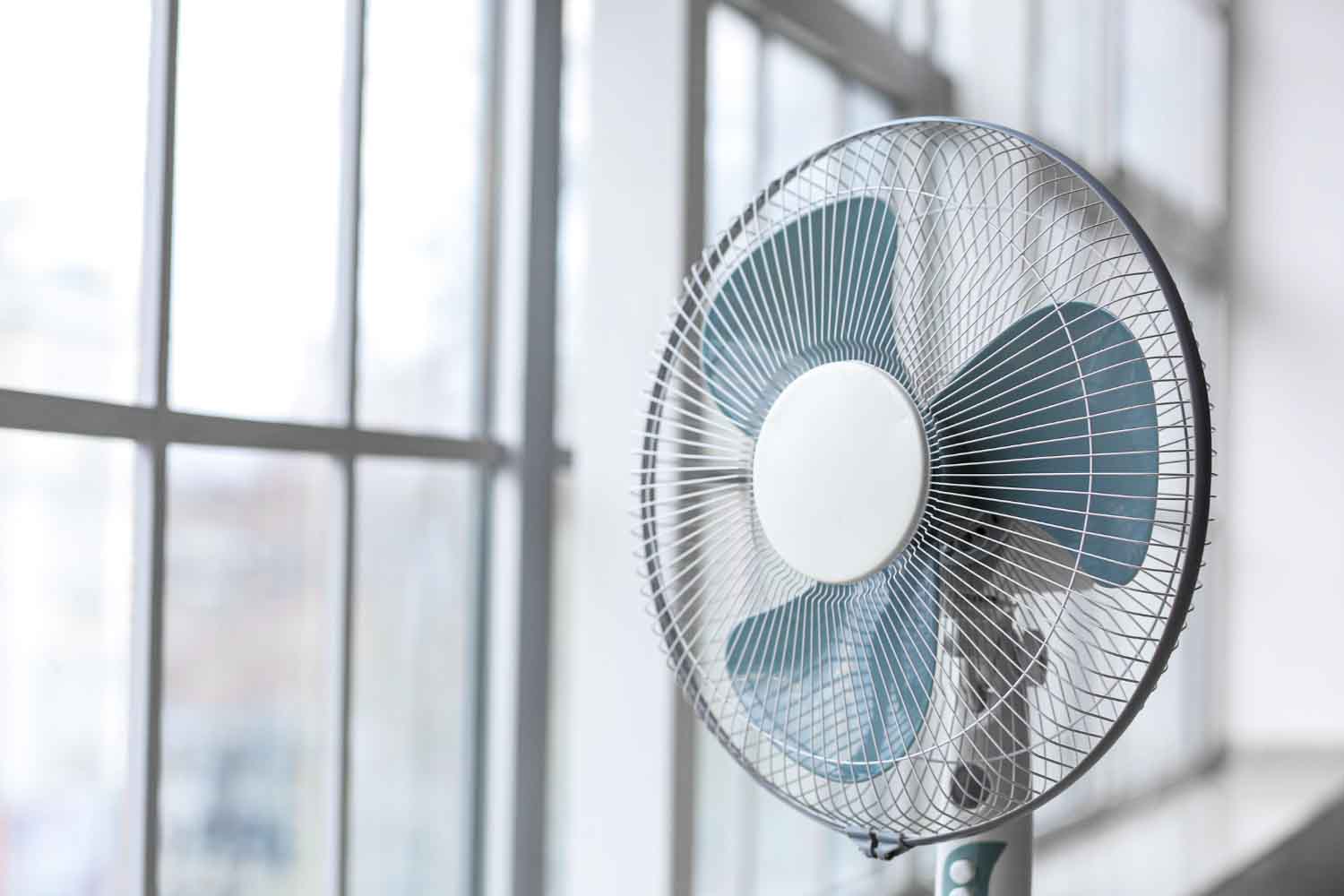
The fan glued to the window seems ready to do its duty. Too bad that, in this way, it ends up putting sticks between the blades: it draws back part of the air in the room and reduces the flow that it should expel. To really let the heat out, it should be facing outwards and set back at least half a metre, leaving another window open on the opposite side of the house.
It was measured by Matthias Wandel, a Canadian engineer and popularizer, with an anemometer and several distance tests. In the tested configuration, the result was clear: fan towards the outside, a little space in front and cooler air drawn from the other side of the house. In short, resting it on the frame makes it work worse just when it should be earning power.
Because the fan glued to the window moves less air
In his experiment on the passage of air through the house, Wandel placed an anemometer in front of a second window and compared different fan positions. This is a domestic test, without scientific review, but conducted with repeated measurements and different configurations.
When the fan tried to draw outside air into the room, the movement detected from the opposite side of the building remained very weak. Turning it outwards, however, increased the flow. The most noticeable improvement appeared when the device was moved away from the window by approximately 50-60 centimetres.
The reason lies in the way the jet crosses the room. The blades push the air in front of the fan and, as it advances, it also drags the surrounding air with it. If the appliance is pressed against the frame or the mosquito net, the flow immediately encounters an obstacle and part of the air goes back around the edges.
By leaving a certain distance, however, a larger mass of air moves towards the window than the one crossed directly by the blades. It is the so-called air entrainmentthe entrainment of the surrounding air into the jet.
The same phenomenon is exploited, with instruments of much greater power, in the ventilation used by firefighters. Tests from the National Institute of Standards and Technology have shown that moving a fan back from an opening can increase the overall volume of air pushed through it. The distances studied by NIST concern professional devices and large buildings, so they do not provide the living room with a universal measurement down to the centimeter.
From 50 centimeters to one and a half metres, the room decides
The best position changes with the diameter and power of the fan, the width of the window, the presence of a mosquito net, the wind and the layout of the rooms. You can start from half a meter away and slowly move back, up to a meter or a meter and a half, observing when the passage of air becomes clearer.
In Wandel’s test, a small table fan placed about 90 centimeters from the window was able to move a quantity of air comparable to that produced by a larger model placed directly against the mosquito net. A more powerful fan helps. A well-made fan, it seems, can make up a lot of ground.
For the system to work, there needs to be a way in. The fan expels air from a window, while another opening, preferably on the opposite side of the house, draws in the outside air. Keeping everything open without criteria risks dispersing the path; it is better to choose which environments to cross and let the flow follow a recognizable direction.
The window should be opened when it is cooler outside
This arrangement does not produce cold air: it replaces the internal air with that available outside. If it’s 35°C outside and 29°C inside, the fan will let the heat in with remarkable diligence.
The system is especially useful in the evening, during the night and in the early hours of the morning, when the external temperature drops below that reached by the rooms. The replacement can also help cool walls, floors and furniture, which have absorbed heat during the day and continue to give it back for hours.
The US Department of Energy indicates the nightly turnover, called night flushingamong the passive strategies useful in areas where the nights are quite cool. Opening windows should be avoided when the outside air is very humid, polluted or warmer than that in the house.
During sunny hours it is advisable to close the windows, lower shutters and roller shutters and limit the entry of direct radiation. The fan can continue to move air over people and make the heat more bearable by evaporating sweat.
To expel the heat accumulated in the rooms, however, you need a window, a second opening and a few tens of centimeters left free in front of the blades. The fan moves the cool air when it finds it. Manufacturing it remains outside of his competence.
