
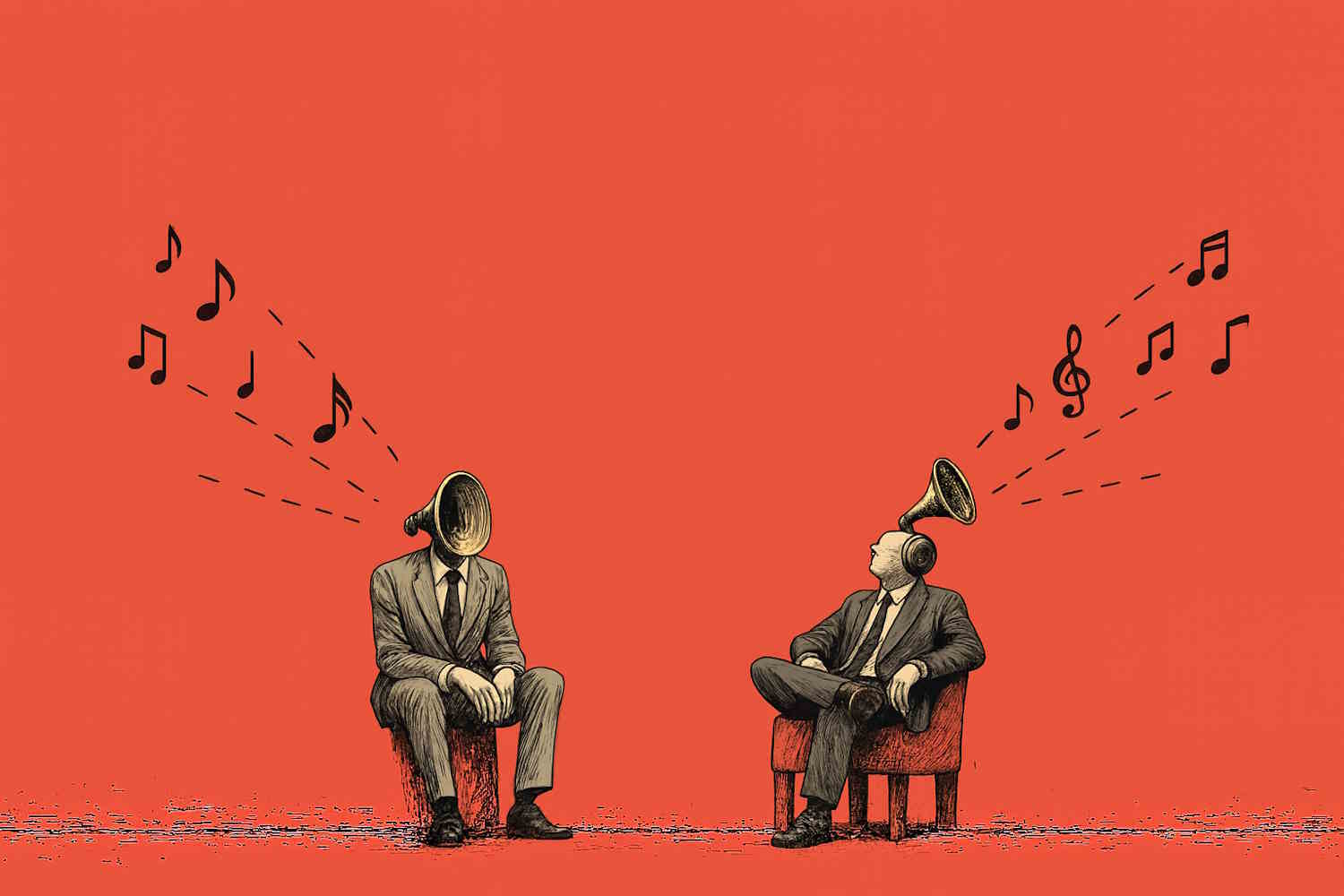
For most people, listening to a beloved song means feeling the heart accelerating and skin fans. But for someone, any melody – from rock to jazz – remains without emotional meaning.
A recent scientific revision published on Trends in Cognitive Sciences It clarifies that these are not hearing problems or “bad musical taste”. The cause is a brain disconnection: the sound correctly reaches the auditory system, but cannot move to the areas that generate the feeling of reward. This disorder has a precise name: specific musical anedonia, or a selective indifference to music in otherwise healthy people.
Studies show that those who suffer from musical aedonia have a normal hearing and react with pleasure to other stimuli, such as winning money in a game. In these cases, the Accibuens nucleus – the nerve center of pleasure – is activated in a normal way. However, when they listen to music, the activity in this area remains minimal, as well as the physiological parameters (heartbeat and skin conductance).
Research suggests that the problem is born in the connection between the upper right temporal cortex and the Accumen Core. There is no direct highway: the elaborate musical signals pass first by structures such as the Orbitofrontal cortex and the insula, true “switchboards” that stop the sound full of meaning towards the pleasure circuit. If these connections are weak, music loses much of its emotional power.
The phenomenon also involves cerebral chemistry: dopamine and internal opioids transform the tension and release into emotions, especially in music, where expectation and surprise follow one another instant after moment.
How to identify musical anedonia
To identify the disorder, scientists developed the Barcelona Music Reward Questionnaire (BMRQ), which measures five dimensions of musical pleasure:
- Emotional evocation – Music ability to arouse intense emotions.
- Mood regulation – use of music to manage emotional states.
- Social reward – benefits deriving from social connections related to music.
- Sense-motor involvement-pleasure in singing, dancing or beating time.
- Musical Research – Desire to discover new pleasant music.
Those who suffer from musical anedonia obtain low scores in all areas. The questionnaire, validated in several languages, has shown a broad spectrum of responses: from total indifference to the so-called hyper-edgesic, for which music is essential.
According to studies on twins, the genetic predisposition would explain up to 54% of the variability in musical pleasure, regardless of the perception of the entry or from the general sensitivity to the rewards. Curiously, in some cases the pleasure linked to the rhythm – like the impulse to move – can remain intact, suggesting that the circuits of the time are more resistant than those related to melody and harmony.
From music to other pleasures
The neuroscientist Josep Marco-Pallarés explains that the problem is not in the malfunction of the reward circuit in itself, but in the way it interacts with the brain areas that process specific stimuli such as music. The mechanism could extend to other areas: each sense uses different ways to reach the center of the reward, and the quality of these connections could determine whoever feels pleasure for a dessert, a hug or a work of art, and who instead remains indifferent.
Some neuromodulation studies indicate that stimulating the reward circuit may increase the pleasure perceived in listening to music. The question remains open: is the musical anedonia permanent or can it be “trained” via training targeted? The authors also speculate inverse scenarios: people with general aedonia could maintain an island of pleasure for a single area, such as music. And for the hyper-eddicals, the same bridge that is missing in some could be reinforced beyond the average.
Don’t you want to lose our news?
You may also be interested in:
