
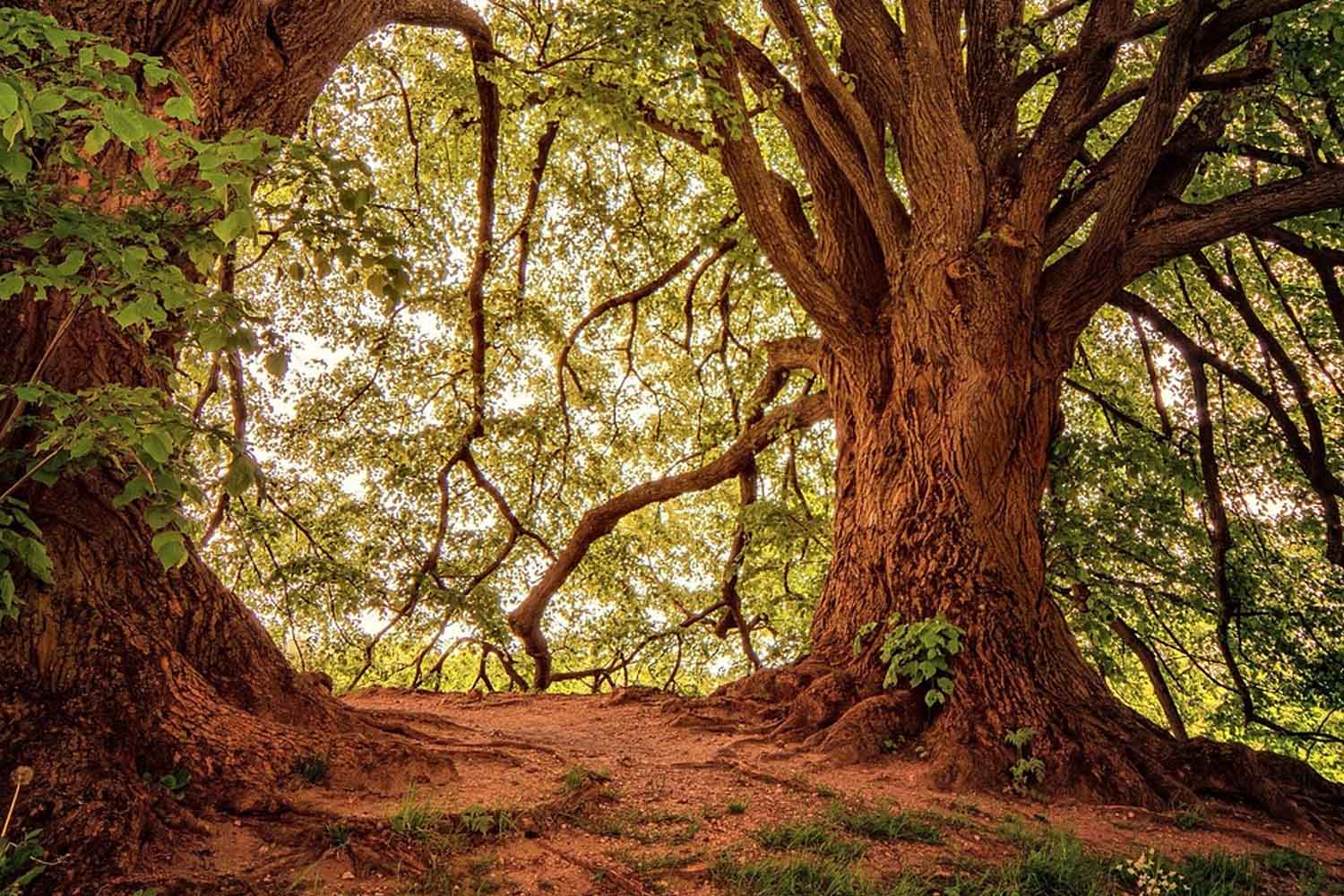
We are used to thinking of trees as large “green lungs”, useful because they absorb carbon dioxide through their leaves. That’s true, but it’s only part of the story. There is something much less visible, and for this very reason even more interesting, that happens along the trunks. In fact, tree bark is not an inert surface: it is a living world, populated by billions of microorganisms that interact with the air we breathe.
Five-year research, conducted in eastern Australia and published in the journal Scienceshowed that logs can contribute to air quality much more directly than previously thought. Not only by absorbing gases, but by chemically transforming them thanks to microbial communities that live permanently in the cortex.
The researchers analyzed eight common tree species, observing them in very different environments: hilly forests, freshwater wetlands, coastal mangroves. What has emerged is surprising for the numbers even before the mechanisms. Each square meter of bark can host up to six trillion microorganisms. Bacteria, above all, which together form a real microbiome, distinct from that of the soil or water.
The study was led by Bob Leung of Monash University in Melbourne, who for years has been working on microorganisms capable of surviving using minimal quantities of gases present in the air. The bark proved to be the perfect environment: stable, always exposed to the atmosphere and crossed by microvariations in humidity and oxygen.
By analyzing the DNA of these microbes, researchers have discovered that many possess the genes needed to “eat” gases such as hydrogen and carbon monoxide. But genetics alone was not enough: to understand if those genes were really active, experimental evidence was needed.
When oxygen changes, the role of the trunk also changes
In the laboratory, portions of bark were isolated in small containers that simulated natural conditions. With normal air, microorganisms began to extract gases from the atmosphere. However, when oxygen was reduced or eliminated, the behavior was reversed and the gases were released.
This step is central to understanding why the contribution of trees is never uniform. Inside thick bark, oxygen can decrease rapidly, especially when humidity is high. In those conditions the microbes change metabolism and move from aerobic respiration to fermentation, also producing hydrogen and methane. It doesn’t take much, therefore, for a trunk to go from being an absorber to a source.
Outdoors, however, direct measurements on trunks tell an interesting story. In different environments, from the coast to inland areas, most trees showed a constant absorption of hydrogen from the trunk surface, in both seasons analyzed. A signal that indicates how these microorganisms are able to work even when the gas concentrations inside the tree are much higher than in the surrounding air.
Because this also counts outside the forests
If you look at the individual tree, the effect seems minimal. But if you broaden your gaze, the dimensions change. Globally, the surface covered by trunks and stems, what scientists call the caulosphere, exceeds 140 million square kilometers. On similar scales, even small gas exchanges become relevant.
Then there is another aspect that makes this discovery interesting also for everyday life. Hydrogen and carbon monoxide compete with methane to react with the hydroxyl radical, a molecule that helps “clean up” the atmosphere. Reducing hydrogen and carbon monoxide means leaving more space for this natural methane control mechanism.
In the case of carbon monoxide, the link to health is direct. It is a toxic gas, produced largely by traffic. Microbes in the bark have enzymes that can turn it into carbon dioxide before it escapes into the air. In urban contexts, where trees coexist with roads and cars, this process could offer an additional benefit, linked not only to the greenery but to the microscopic chemistry of the trunks.
Not all barks do the same thing
Research also shows that there is no “standard cortex.” The structure and chemical composition change from species to species and this influences the type of microorganisms present. Some wetland trees, such as Australian paperbarks, host highly active gas cycling communities. Others, such as certain eucalyptus from drier areas, favor microbes linked to the waxy compounds of the stem.
This means that when it comes to trees and air quality, it’s not enough to count how many plants there are. It matters what they are, where they grow and in what conditions they live. A detail that traditional climate models often neglect, treating trunks as simple “pipes” for gas passage.
The study instead suggests that the cortex is a place of active transformation, capable of changing the composition of gases before they reach the atmosphere. To really understand its impact, data from other countries and climates will be needed, but one thing is already clear: an important part of the relationship between trees and clean air passes through surfaces that, until yesterday, no one really looked at.
You might also be interested in:
