
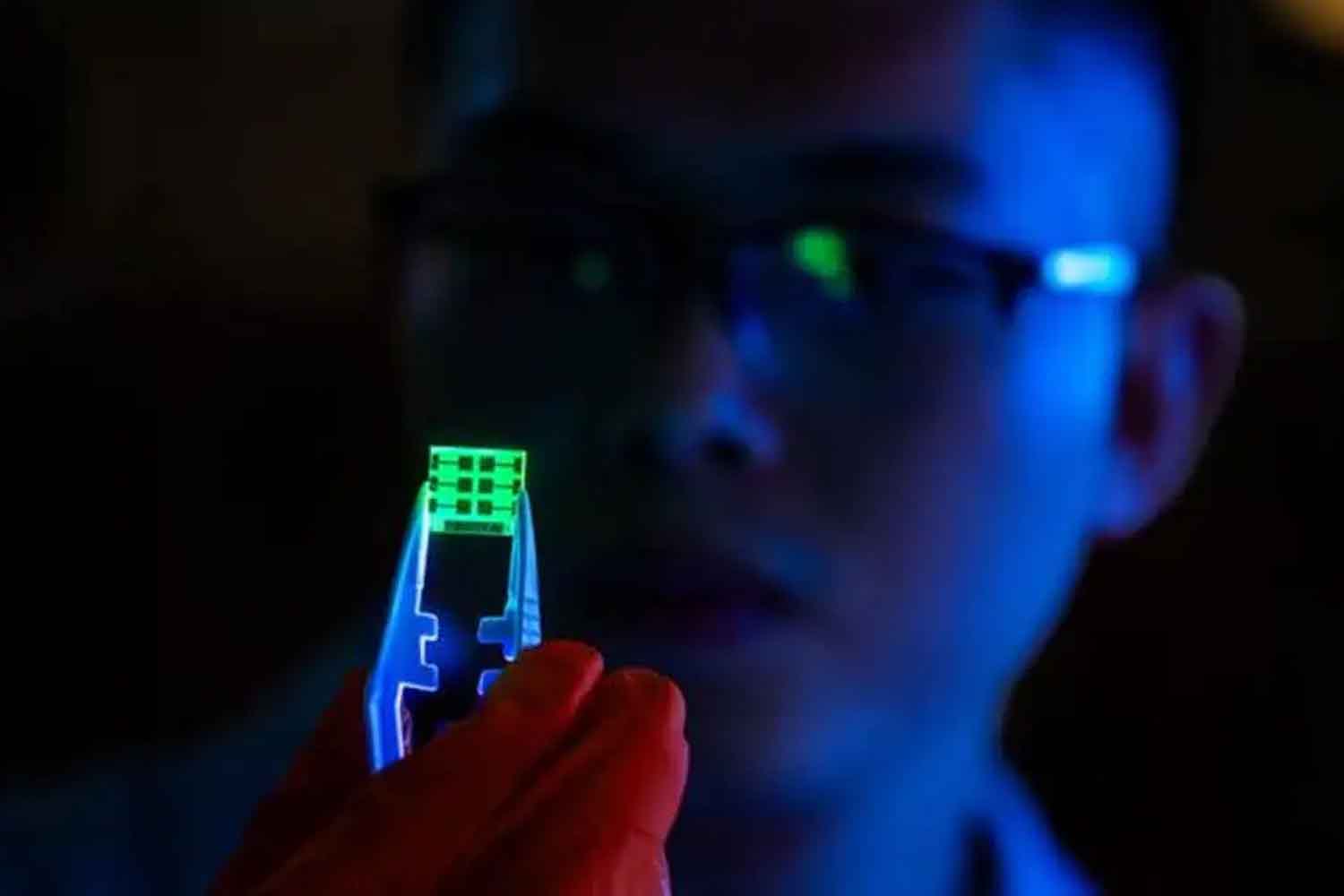
Perovskite LEDs could change the way we light our homes. They cost less, promise more intense colors and could have a lower environmental impact than current technologies.
It seems like one of those innovations destined to revolutionize everything in the space of a few years. And maybe it will be like this. But first there is a knot to untie.
What are perovskite LEDs?
Perovskite LEDs are light-emitting diodes made from a material called perovskite, a mineral based on calcium oxide and titanium that we have so far known mainly for its use in new generation solar panels.
The difference compared to traditional LEDs is concrete. The light bulbs we use today are often based on materials such as gallium nitride, which are expensive and energy-intensive in the manufacturing phase. Perovskite LEDs, on the other hand, can be made through simpler and less expensive processes.
This means, at least on paper, lower costs and a reduced environmental impact already in the production phase. Feng Gao, professor of optoelectronics at Linköping University, talks openly about a new generation of LED technology. Not only for an economic question, but also for the quality of the light: perovskite LEDs are able to produce more vivid and intense colors, a characteristic that makes them particularly interesting for screens, displays, communication systems and even medical devices.
To understand whether they are truly more sustainable, a group of researchers analyzed 18 different devices, covering various shades: red, green, blue, white and near infrared. The environmental performance is comparable to that of OLEDs already mature on the market. An important result, considering that this is a technology that is still evolving. But it’s not all that simple.
Through a complete life cycle analysis – from the extraction of raw materials to disposal – it emerged that the greatest environmental impact comes from the use of electricity and some chemical substances in the production phase. In particular, organic solvents such as acetone and isopropanol, used in cleaning processes. In other words, perovskite LEDs are not automatically ecological: to truly become so, they must improve above all on the production front.
The real obstacle with perovskite LEDs is durability
And here we come to the most delicate point. To offset the environmental impact generated during production, perovskite LEDs should guarantee at least 10,000 hours of operation. This is the threshold estimated by researchers to be able to talk about real sustainability. Today, however, the best devices only achieve a few hundred hours.
Muyi Zhang, a doctoral student at the same university, points out that the development of the technology is accelerating and that the duration is progressively increasing. The 10,000 hour target is considered achievable, but has not yet been achieved.
Meanwhile, other research groups have developed perovskite LEDs that are a thousand times brighter than traditional OLEDs. The prospects are also interesting on the economic front: in the future it could reach around 100 dollars per square meter, making this technology competitive compared to current panels.
The study, published on Nature Sustainabilityspeaks of great commercialization potential in the long term. If lifespans are significantly extended, perovskite LEDs could not only rival, but surpass traditional LEDs in both cost and environmental impact.
And then the question becomes broader. When we talk about sustainable lighting, we only think about energy consumption while the bulb is on. But the real difference comes before and after: in the materials, in the production, in the duration, in the disposal. The light of the future may be brighter. But to be truly green it will have to last long enough to deserve it.
You might also be interested in:
