
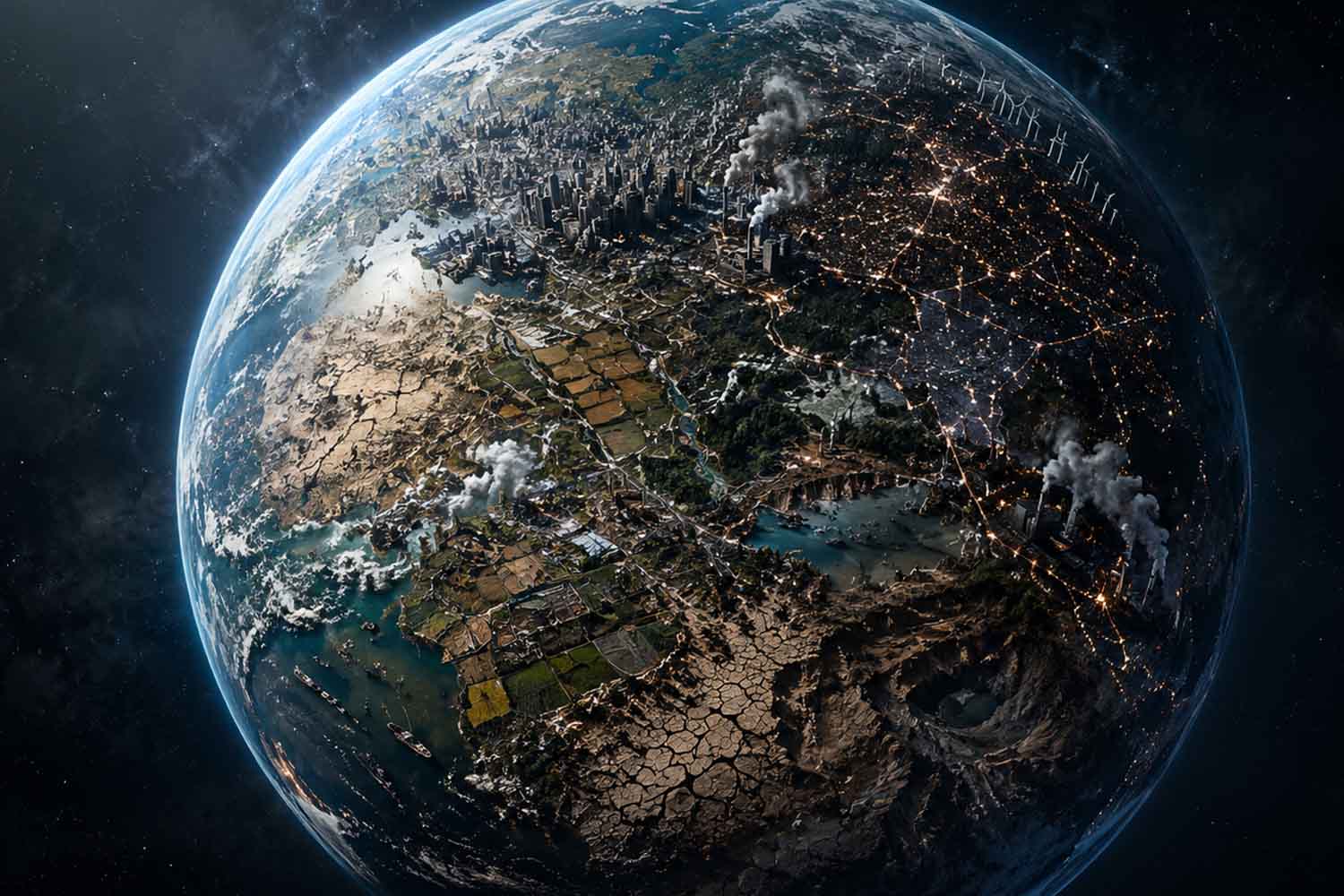
The most inconvenient figure has the neat appearance of a subtraction: 8.3 billion people today, around 2.5 billion as the threshold compatible with a stable life within ecological limits, almost six billion bodies, houses, meals, travel, schools, hospitals, consumption and waste beyond that theoretical margin. Put like this, it seems like a condemnation. Instead it looks more like a bill left on the table for decades: fossil energy, industrial agriculture, transformed soil, goods brought from one part of the world to another, water withdrawn, biodiversity pushed into corners.
A study published in Environmental Research Letters argues that humanity has long exceeded the Earth’s sustainable carrying capacity, that is, the number of people the planet can support over the long term without consuming the systems that make life possible. The work analyzes over two centuries of global demographic data and places a precise turning point in the early 1960s: from that moment on, population growth continued to increase in absolute terms, while the growth rate began to lose strength. The authors call this phase “negative” and read it as an ecological signal: the human system has begun to run beyond the regenerative margin of the planet.
The 1962 bill
Before the mid-twentieth century, the human population followed a trajectory that ecologists describe as facilitation. More people meant more work, more infrastructure, more ideas, more technology, more ability to produce food, cure diseases, build cities, connect territories. Growth fueled more growth. Then the curve changed slope. According to the study, in 1962 the world entered a phase where adding population stopped resulting in ever-faster population growth. The data comes eight years before 1970, indicated by the work as the start of the global biocapacity deficit, when the human ecological footprint exceeded what the Earth could regenerate in a year.
Here we need to keep together two things that are often separated for convenience. Population matters. Consumption matters. The richest part of humanity weighs much more than the others on the extraction of energy, materials, land and food. However, the study insists on a rough fact: during the negative phase, the overall size of the population is strongly correlated with the increase in temperatures, the ecological footprint and total emissions. Translated without making an ideological bludgeon: the problem concerns how many people live on the planet and, at the same time, how they live, how much they consume, which sources they depend on, which economic systems continue to ask for continuous growth as if the matter were an annoying detail.
Human beings are defined by the authors as “ecosystem engineers”. The formula is cold, but it gives a good idea. We have irrigated deserts, moved food across oceans, burned fossil fuels to multiply the work of machines, invented fertilizers, transportation, plastics, electricity, global supply chains, modern medicine. The result was enormous: more lives saved, infant mortality dropped, life expectancy increased, absolute poverty reduced in many areas of the world. A huge part of humanity’s recent history is a history of material improvement.
The price remained in the small column of the balance sheet for too long. That well-being was built by drawing on natural capital, especially fossil ones, at a speed exceeding the ability of ecosystems to reconstitute. Modernity has raised the apparent ceiling: more crops, more energy, more goods, more artificially supported inhabitants. Meanwhile, greenhouse gases, land conversion, pollution, loss of biodiversity and pressure on water resources were increasing. The trick worked as long as the bill seemed distant. Now it arrives in the rising heat, in the territories that are losing fertility, in the cities that chase water, in the animals that disappear from the counts.
Maximum and sustainable
The most delicate step of the study lies in the difference between maximum population and sustainable population. The first indicates how many people could live on Earth in a stripped-down scenario. The model used by the researchers estimates a possible peak of between 11.7 and 12.4 billion people between 2067 and 2076, if current trends continue. It would be a high limit, reached amid growing pressure on food, water, energy, climate and social stability.
The second figure tells something else. A sustainable population asks how many people can live with dignified well-being, economic security and a footprint compatible with the regeneration of the Earth. The estimate indicated by the study is around 2.5 billion people, an order of magnitude close to the world population of the mid-twentieth century. An additional check comes from the ecological footprint: today humanity uses resources at a rate equal to approximately 1.7 Earths each year, according to the Global Footprint Network. The authors of the work reason on an even more prudent threshold, below an Earth, even around half an Earth, to leave room for the recovery of ecosystems and other species. With current average standards and current inequalities in consumption, this would bring the population compatible with those limits to around 2.35 billion.
This figure may sound repulsive, especially because the issue of population brings with it a long history of abuse, racism, violent policies and authoritarian shortcuts. The study, however, indicates another direction: reduction of excessive consumption, voluntary decline in fertility, education, reproductive health, poverty reduction, long-term planning, protection of natural systems. Outside the field of taxation. Inside the much more uncomfortable field of collective responsibility and material justice.
The work also avoids the script of immediate collapse. No disaster movie scenes with cities turned off tomorrow morning. The trajectory described is slower and more concrete: more food and water instability, more climate impacts, more inequalities, more biodiversity lost, more tension on economic systems dependent on fossil energy. The fragility of that model is seen every time a geopolitical crisis touches oil, gas or trade routes. Tensions and war between the United States, Israel and Iran in 2026 have already shown how quickly energy shocks can hit prices, transportation and supplies.
The narrow way
The unpleasant point, to be handled with care, is that the world population continues to grow while the material model on which it rests remains too heavy. Fossil fuels have served as a crutch: they have enabled bigger harvests, faster transportation, bigger industries, denser cities, more advanced hospitals, longer lives. They also masked the limit. Like when you get by with a credit card that’s already maxed out and for a few months it even seems like you have some margin.
Sustainable population therefore becomes an uncomfortable word because it forces us to escape from easy sentences. Reducing everything to the number of inhabitants would be a brutal shortcut. Reducing everything to the consumption of the rich, leaving out the demographic dimension, would be another shortcut, only more elegant. The study brings both things together: quantity of people, quantity of consumption, quality of energy systems, distribution of wealth, use of land, water, biodiversity, materials. The Earth supports many human beings if the way of life is within what ecosystems can rebuild. It holds much less when a part of the world consumes as if it had reserve planets.
The path indicated is always the same, but still not sufficiently listened to: less energy waste, less dependence on fossils, food produced with less pressure on soil, water and biodiversity. Education, especially for girls and women, real access to reproductive health, poverty reduction, cities designed to consume less, economies capable of measuring well-being without nailing it to infinite growth. All much less seductive than a technological promise that fixes everything by itself. Much closer to real work.
The most annoying part of this study lies here: it doesn’t talk about an abstract planet, but about our daily organization. How many kilometers we travel, how much energy we waste, how much food we throw away, how much land we occupy, how much plastic we produce, how many objects we buy to fill gaps that last half an hour. He also talks about the governments that continue to treat the ecological limit as a side chapter, useful for a press release, expendable as soon as a price crisis or a stock on the stock market arrives.
The 2.5 billion threshold should not be read as an invitation to look at people as too many numbers. That would be the worst, and most dangerous, way to use this job. It should be read as a measure of the excess of the system we have built: a system capable of improving the lives of billions of people and, at the same time, consuming the base that supports it. The contradiction is all there, without the need to dress it up as an apocalypse. Earth does not send gentle reminders. It shifts the seasons, dries up the margins, narrows the possibilities. Then he presents the account in the dry language of finite things: water, soil, food, energy. We add the rest, with our best apologies.
You might also be interested in:
