
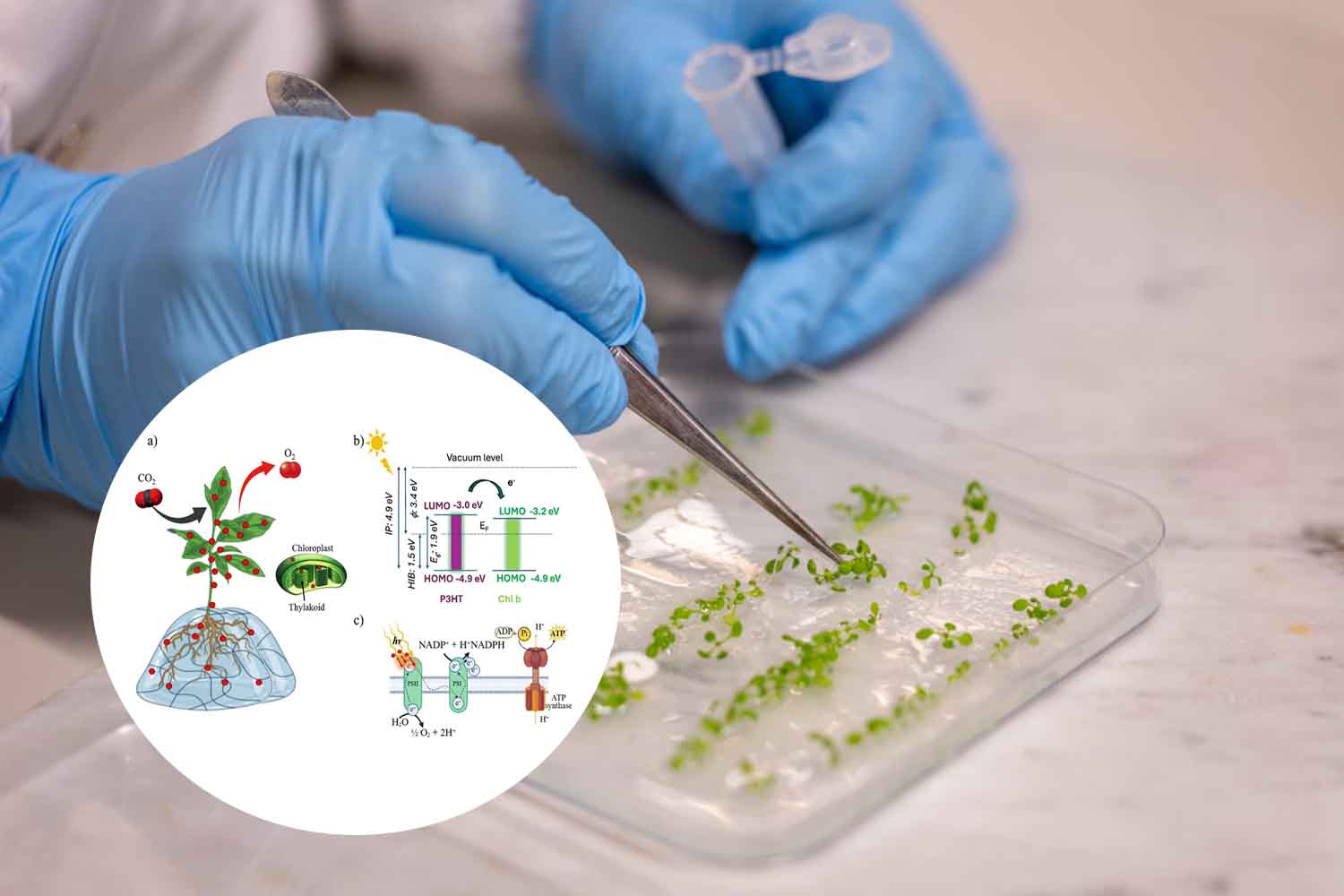
It is a living organism, a plant. It grows, breathes, transforms light into energy. And within itself it houses something that until recently we would have only imagined in an advanced materials laboratory. It’s one biohybrid planta vegetal being that integrates engineered components capable of amplifying natural functions such as photosynthesis, growth and response to environmental stimuli.
This story takes shape in the Sensing Technologies Lab of the Faculty of Engineering Free University of Bolzanowhere a team of researchers, together with other departments and international research centers, created the first completely biohybrid plant by inserting nanoparticles directly into plant tissues. The result is a plant that captures sunlight better, grows more and opens up concrete prospects in the capture of atmospheric CO₂ and the production of bioenergy.
More light in the leaves, more growth, more CO₂ absorbed
The protagonist is the common Arabess, Arabidopsis thalianaone of the most studied plants in the world and the first of which the entire genome has been sequenced. Working on her means being able to observe every change with great precision.
Poly(3-hexylthiophene) nanoparticles, called P3HT, have been integrated into this plant. It is an organic polymer composed of long chains of molecular units containing carbon atoms that repeat like a necklace. A material capable of conducting electric current and already studied for flexible solar panels and green electronics.
The particles are tiny, about five hundred times thinner than the diameter of a human hair. This size allows the roots to absorb them and transport them to the leaves. Once there, they act like micro-antennas that also intercept green light, a part of the spectrum that plants use less than blue and red. Expanding the range of available light means feeding the photosynthetic process with greater intensity.
The data shows a clear change. P3HT-treated plants developed 45% longer roots than controls. Biomass increases up to 17%. The net assimilation of CO₂ increases by 11%, a sign of more intense photosynthetic activity. The leaves expand, the root system strengthens, the entire plant appears more vigorous.
Outlook for agriculture and energy
The study was published on Materials Horizons. In addition to the Free University of Bolzano, the Bruno Kessler Foundation, Eurac Research, the Ludwig-Maximilians-Universität of Munich, the Institute of Materials for Electronics and Magnetism of the Cnr and Elettra Sincrotrone Trieste collaborated.
The real novelty concerns the in vivo integration of nanoparticles into the entire plant. The P3HT-NPs enter the root system, move along the tissues and reach the leaves, where they are observed via confocal microscopy as small fluorescent dots sub-micron. Their presence suggests an interaction with chlorophyll capable of supporting the electron transport chain in the thylakoids, with an energetic alignment between the electronic levels of the nanoparticles and those of the chlorophyll which makes an energy exchange plausible.
The picture that emerges is that of a biohybrid plant capable of making better use of available light and transforming it into growth and absorption of CO₂. Imagined applications cross thesustainable agriculture hey renewable energy systemswith the prospect of more efficient plant organisms in carbon capture and in the production of oxygen.
Studies remain open on the long-term environmental impact, on the persistence of nanoparticles in the soil and on the interaction with ecosystems. Future research will delve into photosynthetic parameters based on chlorophyll fluorescence, subcellular localization with electron microscopy, and fluorescence lifetime analysis to better understand mechanisms at the organelle level.
This biohybrid plant marks a shifting boundary. Biology and materials dialogue inside a leaf, and from there a broader reflection opens on how we can rethink energy, agriculture and climate.
