
Artificial intelligence could soon help us more accurately predict the risk of sudden death from cardiac arrest: a research team led byUniversity of California at Berkeley (UC Berkeley, USA) trained an artificial intelligence model, “teaching” it to recognize the electrocardiograms of people at higher risk.
Cardiac arrest
While a heart attack is caused by a reduction in blood flow to the heart, cardiac arrest occurs when the heart’s electrical current suddenly stops. Cardiopulmonary resuscitation and a shock from an automatic external defibrillator can save lives, but about 90 percent of those who suffer sudden cardiac arrest outside of a hospital die within minutes.
Because people die so abruptly, it’s difficult to know what was happening inside the heart before it stopped. Autopsies may reveal some details about its structure, such as blocked blood vessels or hardened tissue, but the actual functioning of the heart before death remains something of a “black box.”
As the Istituto Superiore di Sanità explains, cardiac arrest is the third cause of death in Europe: in particular, the annual incidence of out-of-hospital cardiac arrest varies between 67 and 170 cases per 100,000 inhabitants, with an average survival of 8%, while between 1.5 and 2.8 per 1,000 hospitalizations, with 30-day survival of between 15% and 34% for that intrahospital.
In Italy, the management of arrest presents significant heterogeneity: a meta-analysis published in 2020 and conducted on over 43,000 cases highlighted an average incidence of 86 cases rescued by emergency services and 55 cases treated with cardiopulmonary resuscitation per 100,000 inhabitants/year. But, despite a 19% return of spontaneous circulation, overall survival stands at 9% and survival with good neurological outcome at 5%.
The organization of the emergency system also shows a varied territorial distribution, differences in the use of 112/118, in the training of operators, in the pre-arrival instructions and in the protocols for the use of semi-automatic external defibrillators.
Extra help from Artificial Intelligence
©Nature
With a new tool that could revolutionize this process, UC Berkeley researchers have discovered a previously unknown signal in electrocardiograms that can better spot high-risk patients before their hearts stop.
Specifically, using over 440,000 electrocardiograms (ECGs) from Sweden, combined with information from death certificates, the researchers trained an artificial intelligence model to analyze the spikes and waveforms produced by the heart’s electrical currents.
They fed the model detailed scans of healthy people, at-risk patients and people who later died from cardiac arrest, until it was able to recognize the patterns waveforms in people who later suffered sudden cardiac death.
Then, over the course of several years, the researchers tested the model on thousands of other patient records from the United States and Taiwan.
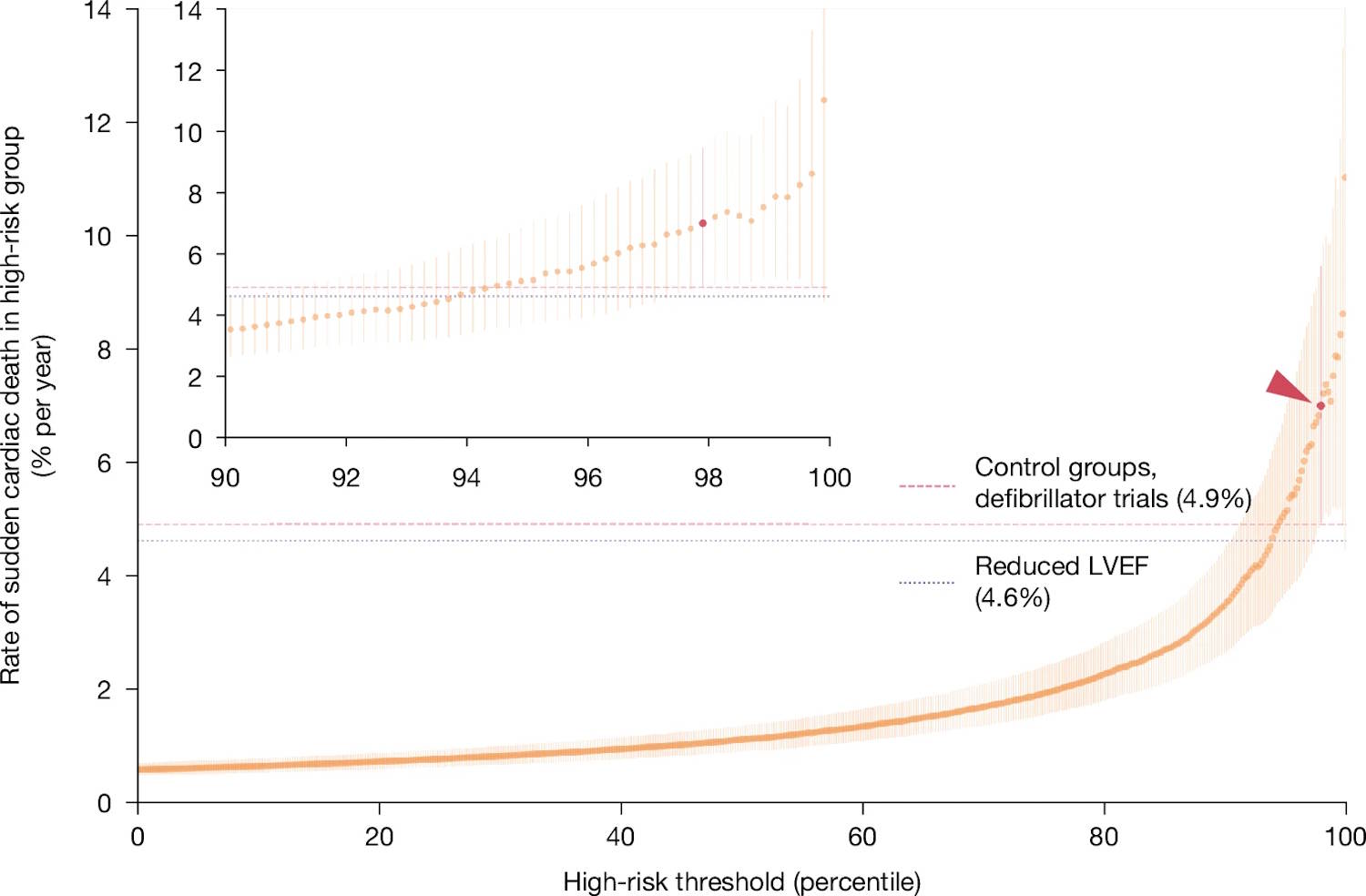
The algorithm’s analysis of patients’ electrocardiograms surpassed the performance of standard clinical tests, which measure the amount of blood expelled from the heart with each beat: in fact, these tests identify a high-risk group with a 4.6% annual rate of sudden cardiac death, while the artificial intelligence system identifies a high-risk group with a 7% annual rate, that is, thousands of patients of difference every year, the vast majority of whom, according to current standards, present a low risk.
©Nature
In other words, the model identified a larger group of high-risk patients and more accurately predicted who would suffer sudden cardiac death, all based on images widely available in medical centers around the world.
The study could allow doctors to more precisely identify who needs an implantable defibrillator, and paves the way for new research into the physiological mechanism identified by the artificial intelligence tool, which appears to be related to sudden and fatal cardiac arrest.
Medical decisions are really difficult, and that’s why artificial intelligence excites me so much – comments Ziad Obermeyer, lead author of the study – Not only can we make better decisions, but also start to understand what is really happening to these patients before their hearts stop
In fact, the most commonly used method to identify patients at risk measures the amount of blood pumped by the heart with each contraction: if this frequency is lower than a certain threshold, the patient may be eligible for the implantation of a defibrillator.
But this test requires patients to undergo a more thorough medical evaluation, which the vast majority of victims did not know they needed. Furthermore, two-thirds of implants for these presumably high-risk patients never activate.
This means patients undergo invasive and expensive procedures to prevent an emergency that may never occur. And in the meantime, thousands of people who didn’t know they were at risk die every year.
In some of these people, we could have prevented those deaths if only we had known about it in time. Many lives are lost due to sudden cardiac deaths, which would be preventable if we had better AI tools to detect them
The next steps
The next phase of the project has already begun: Researchers are collaborating with health systems in Sweden, Taiwan and the United States to implement the algorithm on hospital electrocardiogram databases: for those the algorithm flags as high risk, doctors could alert patients and offer them the option to wear a patch that continuously monitors their heart.
This data could also help researchers better understand the physiological mechanism within the heart that generates signals apparently related to elevated risk, and even lead to the implantation of a potentially life-saving internal defibrillator.
The scientists also designed and put online a website where people interested in assessing their risk can submit basic information and their email address, allowing the research team to contact them for analysis of electrocardiograms once the AI tool becomes more widely available.
A new way of doing science will also be born from these tools – concludes Obermeyer – and it is stimulating to think about how this process will begin
The work was published on Nature.
Sources: UC Berkeley/Nature
