
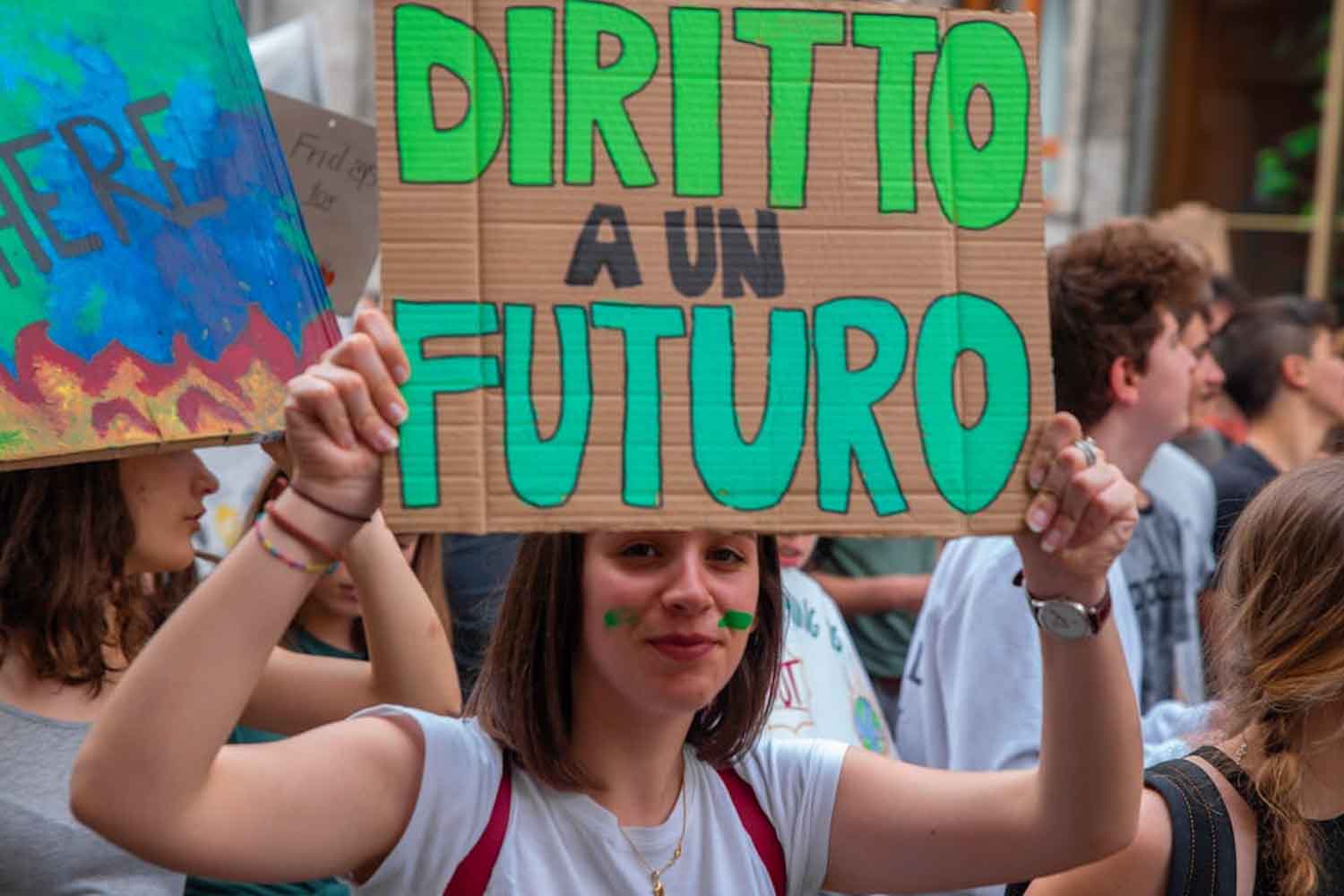
It is enough to listen to a conversation outside a school, on the subway, in front of a university, to realize that the lightness of eighteen years old has a different sound today. There are those who talk about competitions that are already saturated before even trying, those who imagine abroad as plan B with the same naturalness with which one once chose a faculty, those who open the phone and find on the same screen a war, a flood, a new price crisis, a politician who promises a future with the face of someone who is selling a sofa on sale. Gen Z grows into this mix. Then comes the adult comment: they are fragile, anxious, disillusioned. Perhaps the more precise word is another: they are awake. And often very tired.
A survey by the Inequalities and Diversity Forum, conducted on approximately 3 thousand male and female students between the ages of 17 and 19 in 21 Italian schools, presents a fairly clear picture. At the top of the concerns are the lack of work, war, people’s rights and the lack of weight of the voice of young people. The most shocking data concerns precisely this: 81.5% think that their voice does not count in important decisions. The lack of work reaches 3.8 points out of 5, the war at 3.6, the rights and voice of young people at 3.5. On biodiversity and climate change the picture appears more divided: around a quarter of students say they are very worried, while just under 20% say they are not at all.
Fear has very normal data
The most convenient thing would be to archive everything under the label of generational anxiety. It works well in talks, it doesn’t last long, avoid watching the rest. But the Italian numbers say otherwise. ISTAT has found that between the ages of 11 and 19, one in three children says they are afraid of the future and 34% would like to live abroad when they grow up. Inside that desire to escape there is curiosity, ambition, desire for the world. There is also the feeling that the country offers little space to those who arrive later.
Work is the first crooked brick. In March 2026 the general unemployment rate in Italy fell to 5.2%, however the youth unemployment rate rose to 18.1%. The decline in people looking for work affects almost all age groups, except 15-24 year olds, where the number of unemployed is growing slightly. It’s one of those statistical phrases that seem neutral until you put them next to a twenty-year-old person who has to choose whether to study further, accept a low-paid internship, stay in their parents’ house, postpone everything.
Insecurity, for those under thirty, is rarely an abstract word. It’s the short contract, the endless internship, the rent that eats up half your salary, the request for experience for first-time jobs, the rhetoric of merit pronounced by a country where being born into the right family continues to weigh heavily. Gen Z hears all of this before they even really enter the market. He breathes it at home, in older brothers, in cousins, in friends who have just graduated, in parents who do the math at the table with the same attention with which they defuse something.
Climate and war enter the room
The climate weighs more silently and more strangely. According to ISTAT data taken from UNICEF Italy, 70.3% of boys and girls between 14 and 19 are worried about climate change. In the UNICEF-YouTrend survey, 22% of Italians recognize their experience as very or somewhat compatible with ecoanxiety; 7% report weekly physical symptoms related to environmental anxiety, such as headaches, muscle tension, nausea or palpitations, while 9% talk about psychological symptoms, including recurrent and uncontrolled thoughts.
Even war has ceased to be a distant chapter in the history textbook. It enters notifications, family discussions, bills, the words rearmament, security, borders, missiles, refugees. The OECD, in the 2026 report on the mental health of children, adolescents and young people, speaks of a widespread worsening of mental health under 25s in most member countries and indicates a sum of pressures that reinforce each other: economic insecurity, school pressure, climate anxiety, global turbulence and conflicts. These factors, taken together, contribute to a crisis that was already visible before the pandemic and which Covid has aggravated.
Politics often arrives late on this matter. When he speaks to young people, he uses two opposite and equally useless registers: stage encouragement, full of future, talent and innovation, or rebuke. Study, work, commit, participate. As if the problem was just a lack of individual posture. As if it were enough to stay upright in the chair while the floor tilts.
The future promised badly
The European data broadens the scene. In the European Parliament’s Youth Survey 2024, conducted on over 25 thousand young people aged between 16 and 30 in the 27 Member States, the priorities indicated for the next five years are prices and cost of living at 40%, environment and climate change at 33%, economic situation and job creation at 31%. In Italy, the environment and climate reach 46%, work and the economic situation at 38%, the cost of living at 34%. These are percentages that describe a generation that is much less superficial than the caricature that is plastered on it.
Gen Z isn’t watching a single fire. He sees three or four at the same time. The climate changes, work no longer guarantees a trajectory, war returns to the daily lexicon, politics seems to ask for consensus without granting weight. In between, the school tries to do what it can, often with old tools, busy programmes, few spaces for real listening, adults as exhausted as the children.
The word “listening”, in fact, has become almost suspect. Everyone listens to young people, on paper, then important decisions travel elsewhere. And so that mistrust must be taken for what it is: a signal. The 81.5% who feel they don’t count does not describe a listless generation. It describes a frayed covenant. If a person grows up with the idea that their voice is of little use, first it shuts down, then it makes do, then it goes away. Sometimes physically. Sometimes just with your head. Gen Z doesn’t ask to be pitied: they ask to stop preaching at no cost. Because by telling kids that they have to believe in the future, someone should at least avoid handing it to them already dented.
You might also be interested in:
