
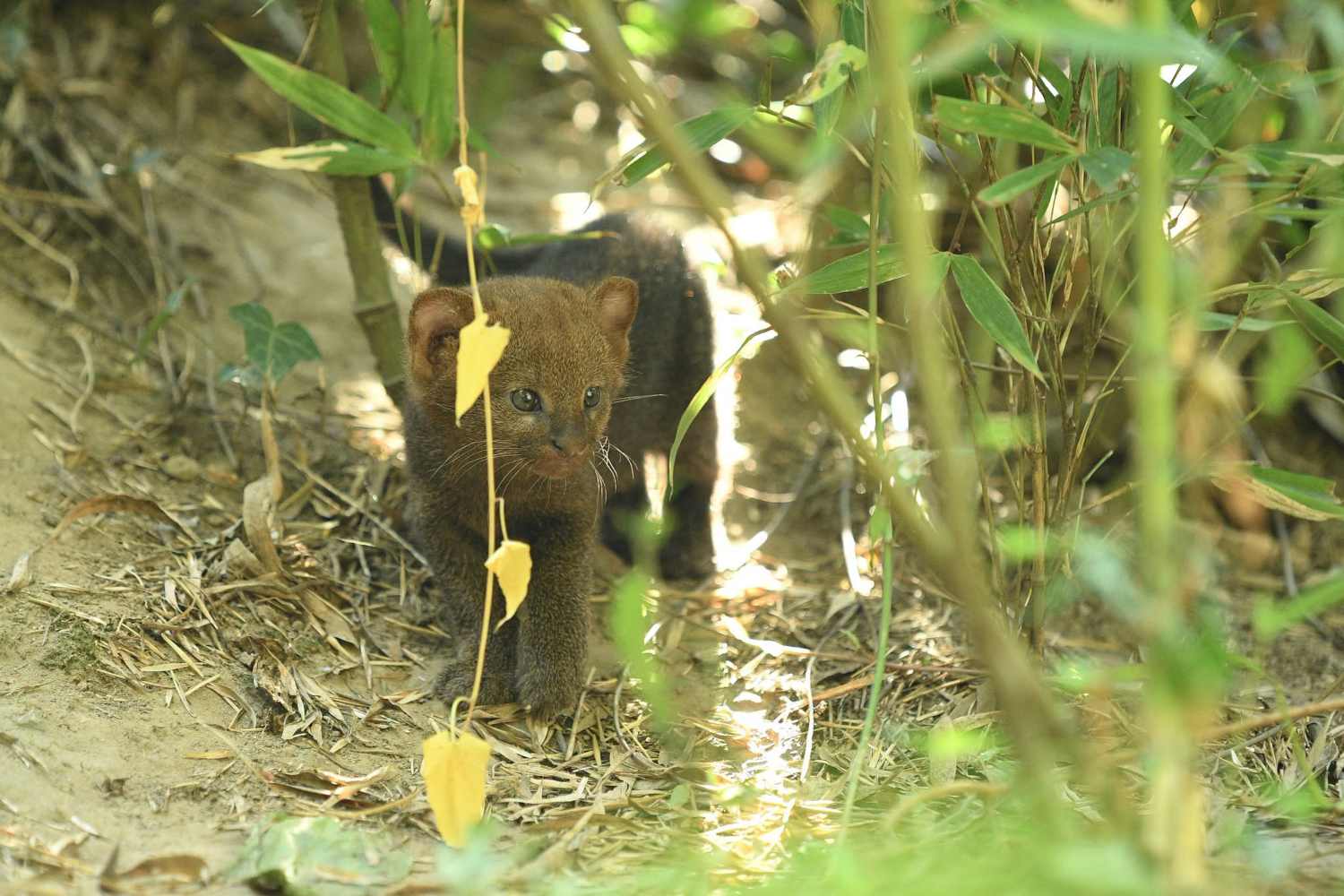
A few weeks after the birth of a baby ocelot, the La Torbiera Wildlife Park located in Agrate Conturbia, in the province of Novara, recorded the arrival of a baby jaguarundi, known scientifically as Herpailurus yagouaroundi. This rare felid, often called the otter cat due to its elongated body, short legs and smooth, unspotted coat, represents one of the most discreet and least known mammals on the American continent.
Although for the first few weeks the mother tends to protect him in the most sheltered corners of the structure to provide him with the necessary care, the little one is already at the center of media attention. However, the curiosity and clamor of visitors hide a much more complex reality: the young specimen will never see its native forests, remaining confined within an enclosure.
The biology of the otter cat and the research work of Tadeu de Oliveira
Weighing between 3.5 and 7.5 kilograms, the jaguarundi is genetically similar to the puma and the cheetah. Unlike many other felines, it has diurnal habits and hunts in open spaces, feeding on small mammals, birds, reptiles, amphibians and fish, thanks to its exceptional swimming and climbing skills. The species ranges from southern Mexico and southern Texas through Central America to central Argentina. Nonetheless, it remains one of the most elusive and least studied predators: to monitor its habits, a female in Brazil was recently fitted with a GPS radio collar before being released into its natural environment.
A life behind bars transformed into a media phenomenon
The announcement of the new baby at the Wildlife Park immediately transformed the little one into a web star, attracting thousands of interactions on social networks, and is already becoming a top attraction. However, the puppy will not know the freedom of open spaces nor will he be able to follow the primordial instincts of his species. Its existence will take place entirely within fenced perimeters, thousands of kilometers away from the ecosystems of Latin America.
The risk of extinction in nature and human threats
And while this puppy will grow up in confinement, outside the cages the species faces an unprecedented crisis. The IUCN has raised the jaguarundi’s status to near-threatened, estimating a remaining population of just 13,000 adult specimens. Habitat fragmentation, the presence of high traffic road networks and conflict with breeders and farmers are decimating wild individuals. Added to these pressures are the transmission of lethal diseases such as mange and rabies, spread by stray dogs. The animal risks disappearing from its territories of origin, making the contrast between the loss of wild biodiversity and the birth of specimens in captivity increasingly stark.
