
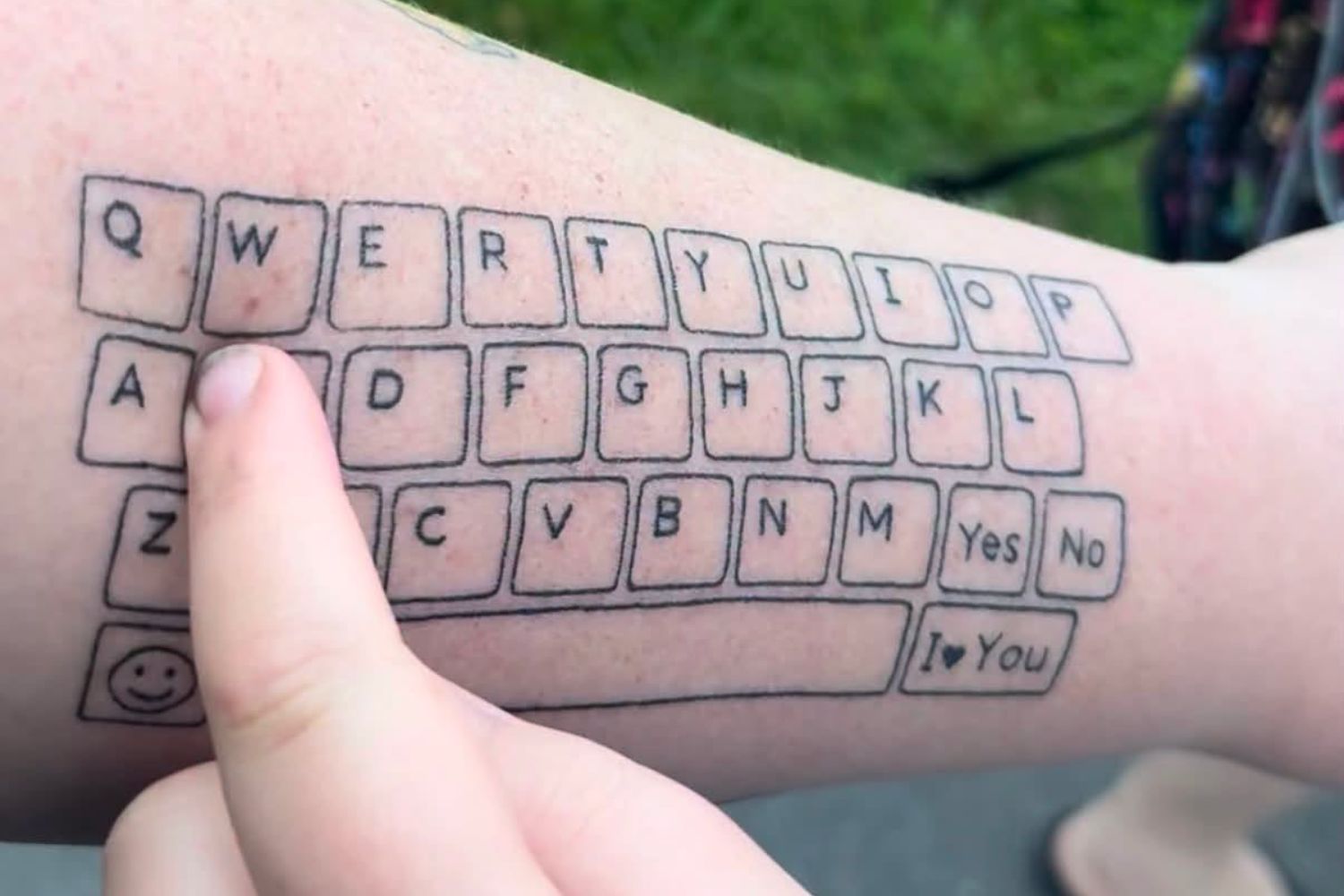
Maternal love can overcome any technological or linguistic barrier, transforming a moment of discouragement into an intuition capable of traveling around the world. Jessica Fletcher, a Canadian mother from Fredericton, found an extraordinary solution to ensure that the voice of her son Hunter, a non-verbal 11-year-old autistic boy, would never be left in the dark again.
During a dinner in a restaurant, the electronic device for Augmentative and Alternative Communication (CAA) used by the little boy suddenly ran out of battery. Faced with her son’s forced silence, Jessica Fletcher tried to write the alphabet on a sheet of paper, but the child turned the napkin over and drew a Qwerty keyboard on it. Understanding the message, the woman turned to Main St Tattoo to permanently etch that interface onto her forearm.
From special keys to the first word typed on your skin
The tattoo created on Jessica’s arm does not only reproduce traditional letters, but includes personalized commands designed for their everyday life: the keys dedicated to the expression “I love you” and the icons for happiness and sadness. As soon as the work was completed, Hunter immediately tested the new ‘body to body’ communication tool, and the first word composed by touching his mother’s skin was “mama”. This method guarantees the child privacy that tablet voice synthesizers could not offer, allowing him to express thoughts and moods in an intimate and direct way. The story was documented on the Hunter’s Voice Facebook page, where the woman talks about the challenges and successes related to autism.
The global phenomenon: from T-shirts to tattoo parlors
The video released online sparked a chain of solidarity and innovation that crossed Canada’s borders. In collaboration with the Maritimer brand, a line of t-shirts was created that features the same Qwerty keyboard on the fabric. The first to wear them were Hunter’s schoolmates, enthusiastic about being able to interact directly with him without electronic intermediaries. The project is now finding application among nurses, first responders and educators, while numerous tattoo studios around the world have begun to offer the same design to parents of non-verbal young people, transforming a private gesture of love into a new standard of universal accessibility.
