
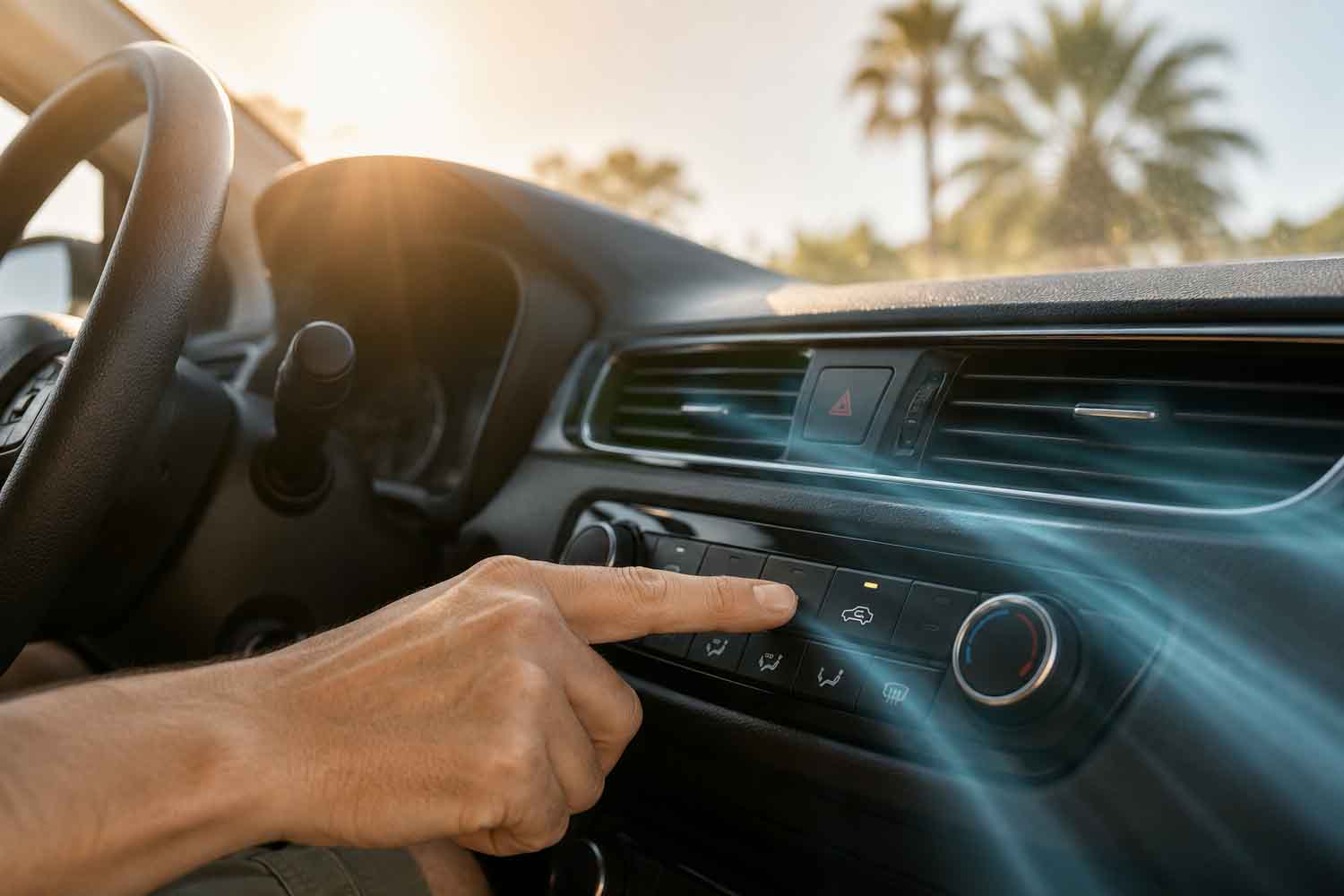
The car remained parked in the sun, the steering wheel is hot and a breath-taking heat rises from the seats. You get in, start the engine and your hand immediately reaches for the air conditioning. Not far away, that button appears with the drawing of a car and an arrow folded on itself: it is the air recirculation, one of the simplest controls on the dashboard and also one of the most discussed during summer trips.
Activating it allows the passenger compartment to cool more quickly, because the system stops continuously drawing in hot air from the outside and goes back to working on the air already present in the car. Using it for hours, however, reduces air exchange and favors the accumulation of carbon dioxide produced by breathing. The solution involves alternation: recirculation in the hottest or polluted phases, external air when the temperature has stabilized.
It is best to let the hot air out first
Inside a closed car left in the sun, the temperature can quickly rise well above that outside. Turning on the air conditioner immediately with the windows closed means asking it to cool an already scorching mass of air.
It is therefore advisable to open the doors or windows for a few moments, letting the accumulated heat escape. A few minutes are enough, or a short distance driven at low speed with the windows down. The air conditioning thus starts from less demanding conditions and manages to make the passenger compartment liveable more quickly. The US Department of Energy also recommends traveling briefly with the windows open before turning on the air conditioning, as ACI also reminds us in the instructions dedicated to driving during the hottest days.
Once the warmer air is dispersed, recirculation comes into play. The system re-cools the internal air, which has already lost part of its heat, instead of continuously sucking in the external air at 35 or 40 °C. The compressor faces less heavy work and the required temperature is reached more quickly.
Recirculation can limit consumption
The air conditioning requires energy and, in cars with a combustion engine, adds a load to the engine. The impact varies greatly depending on the car, the external temperature, the speed and the intensity set. According to the French Agency for Ecological Transition, the use of air conditioning can increase fuel consumption by 1 to 7%.
Recirculation helps to contain this energy demand because it avoids continuously cooling new boiling air. There are also estimates circulating that indicate savings close to 10% in the most favorable conditions, a value that is difficult to apply to all cars without distinction. The benefit depends on the air conditioning system, traffic, number of passengers and the difference between the internal and external temperatures.
On electric cars the same mechanism affects autonomy: air conditioning and heating absorb energy from the battery, therefore the recovery of already cooled air can lighten the system’s work. Many recent models automatically manage temperature, flows and recirculation, modulating them through humidity and air quality sensors. Correct management of the air conditioning therefore allows you to improve comfort by avoiding unnecessary waste, as ACI also explains.
Smog, pollen and odors remain outside
The button becomes particularly useful in queues, in tunnels, behind a vehicle that emits a lot of smoke or when crossing areas full of dust and odors. Temporarily closing the outside air intake reduces the entry of exhaust fumes, ultrafine particles, pollen and other contaminants present on the road.
Studies on air quality in cabins show that recirculation can significantly reduce exposure to particles coming from outside. The advantage is evident in heavy traffic, where the car’s air intake is often located just a few meters from the exhaust pipe of the vehicle in front.
Part of the work falls to the cabin filter, often called the pollen filter. When it is dirty or clogged, the flow from the vents weakens, unpleasant odors increase and the air conditioner has to work longer. The replacement must be carried out following the instructions provided by the manufacturer, anticipating it when you often drive in very busy cities or on dusty roads.
What is inside also continues to circulate
Recirculation keeps part of the road pollutants out and also retains what is already in the passenger compartment for longer. Breath, aerosols emitted by speaking or coughing, odors and humidity remain in the same air mass as long as the external ventilation remains closed.
The phrase according to which the button “recycles microbes” therefore describes the phenomenon somewhat crudely. Bacteria and viruses present in the car continue to circulate together with the air, especially when multiple people are traveling and one of them presents respiratory symptoms. The command alone neither creates microorganisms nor eliminates them. To reduce its concentration, air exchange, a clean system and a properly maintained filter are needed.
During a short journey this permanence has limited importance. On a long journey, especially with a full car, it makes sense to periodically deactivate the recirculation or open a window for a short time.
Oxygen remains, carbon dioxide increases
After a few minutes with the recirculation switched on, the oxygen in the passenger compartment remains sufficient. What changes most rapidly is the concentration of carbon dioxide, or CO₂, that each passenger emits when breathing.
Some experiments conducted in moving cars have recorded levels above 800 parts per million within ten minutes with the ventilation set to recirculation. In some tests, after twenty or twenty-five minutes, concentrations exceeded 1,700 parts per million. Opening a window quickly brought the values back towards those of the outside air.
The accumulation depends on the volume of the passenger compartment, the number of people present, the tightness of the car and the quantity of air that still manages to infiltrate. More passengers mean faster growth in CO₂. High values can be accompanied by a feeling of heavy air, tiredness and a decline in attention. More recent research has also observed possible effects on some aspects of driving.
It also increases the humidity generated by breathing. When it encounters colder glass it can form condensation and fogging. In that case, recirculation must be excluded and the dedicated demisting function must be used, which draws in drier air and directs the flow towards the windscreen.
When to press the recirculation button
In-car air recirculation works best in the first few minutes after airing an overheated car. It is also useful in traffic jams, in tunnels, behind trucks and buses, near fires, construction sites, freshly treated fields or areas affected by intense odors.
When the passenger compartment reaches a pleasant temperature, the external socket can be reopened for a few minutes. On long journeys this alternation keeps the air fresher and limits the accumulation of CO₂. The recommended stops during motorway journeys already help a lot: opening the doors and getting out of the car quickly disperses the stale air.
On automatic air conditioners it is best to leave the “Auto” mode working, except for particular needs. The system can activate recirculation during the initial cooling, gradually reopen the external suction and intervene when it detects humidity or risk of fogging.
In many families the button continues to produce the same scene: someone presses it as soon as the air conditioning turns on, someone else turns it off convinced that they always have to breathe new air. Both get a piece of the story. The recirculation cools faster, lightens the system’s work and protects from external smog. Keeping it inserted for too long fills the passenger compartment with the breath of those traveling inside. The compromise lasts just long enough to feel the steering wheel stop burning: a few minutes of recirculation, then a breath of fresh air.
