
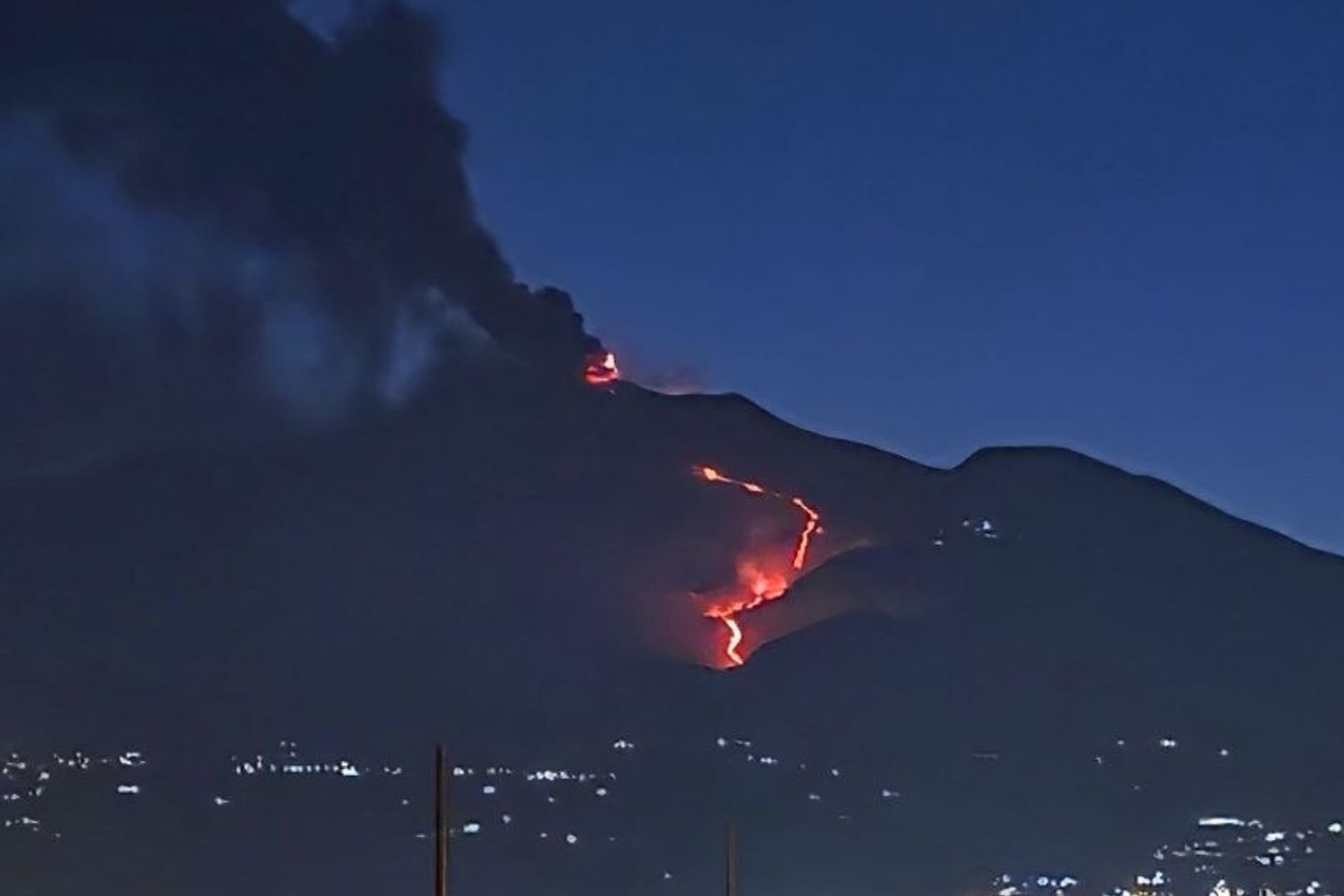
Etna: the scientists ofNational Institute of Geophysics and Volcanology (INGV) analyzed what happened on 13 May 2008, when it was possible to simultaneously observe what was happening on the surface and in depth during a magmatic intrusion, the rise of magma inside the volcano along fractures in the rock, in the absence of an eruption. The study could improve volcanic risk prevention.
What happened on May 13, 2008
©INGV (mod Bonaccorso et al., 2026)
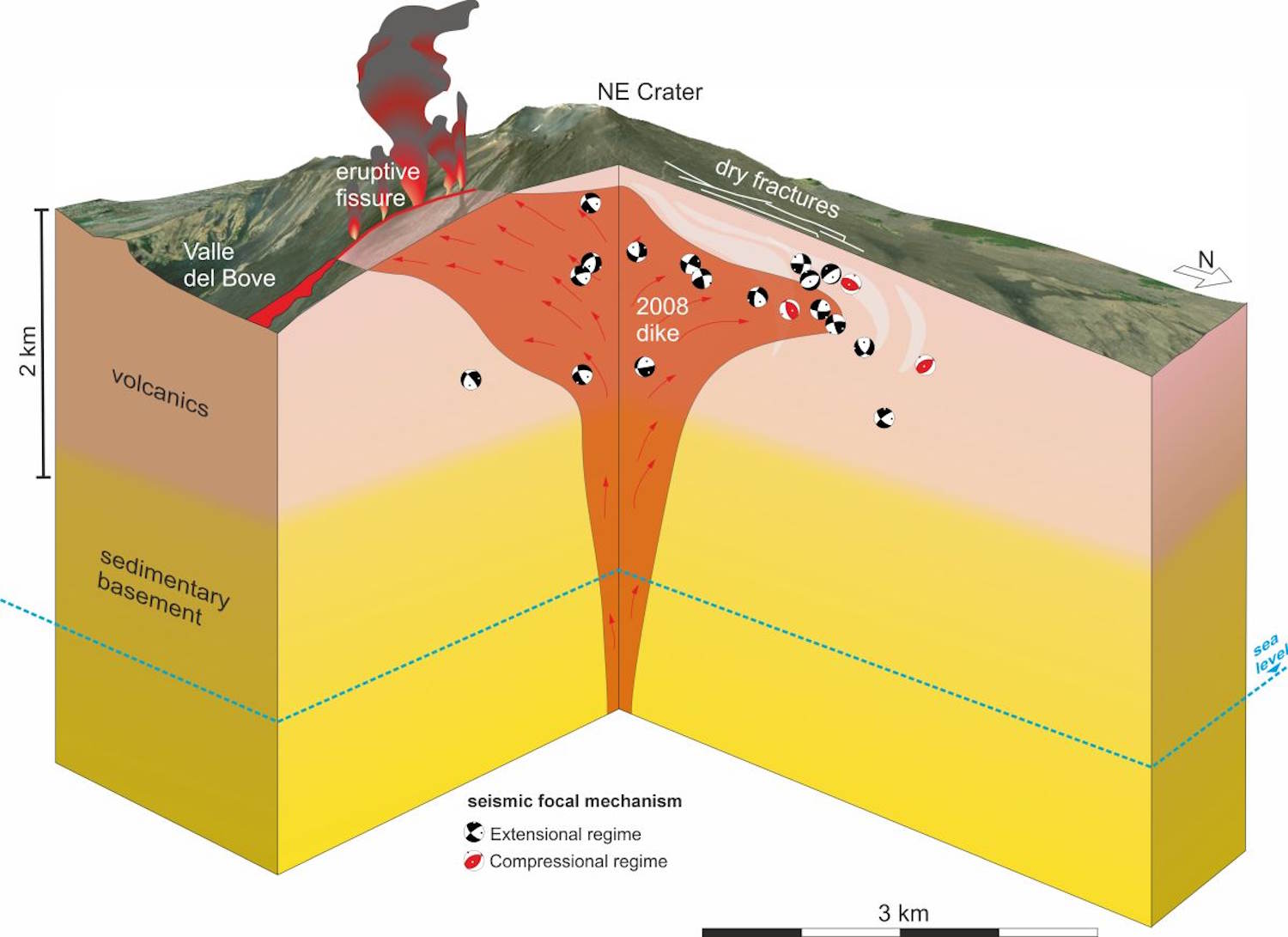
As the INGV experts explain, on 13 May 2008 a lateral dyke, i.e. a body of magma that insinuates itself along a fissure in the rock, began to propagate from the volcano’s central supply conduit towards the north, generating an extensive field of fractures on the surface and a sequence of earthquakes that accompanied its advance, precisely tracing its migration.
But there was no real eruption: in fact the magma did not reach the surface on the northern flank, while the propagation headed south, giving rise to the eruption in the Valle del Bove.
What remained on the ground was what scientists call a “dry fracture field”, i.e. non-eruptive, one of the most significant cases of interaction between a magmatic intrusion and the brittle deformation of the ground.
The initial dynamics aroused particular apprehension because the direction of the dyke was reminiscent of the scenario of March 1981, when an eruptive fissure rapidly propagated towards Randazzo causing serious damage – explains Alessandro Bonaccorso, Research Director of INGV and coordinator of the study – In 2008, however, the propagation stopped spontaneously, offering a unique scientific opportunity to observe in detail the behavior of a lateral intrusion
The July 2026 study
©INGV
The recent study reconstructed when it occurred on May 13, 2008, observing in particular the analysis of surface fractures and seismic data, which made it possible to reconstruct the evolution of the intrusion.
We estimated that the magma propagated to a depth of between approximately 200 and 600 meters – explains Marco Neri, Research Director at INGV and co-author of the article – The study also shows that, as the dyke advanced, the pressure of the magma was no longer sufficient to overcome the resistance of the rock into which it was intruding. Its propagation thus slowed down until it stopped, while the magma gradually began to solidify
But there’s much more.
The cumulative seismic moment released during the event coincides with the elastic energy expected from the modeled dyke – report Elisabetta Giampiccolo and Carla Musumeci, seismologists of the INGV team that conducted the research – This data, associated with the change from extensional to compressive of the failure mechanisms that generate the earthquakes during the propagation of the dyke, indicates that the system had exhausted its propagation ‘energy budget’: no energy residual, no possibility of advancing further
In other words, by simultaneously observing events on the surface and in depth, scientists have managed to understand what really happens during a magmatic intrusion, even in the absence of a real eruption.
The dike has in fact “traced” its path and its energy balance has made it possible to demonstrate that the fractures were caused by it, as were the associated earthquakes.
All this made the case of May 13, 2008 a unique example for understanding Etna’s lateral intrusions. And it could really help scientists improve their understanding of seismic risk, and therefore the preventive measures to use.
The work was published on Frontiers.
Sources: INGV / Frontiers
