
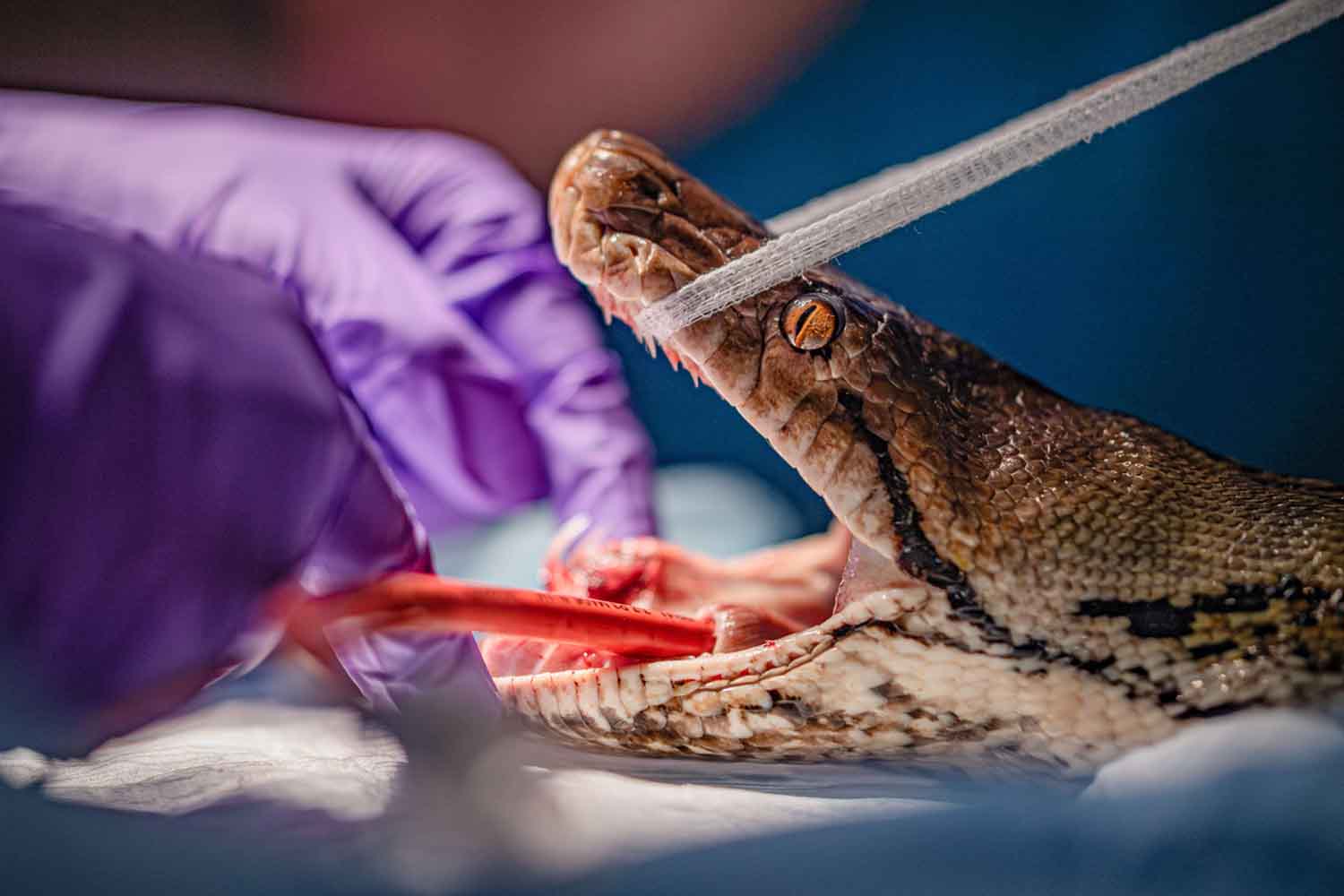
To operate on her they had to put two operating tables together, until they obtained a space almost as large as a double bed. Then heated blankets, hot air and ninety minutes of intervention. Jodie Foster weighs about 50 kilos, measures 15 feet – just over 4.5 meters – and is a reticulated python from Chester Zoo, in the United Kingdom. After a tumor in his jaw returned and began destroying the bone, veterinarians tried something that, as far as the specialists involved were aware, had never been done before on a snake: electrochemotherapy. Months later, the latest checks show no signs of recurrence and Jodie has returned to eating normally.
Even the name has a story worthy of the character. When he arrived at the zoo, the abbreviation “JF” appeared on his documents, short for juvenile femaleyoung female. Someone decided that JF could very well mean Jodie Foster. That’s what remained.
© University of Liverpool
The tumor had returned and was destroying his jaw
The first signs were quite simple: Jodie was eating less and spending more time inactive. The tests then identified a fibrosarcoma in the jaw, a malignant tumor of the connective tissues. An initial operation had allowed it to be removed, but the mass had formed again and had begun to invade the bone.
For a python the problem was particularly serious. These snakes have an extremely mobile skull and jaws, essential for grasping and swallowing prey much larger than their head. The reticulated python, Malayopython reticulatusit is also the longest snake in the world and can reach considerable dimensions. A compromised jaw therefore means directly affecting an essential function for the animal.
Ian Ashpole, a vet at Chester Zoo, said another surgery alone probably wouldn’t have been enough. The tumor was making eating increasingly difficult and the risk of losing Jodie had become real. Hence the collaboration with the oncology specialists of the University of Liverpool.
The operation began already in the python’s habitat, where Jodie was anesthetized before being transferred to the veterinary facility. During the 90 minutes of surgery, blankets and heated air were used to keep their body temperature stable. Ashpole removed the mass and part of the diseased jaw with a hemimandibulectomy. Then came the new part.
How electrochemotherapy works
The name seems to be that of a particularly aggressive therapy. The principle, however, is quite precise: first an anti-tumor drug is administered, in Jodie’s case bleomycin; Immediately afterwards, short electrical impulses are applied to the area to be treated.
The pulses temporarily make the membranes of the tumor cells more permeable and facilitate the entry of the drug. In this way chemotherapy can act locally with greater efficacy and with lower quantities of active ingredient than those that would be necessary without electroporation. It is a technique already used in human oncology for some indications: the British NICE, for example, has guidelines dedicated to electrochemotherapy for some skin tumors.
Veterinary oncology wasn’t starting from scratch either. Veterinary guidelines on electrochemotherapy already exist and the technique has been tested on several species. Jodie’s record therefore specifically concerns snakes, as stated by the team, and not all reptiles: cases of electrochemotherapy have also been published, for example, in turtles.
However, adapting the treatment to a python as long as a large compact car, with a tumor in its jaw and very different anesthetic needs from those of a dog or a human being, required a new protocol.
Jodie is back to hunting and eating
The most concrete part comes months after the surgery. Despite the removal of a portion of her jaw, Jodie continues to grasp and swallow food without difficulty. She is active again, exploring her habitat normally and zoo staff describe her again as “bright and feisty”, lively and combative. A check-up carried out in the week before the announcement on 21 August confirmed there were no visible signs of the tumor returning.
However, there is a scientific step still to be completed. The case was announced by Chester Zoo and the University of Liverpool, while a detailed account of the proceedings has yet to be formally published. José Alvarez Picornell, from the university’s Department of Small Animal Clinical Science, explained that the team intends to make the protocol and results available for other veterinarians to study and develop further.
For now, she remains a 50-kilo patient who a few months ago risked no longer being able to feed herself and today she has returned to doing what a reticulated python does quite well: eating. To get there, oncologists, veterinarians, electrical impulses and two operating tables stuck together were needed. The department, evidently, had not foreseen the Jodie Foster size.
