
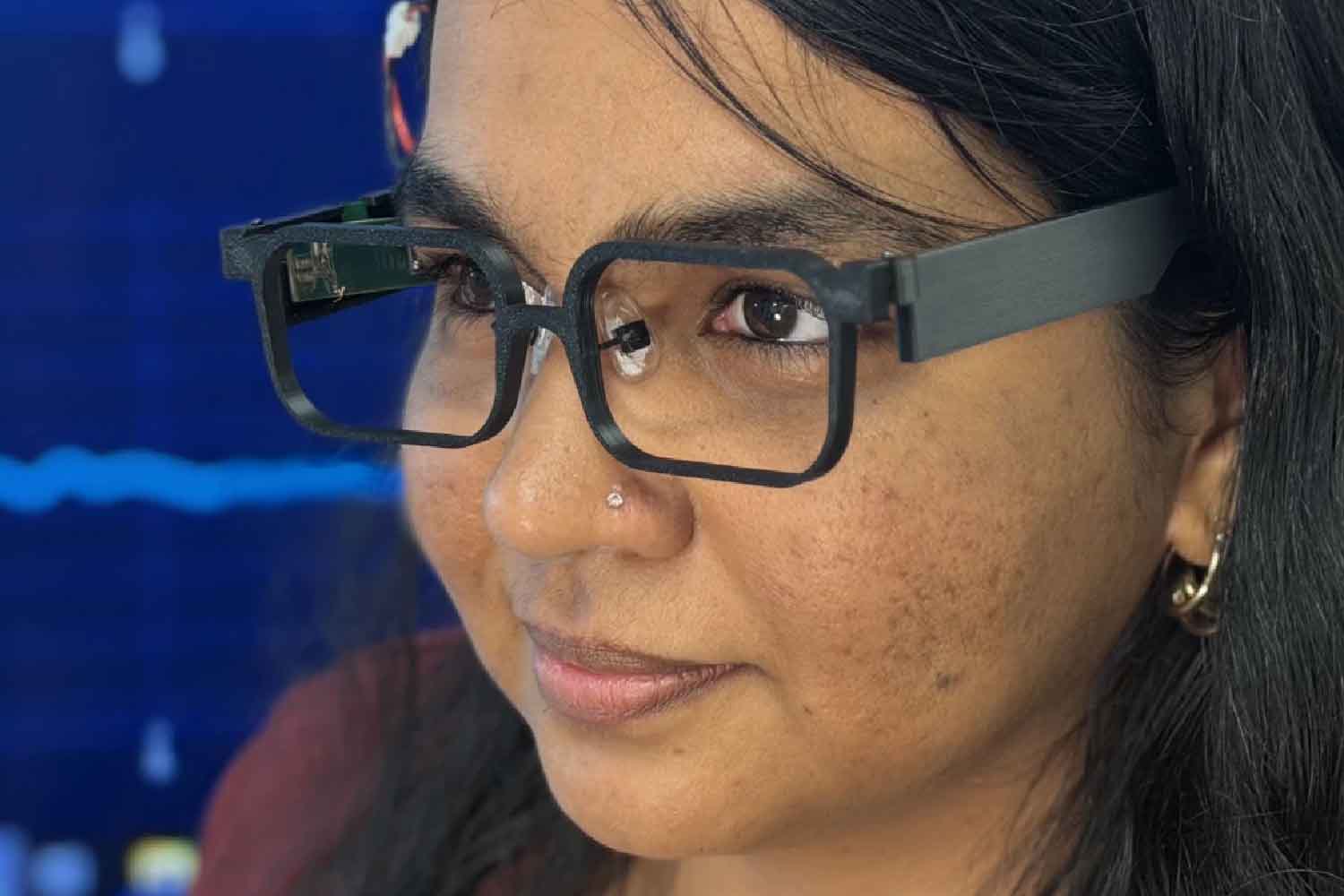
Just blink to generate a small electrical impulse. Moving your eyebrows, chewing or clenching your teeth produces others, each with different characteristics. A group of American researchers has found a way to collect these signals through three tiny sensors applied to the frame of a pair of glasses. And to use them to monitor some parameters of our health, without having to add electrodes or other devices to the face.
They are called GlassTENGwere developed by Northwestern University and have already achieved interesting results: during tests on 20 volunteers, the system recognized six different facial activities with an overall accuracy of 93.8%. He also managed to measure the heart rate through the very small pulsations of the arteries of the face.
The idea comes from a rather simple observation. Our face is constantly moving, even when we are still. And millions of people already wear glasses for a good part of the day. Why not use that very frame to collect health information?
Like the blink of an eye it produces electricity
The operation of GlassTENG exploits thetriboelectric effecta phenomenon we all know, even without ever hearing the name. It’s the same static electricity that makes a balloon stick to your hair after rubbing it or gives us a small shock when we touch a metal object.
When two different materials come into contact and then separate, they can generate a difference in electrical charge. The researchers applied this principle to three flexible, very thin sensors made up of layers of materials that compress and separate following the movements of the face. Each blink of an eye exerts pressure on the sensor, producing an electrical signal. The same happens when we move our eyebrows, chew or clench our jaw.
And the differences can also be seen in the numbers. According to the scientific study dedicated to GlassTENG, eyelid and eyebrow movements produce signals between 200 and 500 millivoltswhile the more energetic ones of the jaw can reach 1.5 volts. Even the pulsation of an artery generates a detectable signal, between 50 and 100 millivolts.
To intercept these activities, the researchers placed the sensors in three places on the frame: on the bridge of the nose, near the temple and in the area above the ear. From those positions they can perceive the movements of the muscles and the pulsations of the underlying arteries. The result is a frame that, in a certain sense, feels what our face does.
Glasses recognize when we clench our teeth
One of the most interesting applications concerns the bruxismthe disorder characterized by involuntary clenching or grinding of the teeth, which can also occur during sleep. During the experiments, 20 volunteers wore GlassTENG and performed six tasks: blinking, raising eyebrows, clenching their teeth, making them chatter, eating and speaking.
A machine learning algorithm analyzed the electrical signals generated by the sensors, learning to associate each combination of pulses with a specific movement. The results were particularly good for jaw-related behaviors: the system recognized the chattering of teeth in the 99% of cases and the window in the 96%.
The prospect is to transform a common pair of glasses into a tool capable of noticing when we unconsciously clench our jaw and, in the future, warning us with a small notification. For those who spend many hours in front of the computer with tense shoulders and clenched teeth, it could be a very useful reminder.
There are still movements that are difficult to distinguish. Speech, for example, was recognized correctly in only 55% of cases, because some movements of the jaw closely resemble those of chewing. A difficulty that researchers will have to face in future developments.
They can also measure your heart rate
The same sensors can perceive something much more delicate than the movement of the jaw: the pulsation of the arteries that cross the face. In particular, the sensor on the bridge of the nose is located near the angular artery, while the one on the temple intercepts the pulsations of the superficial temporal artery.
Each heartbeat causes a tiny change in pressure. The sensor transforms it into an electrical signal from which the heart rate can be obtained. To verify its reliability, the researchers compared the measurements obtained with GlassTENG with those of a Polar H10 chest strap, used as a reference.
In the resting experiments, conducted on ten participants, the average absolute error was just 1.82 beats per minutecalculated over 30 second intervals. A promising result for a technology that uses such small sensors, integrated into an object that many people already wear on their noses every day.
Sensors that consume very little energy
The other interesting aspect of GlassTENG concerns power consumption. The three sensors are self-powered in signal generationbecause they directly exploit the mechanical energy of the movements they detect. The electronic circuit necessary to read them consumes little overall 4.1 microwattsan extremely small amount compared to that required by many traditional detection technologies.
The prototype still uses separately powered electronic components to process and transmit information, but researchers are working to further reduce power consumption and integrate data processing directly into the mount. The goal is to develop glasses capable of continuously monitoring certain physiological parameters, providing useful information without requiring frequent recharging.
As he explained Nivedita Aroraprofessor at Northwestern University and head of the research, the human face contains a huge amount of information about our health. And glasses represent a particularly suitable support for collecting them, considering how many people already wear them every day.
GlassTENG is still an experimental prototype and further tests will be needed to evaluate its functioning during normal daily activities. The possible applications, however, go beyond bruxism: researchers imagine systems capable of following heart rate, some eating behaviors and even signals associated with fatigue.
For now, three small sensors, a mount and a group of volunteers were enough. The rest was done by the eyelids, eyebrows and jaw, with all those movements that we repeat every day without even realizing it.
